
In short
- Four signatures reveal an AI-suited process: gathering context, handovers, triage and synthesis.
- Where the work is mostly about interests and judgement, the human stays indispensable.
- The useful question: which of those four carry your worst Mondays?
The pattern behind our own choices
When we redesigned our own operation we did not pick at random. The processes we chose all had the same shape, and we keep seeing that shape at clients across very different sectors. Four signatures give away a process that lends itself to AI.
1. Gathering context together
Work where someone first has to fetch information from everywhere before the actual task can begin. At a builders' merchant we watched a customer-service team look up delivery times all day by searching two systems that do not talk to each other. The context existed. It was just scattered. That costs a few minutes per question, and multiplied across a day of questions you can see exactly where the time goes. This is usually the clearest place to start.

The useful question is which of these four signatures carries your worst Mondays.
2. Handovers where information falls away
Processes with many links, where at every handover something gets re-entered or re-estimated by hand. At the same logistics operation an order travelled through an export to Excel, a manual count, a physical walk-round and back into the system before a route existed. Every one of those steps is human work that is mostly retyping and transferring, and that is where the room sits.
3. A stream that needs triaging
An inbox, a ticket queue, a stack of incoming questions that all need sorting and placing in context before anyone can pick them up. Our own Monday email is one example: out of everything in play, an agent filters out what genuinely needs a decision. For an insurer or a service department it is the same movement applied to claims or customer questions.
4. Synthesis and reporting
Work where separate sources come together into a text: a report, a summary, a write-up. Advisory work is full of it. Generative AI is strong here, as long as a human makes the final call, because what it saves you is the first draft rather than the judgement.
Where AI stays limited
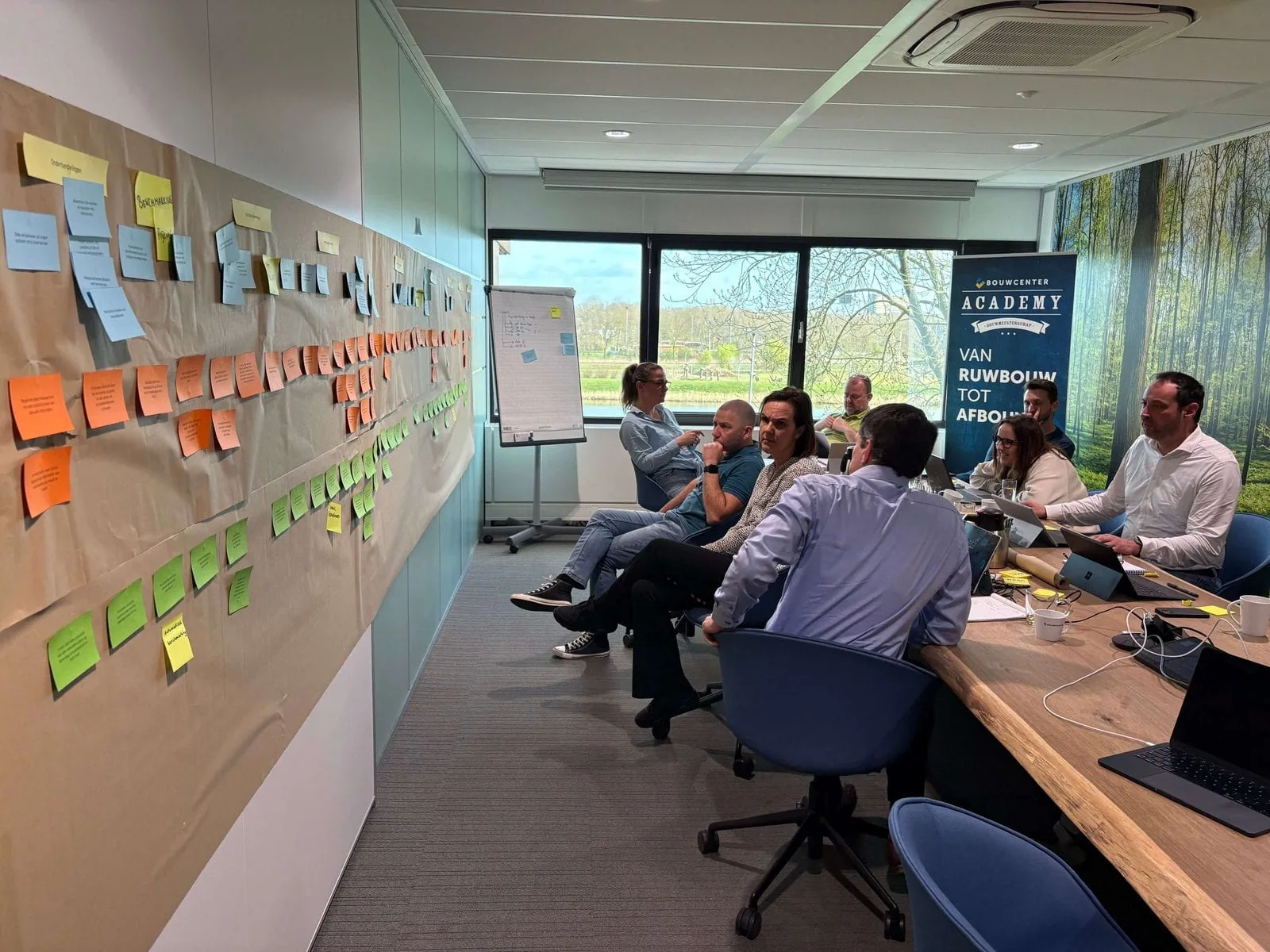
In a strategy session with an advisory firm this came out sharply. One participant said most of their value sits not in the data but in navigating interests between parties: politics, governance, delivery context. Several others agreed immediately. That is work where AI adds little for now, and we would treat it as a strength to protect rather than a gap to close. The craft is in telling the two apart: automate the looking-up and the retyping, and guard the judging and the translating.
The question to ask yourself
So the useful question is not really where you could deploy AI, because almost everywhere something is possible. It is which of these four signatures carries your worst Mondays. Where does somebody gather context every single day? Where does information fall away at a handover? That is where it starts, whatever sector you are in.

Ruben Horbach
Co-founder · Back From the Future
Ruben researches how organisations adopt AI meaningfully — not as technology, but as a change in work and people. He builds the agent infrastructure behind BFF and speaks about the near future of work.