
In short
- Efficiency improved ~18x in sixteen months, so any AI cost estimate has a short shelf life.
- Demand still climbs faster than efficiency, so total energy use rises anyway.
- The binding constraint has moved to land, permits, credit and neighbours.
- Roughly a third of the buildout is now funded by debt rather than operating cash flow.
- Access is settled; the real gap is between end-to-end AI work and a faster search box.
I spent part of this week reading local newspaper coverage from Caledonia, Wisconsin, a patch of open land on the 90-mile stretch between Milwaukee and Chicago. A resident named Prescott told a reporter, "I live in paradise." He'd decided against the proposed data center before he finished hearing about it.
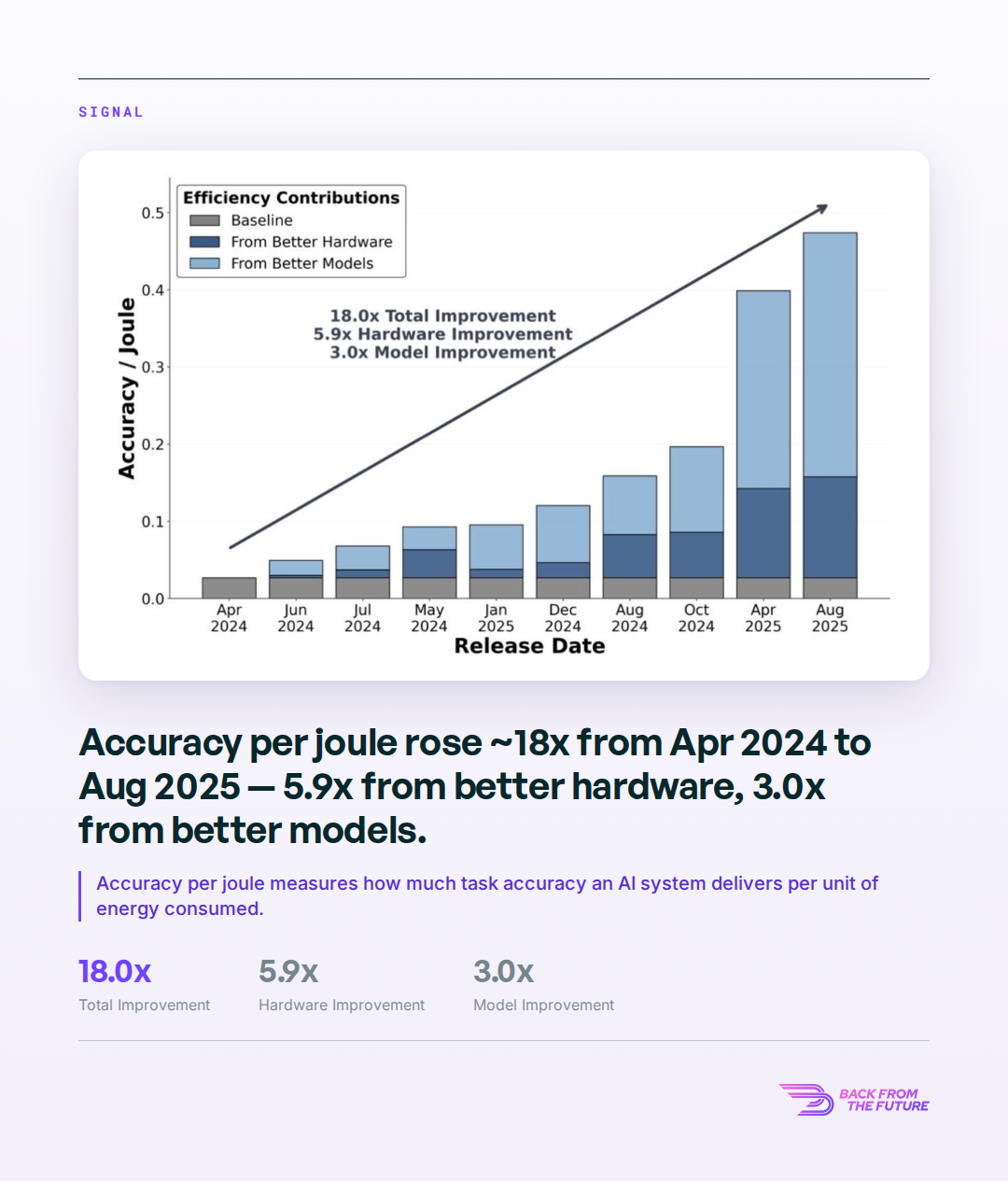
That is where this week's numbers landed. Amazon lifted its 2026 capex plan to about $220 billion and pointed at memory prices. Across the seven biggest builders, capex runs from $160 billion in 2022 to an estimated $863 billion in 2026. OpenRouter is routing tokens at a run rate above 4.5 quadrillion a year, doubling roughly every eleven weeks for three straight years. And accuracy per joule on a fixed task improved something like 18x between April 2024 and August 2025.
Four facts that don't sit comfortably together. Demand compounding at a third a month. Efficiency improving nearly twentyfold in sixteen months. Spending accelerating anyway. And a man in Wisconsin who would rather have a concrete slab than a hyperscale campus.
So which constraint actually binds? I've watched the AI conversation move its bottleneck three times in two years — first the models, then the chips, now the grid. My read this week is that it has moved again, into something older and slower: land, permits, credit and neighbours. Here's how I'd trace it.
Efficiency is a moving line, and almost nobody models it that way
The 18x figure is the one I keep coming back to. Same task, correct answer, a fraction of the energy, sixteen months apart. And the chart behind it splits the gain into separate contributions that stack — better models, better serving, better hardware — rather than crediting one breakthrough.
That number is missing from almost every energy-and-AI argument I read. The standard move is to take today's joules per answer, multiply by a projected count of answers in 2030, and present the output as physics. It treats efficiency as a constant. Efficiency hasn't held constant for a single quarter.
I'd hold the exact multiple loosely. It's one measurement window on one task family, and the decomposition matters more than the headline — I'd want the underlying categories named before anyone builds a business case on it. Treat the figure as directional. The shape is what matters, and the shape is a curve that bends down fast.
Here's the admission that keeps me honest, though: bending efficiency does not make the grid problem go away. Demand is climbing faster than the efficiency curve, so total consumption still rises. Both things are true at once, and most published forecasts pick whichever one supports the conclusion they already reached.
What this changes for you is the shelf life of your own estimate. If you costed an AI workflow in early 2024 and shelved it because the compute bill looked absurd, that verdict expired. Not because someone invented something — because eighteen months of ordinary compounding happened underneath it. The same applies forward: a 2027 cost projection built on 2026 joules is a projection about a constant that isn't one.
The useful discipline is to write down which of your assumptions are prices and which are physics. Prices move. Physics doesn't. In my experience almost everything people file under "physics" in an AI business case is actually a price.
When the fast thing meets the slow thing, the slow thing sets the pace.
The thing you cannot compound is a permit
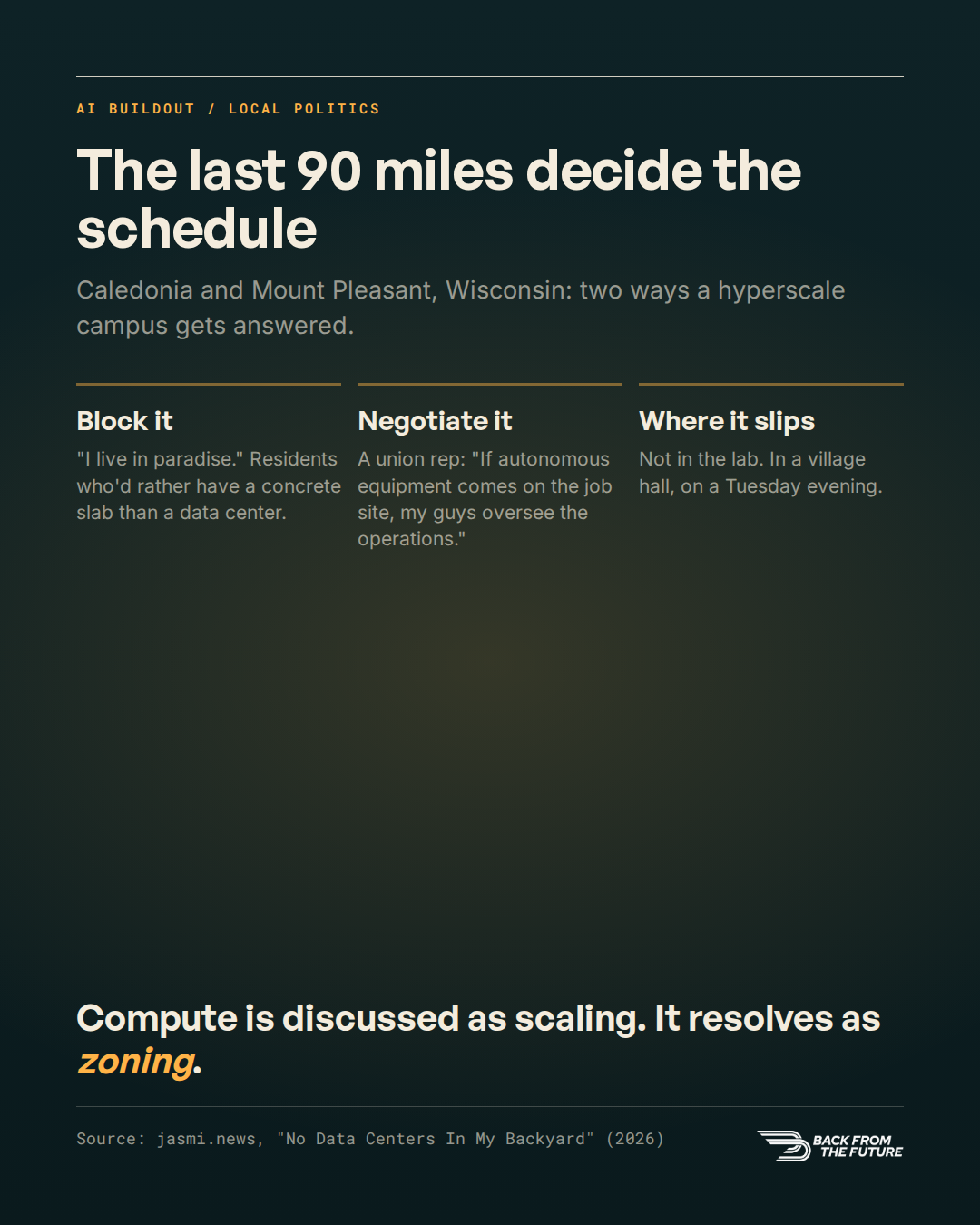
Which brings me back to Caledonia. Every gigawatt in an AI roadmap eventually lands on a specific piece of land with specific neighbours. The reporting from Caledonia and Mount Pleasant shows what that looks like when it arrives: residents who, asked what they'd rather see built there, don't really have an answer, and a local reporter's read that the real choice on offer may be a hyperscale campus or a concrete slab — and the slab wins.
This is the constraint I'd call Compounding Meets Concrete. Every input to AI is compounding at a rate with almost no precedent — tokens doubling every eleven weeks, revenue doubling roughly every seven months, efficiency 18x in sixteen. And every one of those curves terminates in something that compounds at zero: a zoning hearing, a transformer lead time, an interconnection queue, a neighbour named Prescott. When the fast thing meets the slow thing, the slow thing sets the pace.
The counter-case is real and I'd weigh it seriously. Plenty of communities want the campus. Mount Pleasant took Foxconn's promise and got something rather different, which is precisely why Caledonia is sceptical now — that's learned behaviour rather than reflex. And hyperscalers have shown they'll route around resistance: they buy land in the places that say yes, which means local opposition redistributes construction more than it stops it.
But redistribution has a cost, and it shows up in the funding mix. Across the big builders, operating cash flow still covers roughly two-thirds of the buildout. Stare at the other third. Debt tied to OpenAI's computing needs is now moving credit markets. Amazon's trailing free cash flow has swung to a $7.6 billion outflow. Capex used to be a statement about how much cash a business threw off. It's turning into a statement about how much a business can borrow against a forecast.
And Alphabet is now paying SpaceX roughly $920 million a month for capacity at xAI data centers, funding part of the buildout with an $85 billion stock sale that includes $10 billion from Berkshire Hathaway. I'd want that tied to a named filing before I lean on the exact figures. Directionally, though, the message is clear: when you cannot build fast enough yourself, you rent from whoever put steel in the ground first — even a rocket company, even a competitor.
The market is deepening while it narrows
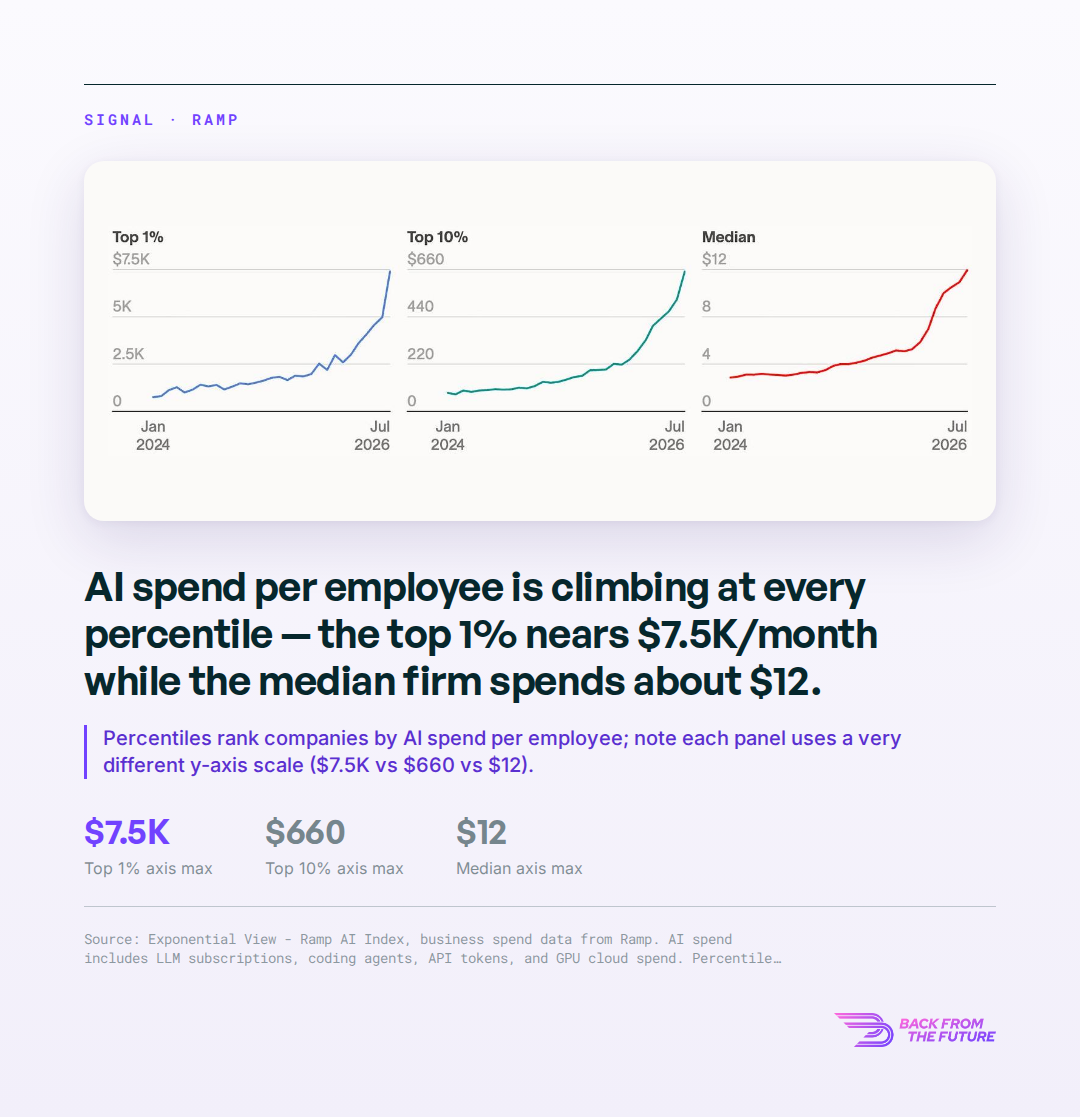
Ramp's August 2026 AI Index puts two findings next to each other and lets them argue. AI spend per employee is growing exponentially across every spending tier, steepest in 2026. In the same report, adoption of OpenAI — and to a lesser extent Anthropic — has slowed among first-time buyers.
Spend per head up. New entrants down. And Ramp is explicit that the slowdown has nothing to do with defection: first-time buyers are not moving to open source or Chinese models. They're simply not arriving.
Set that beside the token data and it sharpens considerably. By June 2026, frontier firms had reached 17.1x output tokens per active user. Typical firms sat at 2.1x. Same models on the shelf for both, and an eightfold gap in how hard those models get worked.
I think token volume is a crude measure and I'd resist reading it as productivity. It's honest about exactly one thing: how much of the work has left human hands. Two-x usage looks like people asking questions and pasting answers into a document they were going to write anyway. Seventeen-x looks like something drafting, checking, rewriting and running long chains of steps that nobody reads line by line. One of those is a helper. The other is a handover, and the organisational change required to get there is where most programmes stall.
The honest counter to my own framing: an eightfold token gap might just mean frontier firms are wasteful. Long agent chains burn tokens on retries and dead ends. I've seen that in practice — a badly specified agent can spend a fortune being confidently wrong. Which is why I'd read the 17x as evidence of a different operating model rather than a better one, and check the outcomes separately.
What this means for you is that the adoption question has quietly changed shape. Buying access is settled. The gap now sits between organisations that let AI do work end to end and organisations that use it as a faster search box, and no procurement decision closes that gap.
The labs are running the experiment on themselves
More than 90% of Anthropic's engineers now build with self-improving loops, according to an Anthropic engineer who expects 100% within four to six months. Those loops already run for days at a stretch. Separately, an extrapolation from Anthropic's own August 2026 risk report puts fully automated AI R&D somewhere between December 2026 and February 2027, or around 2028 under pessimistic assumptions.
I'd treat those dates as close to worthless as forecasts — whose extrapolation, published where, on what assumptions, all matter enormously for a range that specific. What I'd take seriously is the 90%. Internal practice is a better signal than any product page, because a lab has no incentive to tell you what its own engineers stopped doing by hand.
The corroborating result arrived the same week. Claude produced a working key-recovery attack on six of the 32 rounds of the Serpent-128 cipher. Anthropic says in the same breath that full Serpent is a 32-round cipher, which limits the impact considerably. The published cryptanalysis of that same reduced variant needs more than 2^70 plaintext pairs and 2^90 decryptions; what the preview system Anthropic calls Mythos found is practical to run.
I'd want the specific published attack named before calling it a novel contribution — that's the standard the claim itself sets, so it should meet it. Cryptanalysis is one of the very few fields where "novel" has a checkable definition: you recover the key with less work than the best published attack, or you don't. No taste to argue about, no reviewer to persuade.
So the two things travel together. A lab whose engineers have handed most of their loop to the machine produces a result in the one domain where the claim can be adjudicated. That's the pattern I'd watch: capability announcements matter far less than what the people building them quietly stopped doing themselves.
What I'm watching
The constraint keeps sliding down the stack toward things that take years. Five immersion DUV lithography machines are scheduled to ship to Chinese chipmakers this year, developed by Shanghai Yuliangsheng. Five tools change nobody's production plan. Five is the first number after zero, and export controls behave far more like a clock than a wall.
Compounding Meets Concrete is the lens I'll be carrying into client conversations this autumn, and it's the question a keynote is for: your fastest-moving assumption and your slowest-moving dependency, written on the same page. In the sessions we run, the slow one is almost always missing from the plan entirely.
If this is useful, subscribing means it lands in your inbox each week.
Eight things I could not fit
- Alphabet lost roughly $185bn of market value in a day after four AI leaders walked on 5 August, Demis Hassabis among them, stepping back from running Google DeepMind. Fewer than one in a hundred of the world's 11,261 listed companies is worth $185bn in total — a useful check on the story that intelligence is getting cheap.
- Article 50 of the EU AI Act became enforceable on 2 August: AI-generated images, text on matters of public interest and chatbots all carry a machine-readable disclosure obligation, and a visible caption alone doesn't satisfy it. The Act names no standard, while one widely deployed open standard fits the description and the Code of Practice recommends pairing it with invisible watermarking. Formally free, practically steered.
- Google DeepMind's Gemini Robotics 2 pitches "whole body intelligence" — base, torso and arms treated as one control problem instead of a mobile platform carrying an arm. The hard part shifts from mechanics to policy, which is where foundation models are strongest.
- Two robot arms out-sorted a humanoid. X Square's WALL-B-powered 6-axis arms handled 1,816 mixed parcels at 98%+ accuracy in a one-hour autonomous livestream, roughly 45% faster than Figure's humanoid on the same job. Package sorting is the clip humanoid companies run most, which makes losing it awkward.
- The next Atlas is engineered to be boring. Boston Dynamics describes it as an order of magnitude simpler, with fewer parts and crucially fewer unique parts — cheaper, faster to build, more reliable, and completely invisible in a demo clip.
- A robot navigated an office it had never entered, zero-shot. Niantic Spatial, Flexion and NVIDIA trained an RGB-only policy entirely inside a Gaussian-splat reconstruction loaded into Isaac Lab, then ran it in the real building. The capture is now the training environment.
- A UK power plant was down four days after an Iranian cyber attack, which The Telegraph calls the most successful on a UK energy facility to date; the NSA had warned days earlier. Two weeks before, OpenAI introduced GPT-5.6-Cyber for authorised security work — offensive capability was already in the field, run by people who publish no model cards.
- Matic shipped a home robot with no app and no map to draw. You point at the mess and say "clean this"; it listens in 70+ languages and watches your hand. Every prior home robot priced in a setup session, which quietly capped the market at people willing to sit down and configure a machine.

Ruben Horbach
Co-founder · Back From the Future
Ruben researches how organisations adopt AI meaningfully — not as technology, but as a change in work and people. He builds the agent infrastructure behind BFF and speaks about the near future of work.