

In short
- Aleph's ultrasound imaging reads the brain non-invasively, dropping the BCI barrier from surgery to a headset.
- A single phone camera now rebuilds rooms in 3D at 20fps — no lidar or rig required.
- China hires junior and wide while the US gates on seniority; Chinese open-weight models now dominate usage.
- With baseline competence free, price outweighs experience — value moves to specifying problems and catching agent errors.
- Ukraine's war runs on release cycles: capture, tear down, iterate — weekly software, monthly hardware updates.
A pattern ran through this week's news, quiet but consistent: things that used to require a permission slip, an expensive rig, or years of experience got cheaper to reach. I do not mean the models got cheaper. I mean the entry cost did, the surgery and the lidar and the seniority and the classified programme. When that number drops the population who can participate expands, and the whole shape of a field changes with it.
Five places I saw it clearest, and then six things I could not fit.
You used to need a drill to read a brain
What are reportedly the highest-resolution 3D images of the human brain ever taken from outside the skull arrived this week. A lab called Aleph did it with sound: ultrasound waves, no incision, no electrodes threaded into tissue. Physics bouncing off neurons, reconstructed into a picture sharper than anything we have managed non-invasively.
The brain-computer interface race has been a surgery race. You drill through the skull, place the implant, and accept the risk. That trade-off is exactly why BCIs stayed a story about paralysis patients and clinical trials, because the surgery was the gate.
If you can read intent from outside the skull, the addressable population probably stops being a few thousand trial patients and becomes everyone. Whether the resolution is good enough yet is genuinely unclear to me, and the answer probably is not for a while.
It is also worth saying what a lower gate does not fix. An implant is a gate on who can participate; it is not the only thing standing between a signal and a product. Reading intent well enough to control something reliably is a separate problem from reading it at all, and the regulatory path for a consumer device that claims to read your mind is not obviously shorter than the one for a medical implant. The question I would hold is what a field looks like once its barrier to entry drops from brain surgery to putting on a headset, not whether the headset is ready.
The barrier to fielding a better weapon collapsed from classified megaprogramme to shipping a firmware update.
Spatial capture just fell out of the rig and into your pocket
A single phone camera can apparently now rebuild a room in 3D at 20 frames per second, using a new open-source model that reconstructs scenes live over long sequences with no lidar and no rig. One camera, streaming. Meanwhile people are crowd-sourcing real places into explorable 3D Gaussian splats, so you can walk into St. Stephan's from your desk.
Spatial capture used to mean expensive lidar rigs and slow post-processing. That was the entry cost, and it is collapsing onto a device already in everyone's pocket.
The same week, Snap shipped consumer AR glasses that need no phone, no puck and no tether: $2,195, a 51-degree field of view, four hours untethered. That price is still a developer number rather than a consumer one, and I would treat the four-hour figure the way I treat every battery claim in a launch post.
But the form factor now exists as something you can actually buy, and a robot needs exactly this kind of cheap live 3D understanding to move through space. Those two threads are worth watching together, because the moment capturing the world costs nothing, both a walk-in map of the planet and a robot's sense of a room stop being expensive problems.
China is not gating on seniority, and that is the adoption bet
US AI companies want senior engineers and China is hiring juniors. According to an analysis of technical job postings, US roles ask for significantly more years of experience on average. The US gates on seniority; China hires wider and younger.
These are two different bets on how you build an AI workforce. One says the work is hard enough that you need people who have already done it. The other puts more hands on the problem now and lets them learn on the job.
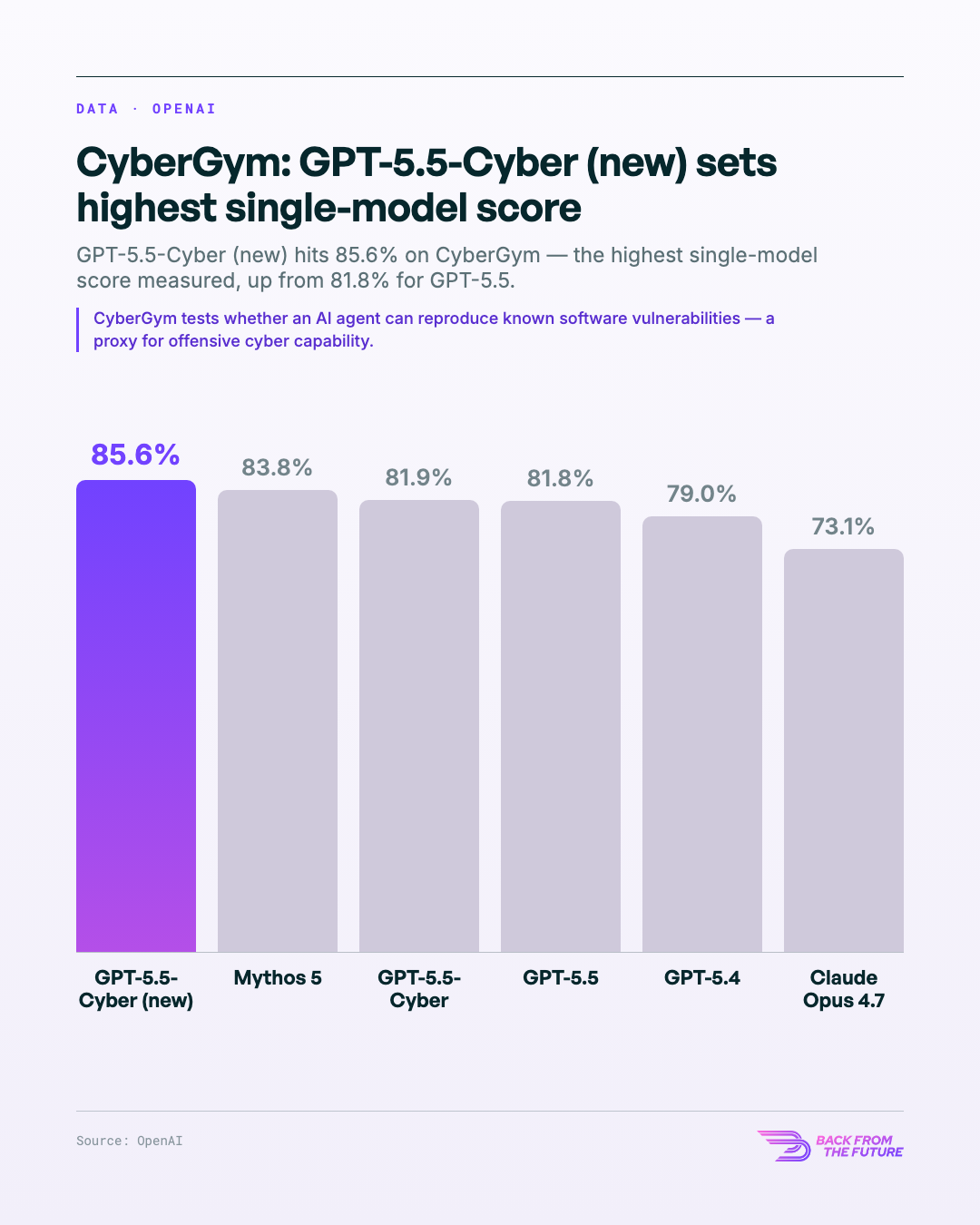
Hiring young and wide puts far more people in daily contact with the tools, in more places, doing more things, and I think that is the race being quietly won. On OpenRouter, weekly usage of Chinese models appears to have surged this year. The FT ran a headline most Western readers would find hard to believe: the world is already running on Chinese AI. DeepSeek V4 Flash tops the leaderboard at 4.68 trillion tokens processed.
Western media covers AI as a benchmark race, as though the question were whose model scores highest this quarter, when cost is what decides who gets embedded in the world's workflows, and open weights are what make the cost collapse. A low entry cost, again, is the thing that scales.
The counter-argument deserves a hearing, because a junior-heavy workforce is also a bet that the tools stay easy. If the frontier moves somewhere that needs deep systems experience — and training infrastructure at scale is exactly that kind of work — then hiring wide buys adoption and not capability. Both things can be true, and this week only told us about the adoption half.
When baseline competence is free, your resume stops working
Half of US adults have now used ChatGPT, Claude or Gemini, so mass adoption has stopped being a forecast. New research from a large online labour market reports something quieter underneath that number: after ChatGPT, clients started weighing what you cost more than who you are. Experience, track record and the story a resume tells all carried less weight, and price carried more.
It is one marketplace, and freelance markets move faster than employment, so I would not read it straight across to salaried work. The mechanism is what interests me.
Most of the jobs conversation is still about replacement, about which roles vanish and which survive. This one is slower and stranger. A resume works by signalling scarce judgment, so flood a market with baseline competence and the thing that used to set you apart becomes cheap to reproduce. When the market assumes everyone arrives competent, the signal you spent years building stops doing its job.
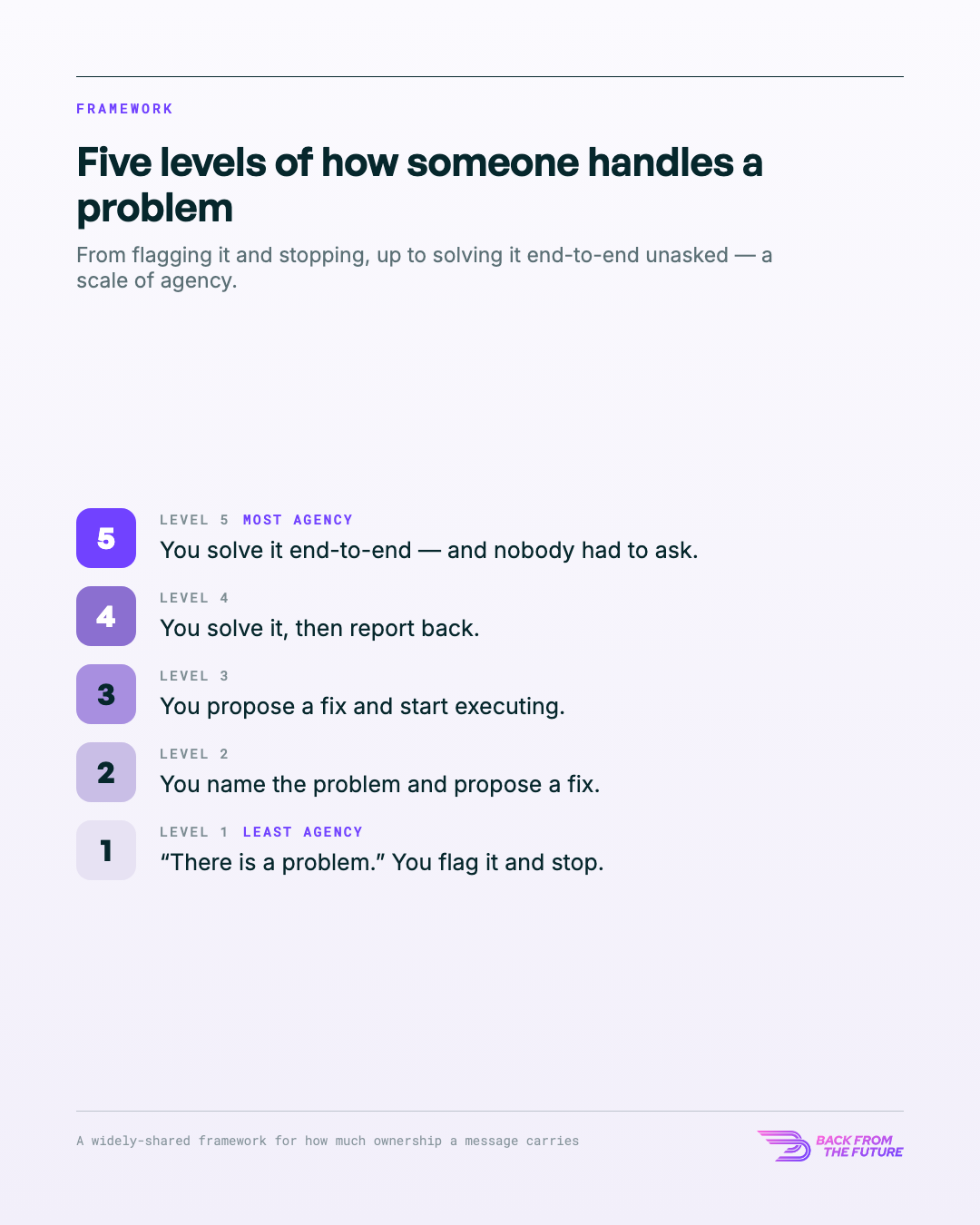
There is a five-level scale for how someone handles a problem. At level 1 you flag it and stop; at level 5 you solve it end to end and nobody had to ask. Most people cluster at level 1 or 2. Agentic AI now does levels 1 through 3 without breaking a sweat: spots the issue, drafts the fix, runs the first pass. The lower rungs are being automated out from under us and the value moves up, to whoever can specify the problem precisely, catch what the agent gets wrong, and carry it the last two levels. This is exactly why I keep returning to the same theme in keynotes, because an organisation needs a shared picture of where judgment now lives before it can reorganise around it.
The battlefield became a release cycle
Ukraine will build 7 million drones this year, double last year, which works out to 10,000 burned every single day. Petraeus put rough numbers on the loop: software updates every week or two, hardware roughly every three to four weeks. A weapon ships, gets used, gets countered, and the next version is already in the field before the enemy adapts.
Then there is TrophyLab, launched the same week, where every Russian missile and drone and vehicle captured on the ground gets opened up, documented, and the findings shared with global partners. Reverse-engineering as a service, at war speed. Hours later at the Eurosatory show in Paris, the manufacturer Fire Point ran footage of their drones hitting the Moscow Oil Refinery, filmed that same day.
Defence R&D used to run on classified programmes, decade-long procurement, and knowledge locked inside a handful of primes. That was the entry cost. What is running in Ukraine is a live loop of capture, tear down, feed the next iteration, and the barrier to fielding a better weapon collapsed from classified megaprogramme to shipping a firmware update.
I would be careful about exporting the lesson, though. A wartime loop runs at that speed because the cost of being wrong is being killed, and because nobody is asking for a safety case before the next firmware goes out. Peacetime procurement is slow for reasons that are partly bureaucratic and partly the reason your aircraft does not fall out of the sky. What transfers is the cadence; what does not transfer is the licence.
The through-line held all week. A brain you can read without a drill. A 3D world you can capture with a phone. An AI workforce built by hiring wide instead of deep. A resume undercut by free competence. A weapons programme that runs on release cycles. Every one of them looks like the same move to me: the price of admission drops, the crowd who can play gets larger, and the field reorganises around whoever is left holding something scarce.
The question I am carrying into next week is a simple one. In your world, what is still expensive to reach, and what happens on the day it is not?
Six things I could not fit
A printer that upgrades itself into a factory. Meiji University's Functgraph starts as an ordinary 3D printer, then fabricates grippers and tools that snap onto its own arm, turning itself into a small assembly station that can pick, place and build. The machine that builds its own extensions is an old idea; that it does so with parts it prints on the spot is not.
Europe's two-year clock is running ahead of its own grid. Mistral's Arthur Mensch told French lawmakers that Europe has exactly two years to build its own AI infrastructure or hand over a trillion dollars in spending. It makes a good headline; the trouble is that the sovereignty rhetoric is running years ahead of the infrastructure. The Netherlands holds arguably more silicon expertise than anywhere in Europe and its growth is throttled by grid connection queues that stretch for years. You cannot run sovereign compute on a waiting list.
A humanoid arm powered by water. Clone Robotics built one with no dense cluster of motors at the joints. A water-based hydraulic system drives artificial muscles that contract the way ours do, so the arm does not merely move like a human arm — it is built like one. Every other humanoid shipping now makes the opposite bet: motors, actuators and boards packed into every joint, mimicking function through sheer engineering density. Two philosophies, and only one of them has to be right.
Capital is returning to robotics, and so is the tooling. a16z's Charts of the Week reports investor interest climbing again after years when the sector was mostly demos and promises. Money alone does not build a hardware industry; tooling does, and NVIDIA's Isaac GR00T is pulling simulation, data and training into one open platform. Humanoid development used to be fragmented across incompatible stacks, with days of setup before a team could start.
The tourist checklist in San Francisco is a Waymo ride and a robot fight. Three different people posted the same thing on the same day: humanoid machines squaring off in a ring with a crowd watching. Combat robotics has quietly become live entertainment, and that is probably the interesting part, because a fight is the cheapest and fastest way to show people what modern actuation and control actually do. Balance under impact. Recovery after a hit. Real-time reaction to a moving opponent. No spec sheet does that.
Five-minute drone delivery is launching in India, not Silicon Valley. Airbound, a Bangalore startup, is building ultra-light autonomous drones to move medicine and lab samples faster than a scooter can weave through traffic. The drone is not the interesting part; the where is. Rwanda ran blood delivery by drone years before most Western hospitals piloted one, and the most consequential deployments in drone logistics keep landing in emerging markets rather than in Bay Area labs.
This is the connected version of the week. If it is useful, it lands in your feed every Monday.

Ruben Horbach
Co-founder · Back From the Future
Ruben researches how organisations adopt AI meaningfully — not as technology, but as a change in work and people. He builds the agent infrastructure behind BFF and speaks about the near future of work.