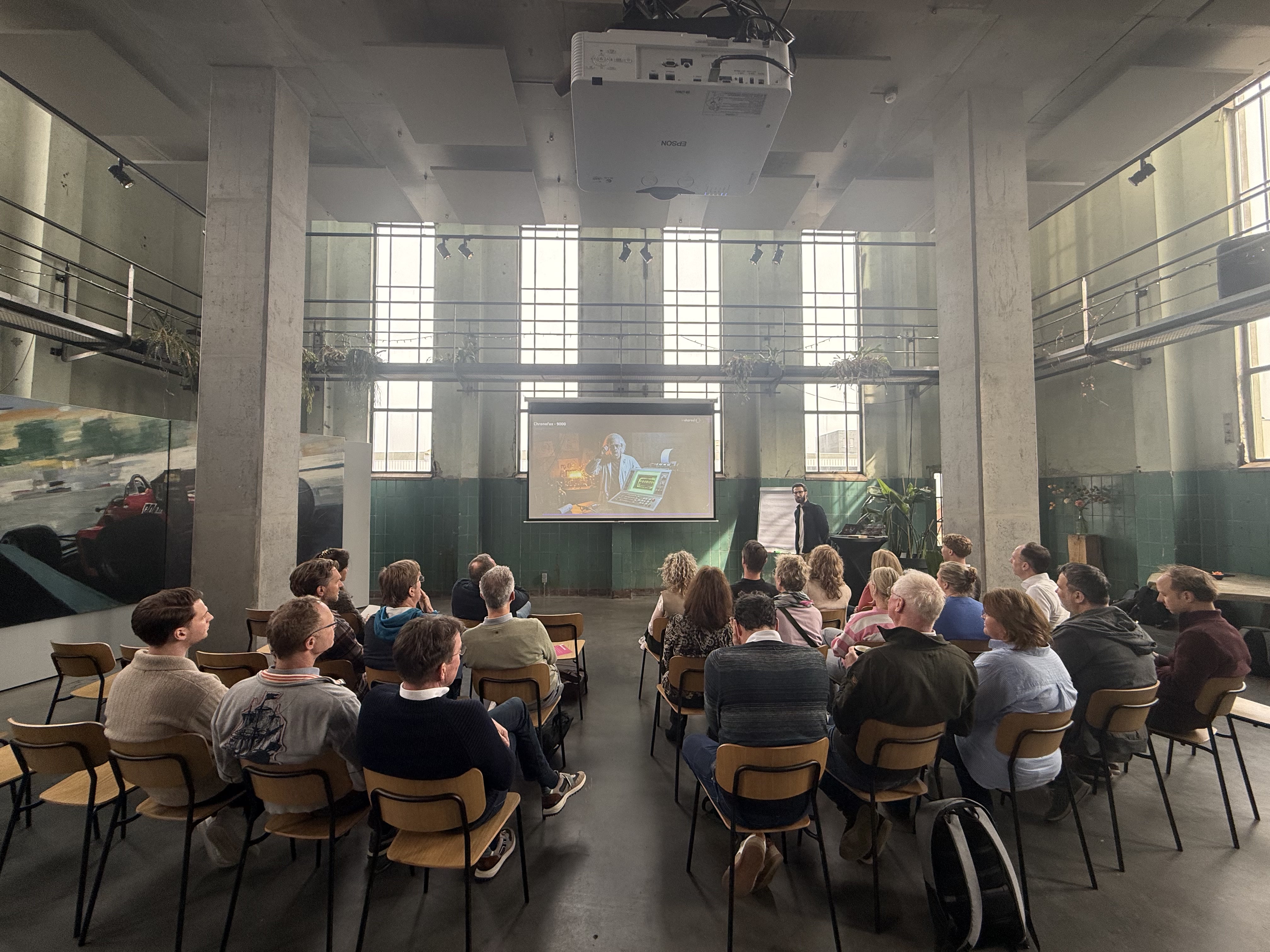

01
Why this, why now
Three things arrived in the same eighteen months: robots that learn instead of being programmed, a supply chain that made them cheap, and a wave of public spectacle that made them normal. That combination is the story.
For fifty years a walking robot was a laboratory curiosity. In the last two years it became a product with a price tag, a factory shift and a marathon finish time. None of those three developments would matter alone. Together they move the humanoid from someday to this budget cycle, and they do it while Europe watches from the stands. This dossier maps the field as it actually stands in the middle of 2026, separates the demonstrations from the deployments, and ends on the only question that matters for a Dutch or European reader: when the robots arrive, who captures the value?
- Dec 2023 — Tesla reveals Optimus Gen 2. Learned-control research begins to eat the field.
- Oct 2024 — Physical Intelligence releases π0, the first generalist robot foundation model.
- Apr 2025 — A humanoid finishes a Beijing half-marathon for the first time.
- 2025 — Chinese firms ship an estimated 80 to 87 percent of the world's humanoids.
- Apr 2026 — At the same race, the winning robot beats the fastest human by 17 minutes.
- Jul 2026 — The Humanoid Application Center opens near Rotterdam to "kickstart" Europe.
02
1. The turn: from scripted to learned
The unlock was not a better motor. It was the arrival of foundation models for physical action, the same shift that took language models from autocomplete to colleague.
The case for the human shape has always been simple. The world is built around our bodies, since doors and stairs and shelves and tools and workstations are sized for a creature about 1.7 metres tall that manipulates objects with two hands. A machine that moves and grips the way we do can, in principle, work anywhere a person works without rebuilding the workplace around it. That argument is old. What changed is that the machines started to earn it.
In October 2024 Physical Intelligence released π0, the first generalist robot policy trained across eight different robot types to fold laundry, bag groceries and bus a table. In March 2025 NVIDIA published GR00T N1 as an open foundation model for humanoids, and Google DeepMind released Gemini Robotics, a version of its Gemini model that outputs physical movement instead of text. Skild AI raised well over a billion dollars to build a single brain that can drive any body. The common thread is that robots stopped being programmed task by task and started to learn behaviour the way language models learned text.
You can see the effect in the party tricks, which is where most people first noticed. Unitree's electric H1 did the first standing backflip by an electric humanoid in March 2024, and one year later its smaller G1 landed a standing side flip. The notable detail is how it was made: the motion was trained entirely in simulation and transferred to the real machine with no additional tuning. A stunt, yes, and also a demonstration that a skill can now be grown in software and poured into hardware.
03
2. The field today: who is building what
Two clusters dominate, one American and one Chinese, plus a layer of companies building the control software that any body can run.
The American cluster is the one Western readers know. Tesla revealed Optimus Gen 2 in December 2023 and has promised a third generation into production in 2026. Figure moved from its 01 to 02 to 03 robots and opened a factory, BotQ, aiming to build up to 12,000 units a year and 100,000 over four years. Agility Robotics has the most real operating hours of anyone. Boston Dynamics retired its hydraulic Atlas and rebuilt it as an all-electric industrial machine, now paired with Hyundai and Google DeepMind. Apptronik builds Apollo, and 1X builds a home robot called Neo.
The Chinese cluster is larger, cheaper and shipping in higher volume. Unitree sells a full-size H1, a compact G1 from around 16,000 dollars, and an entry R1 near 6,000. AgiBot, Xpeng, UBTech, Fourier and Galbot are all in production or close to it. A newer Shenzhen firm, KinetixAI, unveiled a robot in April 2026 claiming 115 degrees of freedom across its body. The numbers that matter are the shipment numbers, and they are Chinese numbers.
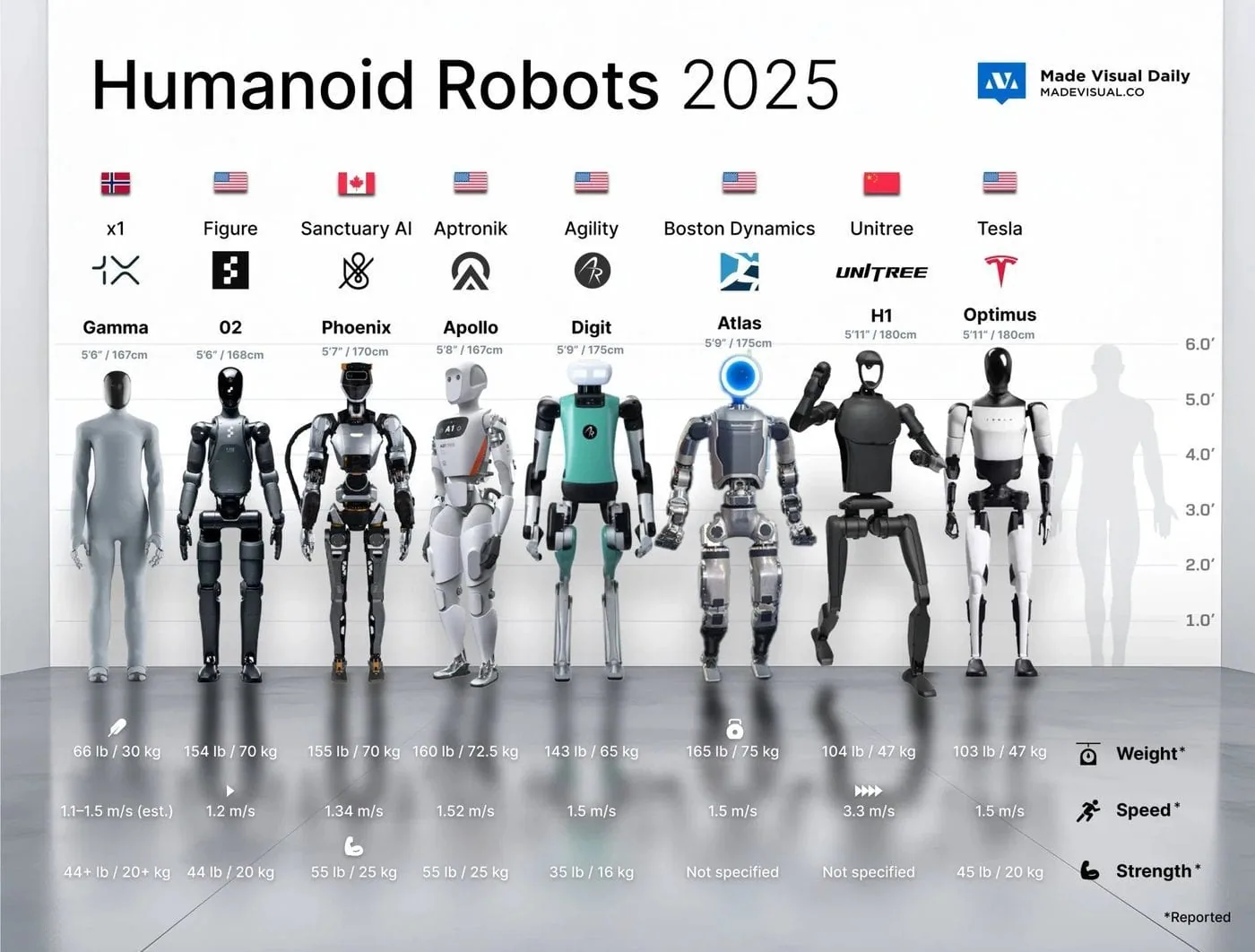
| Region | Body makers | What stands out |
|---|---|---|
| United States | Tesla (Optimus), Figure, Agility (Digit), Boston Dynamics (Atlas), Apptronik (Apollo), 1X (Neo) | Marquee partnerships, the largest funding rounds, and most of the best control models. Almost nothing shipping at volume. |
| China | Unitree, AgiBot, Xpeng (Iron), UBTech (Walker), Fourier, Galbot, KinetixAI | Lower prices, real production volume, and a domestic supply chain for the parts that matter. |
| The "brains" | Physical Intelligence (π0), NVIDIA (GR00T), Google DeepMind (Gemini Robotics), Skild AI | Foundation models that separate the skill from the hardware. Mostly American, and increasingly open. |
Hold onto that split, because it explains a lot of what follows. The West is ahead on the software that makes a robot smart and on the capital that funds the labs. China is ahead on the machines themselves and on the factories and motors and hands that make them affordable. Those two leads do not cancel out. They set up the competition described later in this dossier.
04
3. Speed, and the exponential inside robotics
The reason serious people stopped rolling their eyes is the slope. Milestones that used to arrive years apart started arriving quarters apart, and the price fell just as fast.
| When | What happened |
|---|---|
| Dec 2023 | Tesla reveals Optimus Gen 2. Nvidia announces Project GR00T a few months later. |
| Apr 2024 | Boston Dynamics retires hydraulic Atlas, unveils the all-electric version the same day. |
| Aug 2024 | Figure 02 goes onto BMW's line in Spartanburg for testing. |
| Oct 2024 | Physical Intelligence releases π0, the first generalist robot foundation model. |
| Mar 2025 | Unitree G1 side flip, trained in sim, zero extra tuning. GR00T N1, Gemini Robotics and AgiBot's GO-1 all land the same month. |
| Jul 2025 | UBTech's Walker S2 becomes the first humanoid to swap its own battery, a workaround for the runtime problem. |
| Oct–Nov 2025 | Figure 03 and its BotQ factory. Xpeng's Iron with 82 degrees of freedom. |
| Jan 2026 | Industry data shows roughly 13,000 humanoids shipped worldwide in 2025, the large majority Chinese-built. |
Two clocks are compounding at once. The control models improve on the fast clock of AI research, measured in months. The hardware improves on the slower clock of manufacturing, and it is now on its third or fourth generation at several firms rather than its first. The Walker S2 swapping its own battery is a small illustration of the second clock: when a machine can re-power itself, a single-charge runtime of a couple of hours stops being a hard ceiling on a work shift.
The sharper version of the acceleration is the price. Unitree's own line ran from the 90,000-dollar full-size H1 in 2023 to the 16,000-dollar G1 in 2024 to the 5,900-dollar R1 in 2025, with an upper-body dual-arm unit near 4,300 dollars in 2026.
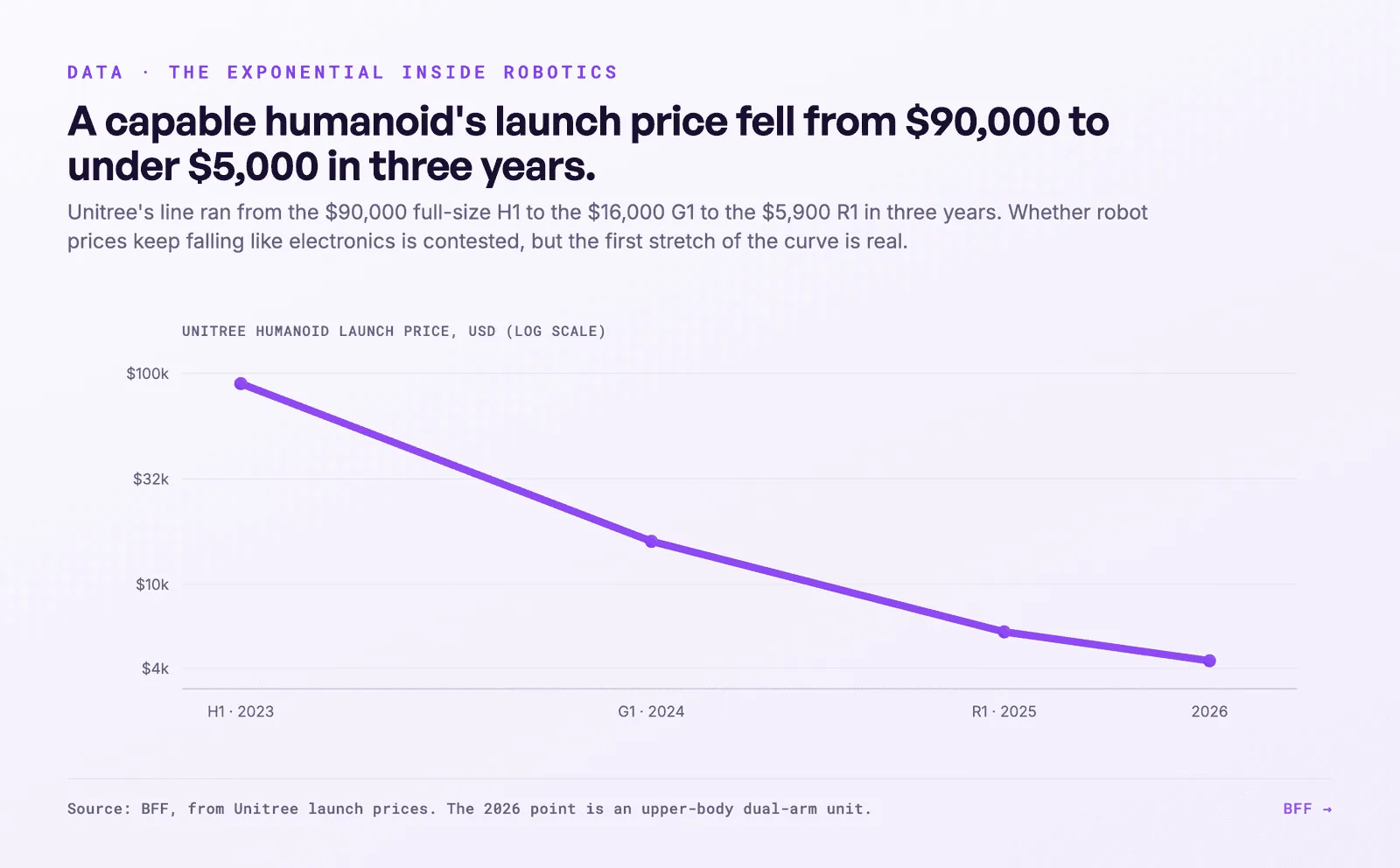
Whether robot prices keep falling like electronics is genuinely contested, and section fourteen gives the case against at length. The first stretch of the curve is real and steep, and I would not extrapolate it further than that. A word of discipline is required here generally, because speed is exactly where this field oversells itself. A milestone is not a product, and a robot that side-flips in a lab is not a robot that can reliably pick your order for eight hours. Several sections below are about that gap, and it is wide.
05
4. The crowd stopped laughing: culture and normalisation
Capability charts change what analysts think. Spectacle changes what everyone else thinks, and in the last year the spectacle turned a corner.
In April 2025 the story was that a humanoid finished a Beijing half-marathon at all, stumbling and overheating along the way. In April 2026, at the same race, the humanoids raced each other and the winning machine, an autonomous robot called Honor Lightning, crossed the line in 50 minutes and 26 seconds. The fastest human finished in 1 hour, 7 minutes and 47 seconds. A teleoperated robot ran it faster still and was penalised for it. In twelve months the narrative moved from "can it even finish" to "it would have won."
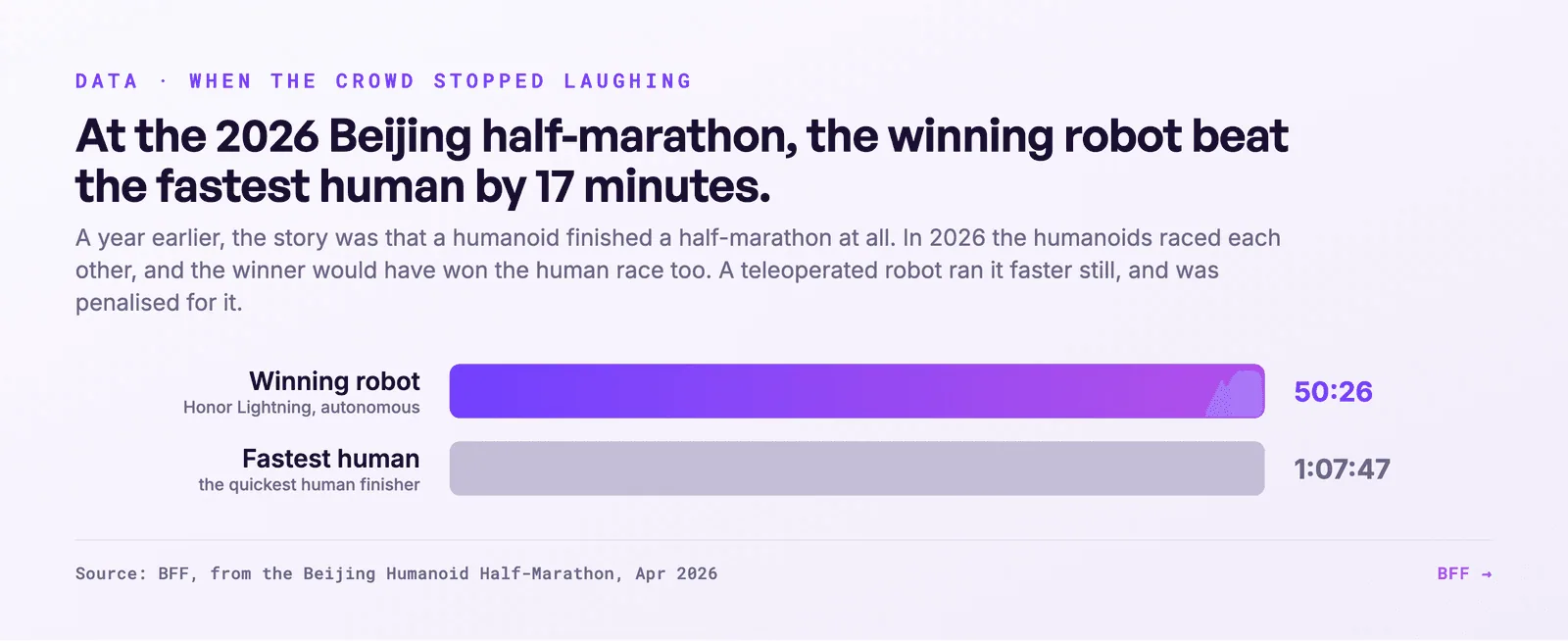
The race is not an isolated stunt. Unitree's combat robots debuted alongside a UFC event in 2025, a mecha fighting league now streams globally, and in one widely shared clip an EngineAI robot kicked its own chief executive to the mat. These are entertainment, and entertainment is how a technology becomes ordinary.
The second shift is subtler and more important: the machines are crossing the uncanny valley. When XPeng showed its IRON humanoid walking with human weight-shifts and small corrections, the common reaction was that from five metres your brain says person and only then remembers it is a robot. XPeng had to cut the suit open on stage to prove there was no human inside. When real footage starts getting dismissed as CGI, the valley has been crossed in both directions at once.
Why does a marathon time belong in a business dossier? Because normalisation is a leading indicator of adoption. Publics that see robots run and fight and dance stop treating them as science fiction and start treating them as procurement. The cultural gap between China, where these events fill stadiums, and Europe, where they are a curiosity, is one more version of the gap this dossier keeps returning to.
06
5. The money: capital stacked on pilots
Capital has decided this is the next platform. The funding rounds are real. The trillion-dollar market forecasts underneath them are projections and should be read as such.
The private money is concrete. Apptronik raised more than 935 million dollars in a Series A that valued it near 5 billion by early 2026. Skild AI, building its universal robot brain, raised around 1.4 billion at a valuation above 14 billion, roughly tripling in seven months. Galbot, a Chinese maker of wheeled mobile manipulators, reached about 3 billion, a record for Chinese embodied AI. Figure sits on the largest valuation of all at around 39 billion.
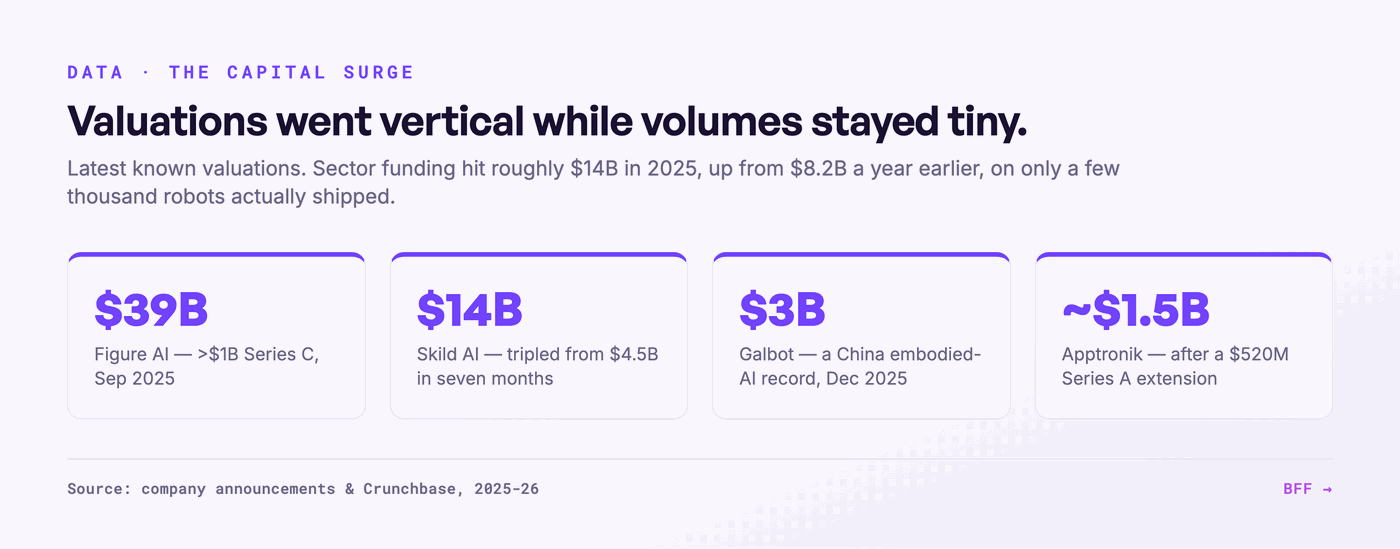
Valuations went vertical in a single year while shipped volumes stayed in the low thousands, and that is the tension worth holding. The public forecasts are where restraint matters most. Morgan Stanley's widely cited model puts the humanoid market at roughly 5 trillion dollars a year by 2050, with over a billion units in use, of which it expects China to hold around 302 million and the United States around 78 million. Those are 2050 numbers, a quarter century out, built on assumptions nobody can yet check. They are useful as a statement of ambition rather than as evidence the machines work. The honest read is that the money is betting on a curve, and the curve is early.
07
6. On the assembly line, and the sectors beyond it
The factory floor is where humanoids do their real, paid work today. It is structured, indoors, repetitive and already half-automated, which makes it the lowest-variance environment a two-legged machine can enter. Four other sectors are following it out into the world.
The factory floor: the core use case
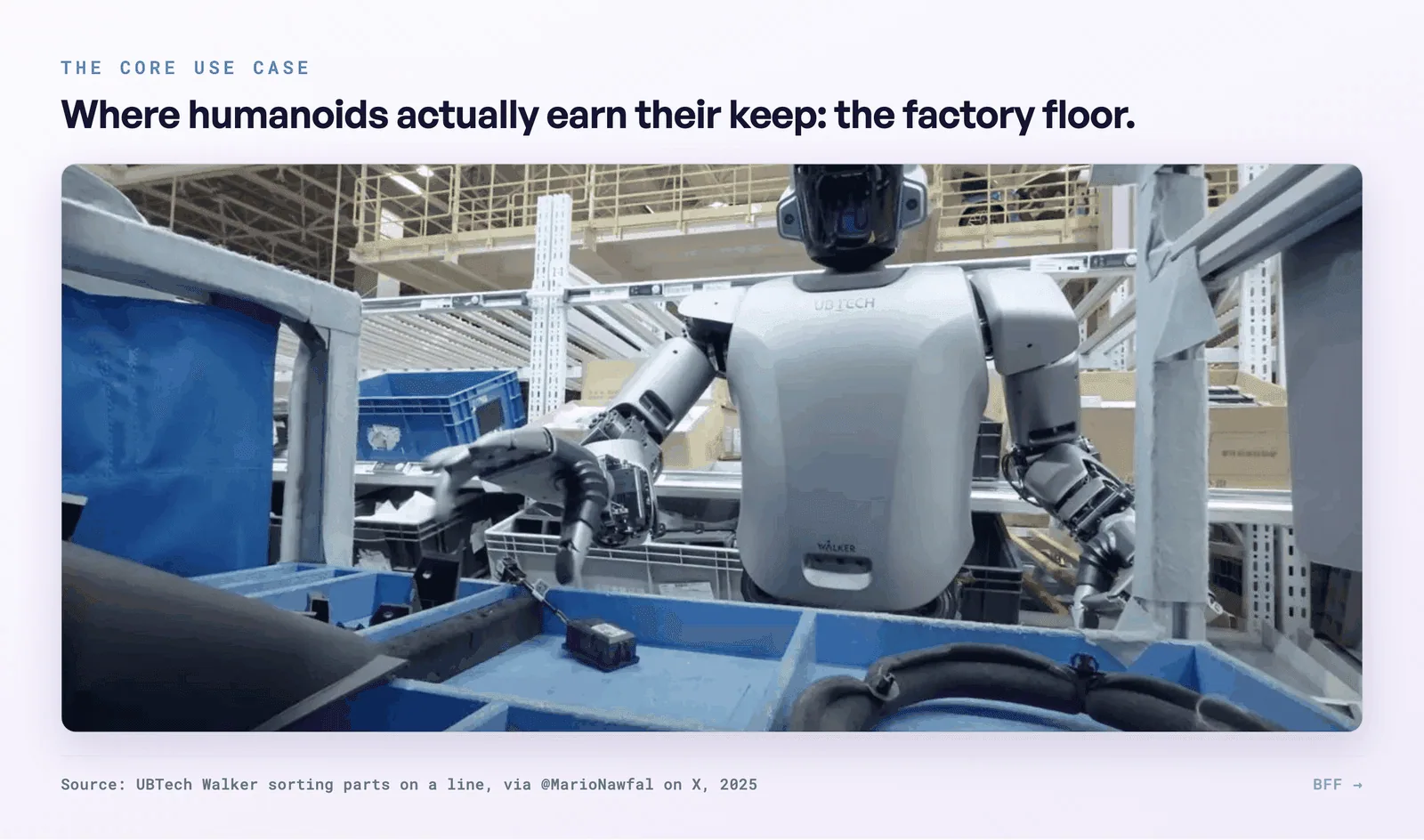
The most concrete deployments are on car lines. Figure ran its 02 on BMW's line in Spartanburg, moving parts across roughly 1,250 operating hours. Mercedes-Benz runs Apptronik's Apollo across multiple plants. UBTech's Walker S2 works production lines at Chinese carmakers including NIO and at the electronics giant Foxconn, with 2025 orders reported at more than 800 million yuan, and the carmaker Zeekr has shown UBTech humanoid swarms assembling vehicles. Tesla's plan is to prove Optimus inside its own factories before selling it to anyone else. Every one of these is a car or electronics plant, which is not a coincidence: a modern assembly line is the one place where the environment is controlled enough, and the economics legible enough, for a humanoid to pencil out.
The direction of travel is the lights-out factory, a building that runs in the dark because nobody inside needs the light. Xiaomi's Beijing car plant reportedly finishes a vehicle every 76 seconds, and its phone factory runs largely unattended. The honest framing of the endpoint is a shift in the human job, from ten thousand people on a line to a handful who supervise the machines that replaced them. That is the future the factory is quietly rehearsing, and it is the backdrop to the labour argument in section fourteen.
Logistics: the first paid hours
Agility's Digit passed 100,000 totes moved in live commercial operation at GXO's Georgia facility in November 2025, under the first humanoid Robots-as-a-Service contract. No purchase, and no integration project the customer owns: GXO pays for hours worked and Agility keeps the fleet running. Amazon tests Digit for the same tote-moving work. The point of the milestone is not the count. It is the contract shape, a warehouse manager renting a humanoid the way they rent forklifts, and that is the model that scales.
Eldercare: the market with the strongest demographic pull
Fourier's GR-3 care-bot, unveiled in August 2025, is 165 cm and 71 kg with 55 degrees of freedom and around three hours of runtime, priced near 27,500 dollars for business use in China, aimed at companionship and medication reminders and health monitoring. Read the market figure around it with care: an eldercare-robot market put near 3.56 billion dollars in 2026 growing about 12.5 percent a year covers the whole category rather than autonomous humanoids alone, and the growth rate is a projection. The reason to watch this sector is not today's size. It is that the demand is demographic, and demography does not turn around.
Retail and the home
Galbot opened the Galbot Store, billed as the first fully autonomous retail format run by humanoid robots, now in more than 30 Chinese cities, while also supplying manipulation to CATL, Bosch, Toyota and Hyundai lines. And 1X put its NEO on open preorder at 20,000 dollars outright or 499 dollars a month, shipping in 2026. NEO is the honest one, only around 60 to 70 percent autonomous at first, with human Expert Mode teleoperators completing tasks it cannot do alone. 1X also signed to route home humanoids into factories, up to 10,000 units between 2026 and 2030, which tells you the home-versus-industrial line is already blurring.
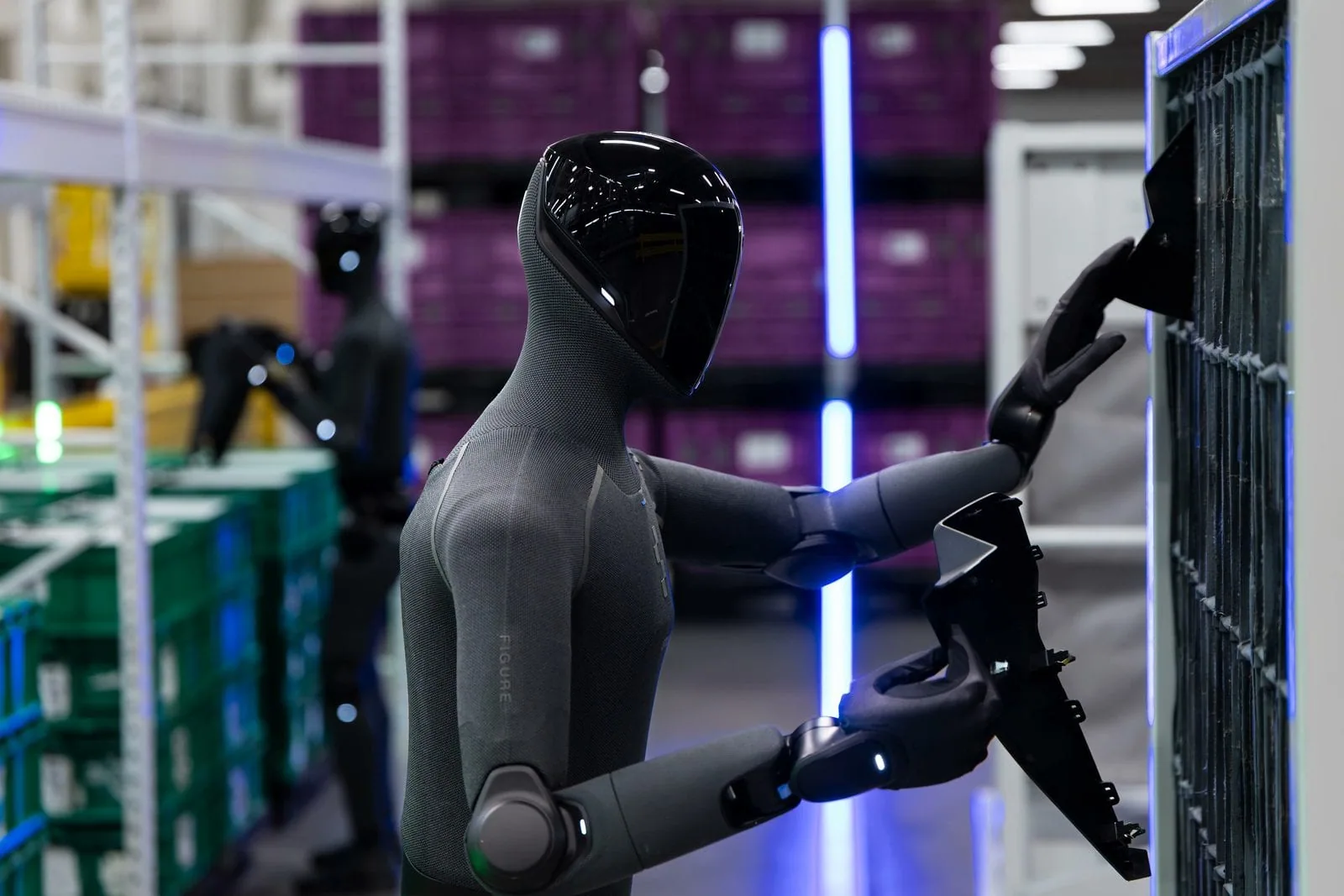
For a European reader, eldercare and the home are the two sectors that matter most, because they are where the continent's labour shortage bites hardest. Hold that thought for section ten.
08
7. Into the home: care, privacy, and the teleoperated stranger
The home is the largest market and the hardest one, and it arrives with a problem no factory robot has: a camera on legs, in your kitchen, with a stranger sometimes driving it.
1X's NEO is the first consumer humanoid you can actually preorder, and the reporting around its launch is unusually honest about the catch. The robot is only partly autonomous, and for anything it cannot do alone a remote human operator embodies it, seeing through its cameras and driving it through the task. The tech investor Robert Scoble, who examined NEO closely at the launch, described the trade plainly: much of it is teleoperated, which means another human will be viewing what is going on in the home, and the mitigation is that on setup you tell the robot where it may not go so it will not walk into a bathroom or a bedroom. That is a real design response. It is also an admission that the product ships with a privacy model rather than just a warranty.
This is where the honesty gate of the whole field sits. A humanoid in the home is a networked, mobile, camera-bearing computer, and the questions it raises are not hypothetical for a European buyer. Under the EU's AI Act a general-purpose robot of this kind is treated as high-risk, with obligations that now phase in through 2027 and 2028 after the Digital Omnibus postponement, and a camera streaming a living room engages the GDPR directly. The care sector adds a second layer of dignity and deception, because a robot that simulates companionship for a lonely older person is either a humane extension of scarce care or a substitute for human contact dressed up as one, and Europe has been more willing than East Asia to ask that question out loud. None of this stops the technology. It does mean the countries that decide the rules early, rather than importing both the machine and its defaults, keep more control over how it lands.
09
8. The demo, the pilot, and the teleoperator
This is the section the launch videos skip. Almost every humanoid you have seen working was doing one of three things: a staged demo, a supervised pilot, or a task with a human quietly driving it.
Start with the genuine progress. Agility Robotics has Digit picking totes at GXO under a paid robots-as-a-service contract, and describes itself as the only humanoid company earning revenue from paying customers, with tens of thousands of real operating hours across a handful of committed sites. Figure ran its 02 robot on BMW's line in Spartanburg and reported moving more than 90,000 parts over roughly 1,250 operating hours. Apptronik's Apollo is in multi-plant pilots with Mercedes-Benz. This is real, and it is more than existed two years ago.
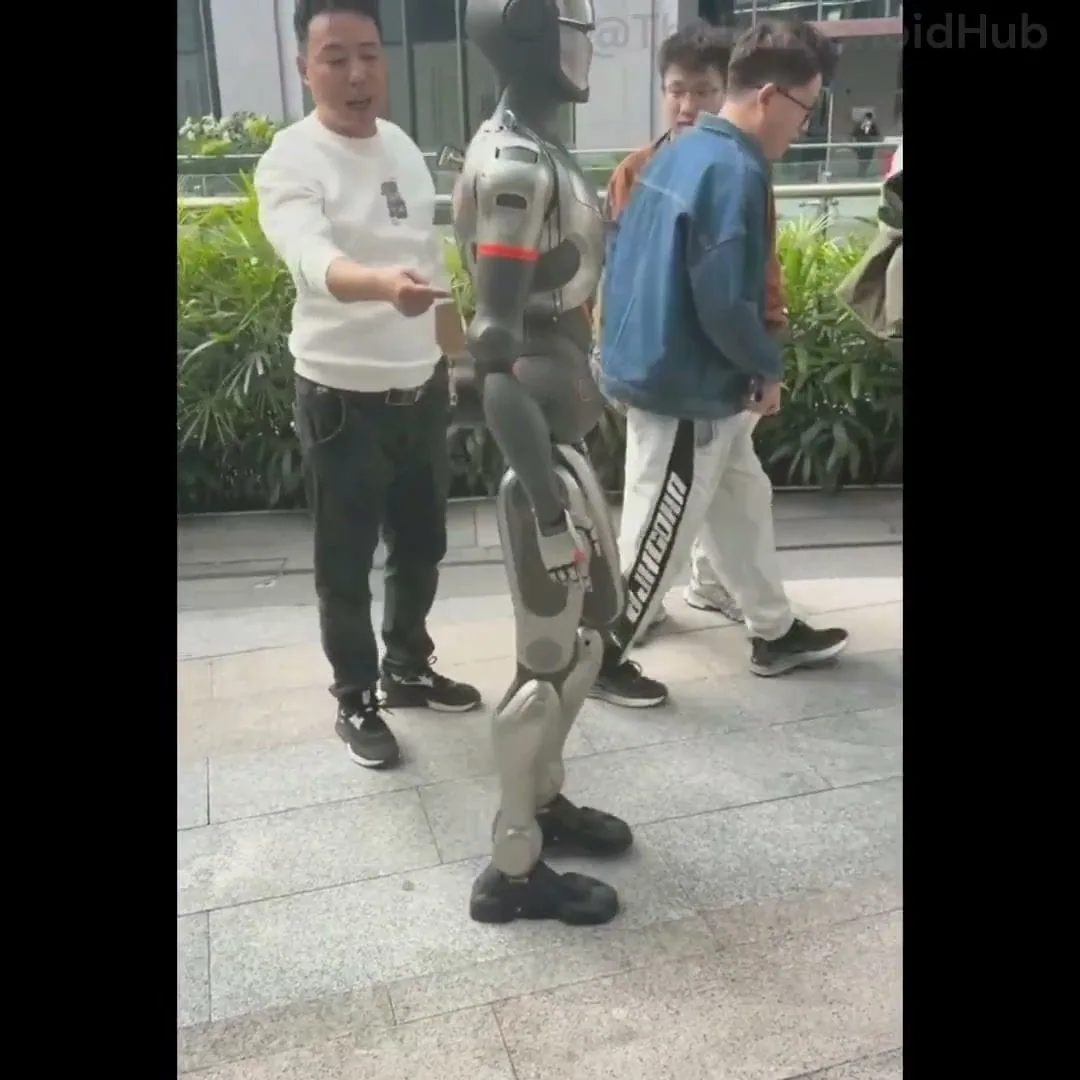
Now the asterisks, because they are large. Figure's headline 200-hour shift with zero failures was a controlled livestream demonstration rather than a production shift at a customer. Its BMW figures came with a target of zero human interventions, and the company did not release how close it got. Tesla's celebrated 2024 event, where Optimus units poured drinks and chatted, turned out to be teleoperated by humans in motion-capture suits. Teleoperation sold as autonomy is this field's most common sleight of hand, and even the honest home robots rely on it.
10
9. China, the United States, and Europe
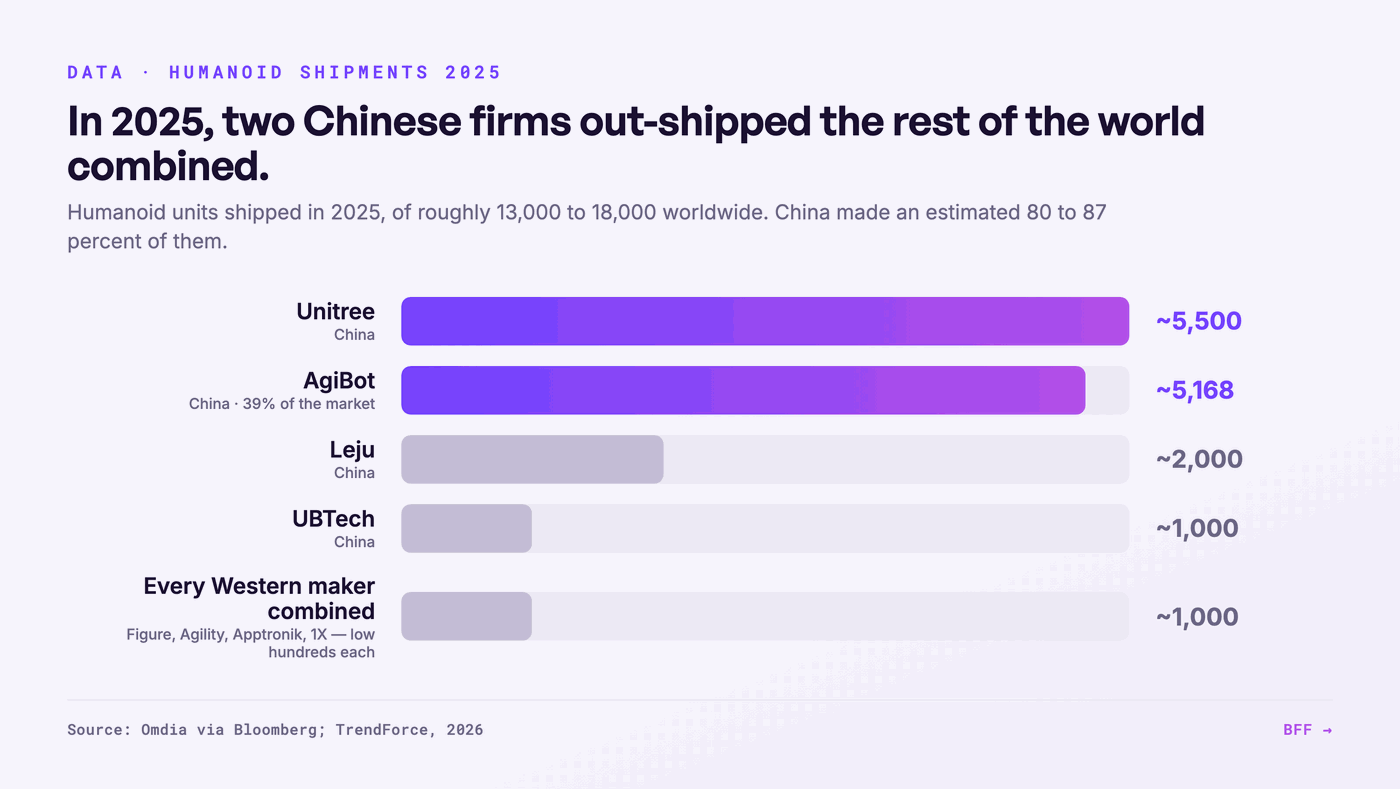
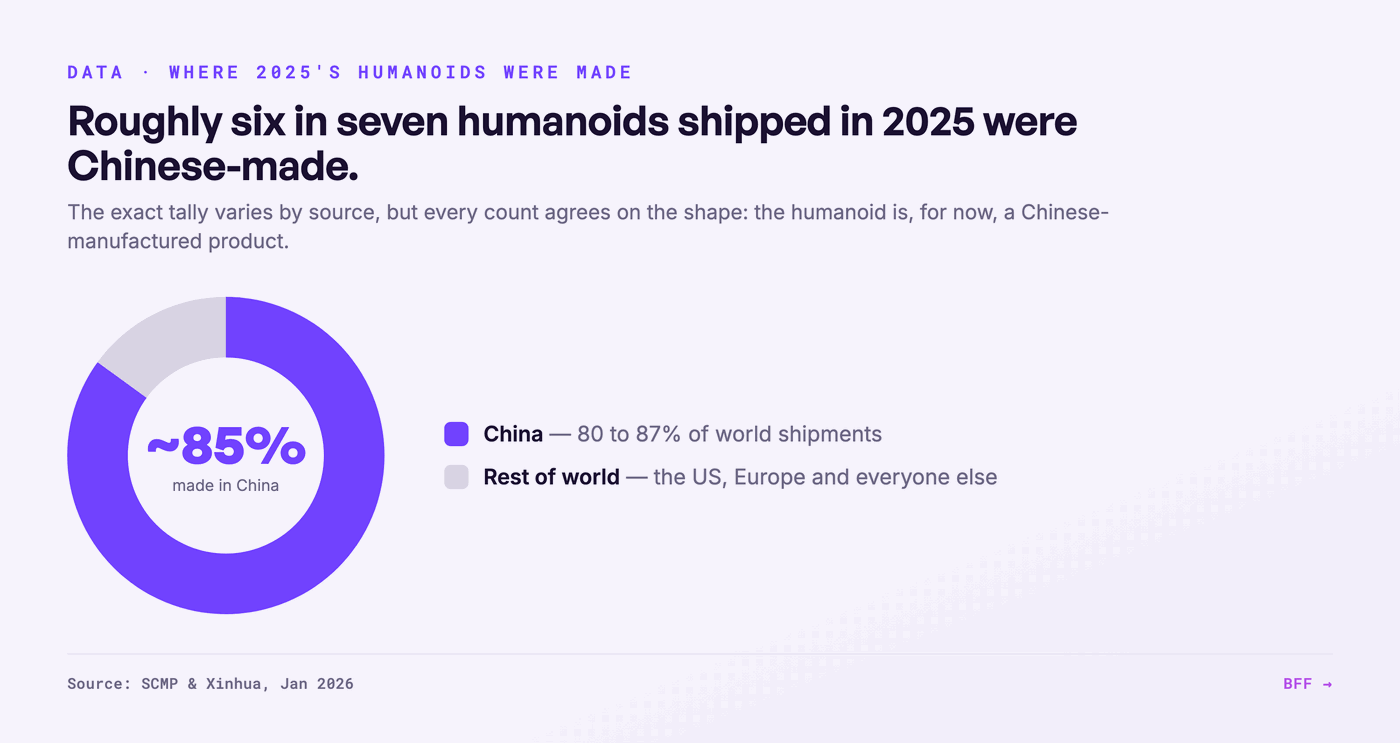
If you want one fact that reframes the whole race, it is this: in 2025, Chinese firms shipped somewhere between 80 and 90 percent of the world's humanoid robots.
Of roughly 13,000 units shipped globally in 2025, the leaders were AgiBot with more than 5,100 units and about 39 percent of the market, Unitree with around 4,200 to 5,500 depending on the count, and UBTech with about 1,000. Every name at the top of that list is Chinese. The exact tally varies by source, and the totals run anywhere from 13,000 to 18,000 depending on who is counting, but the conclusion does not move.
Behind the volume sits policy. China's Ministry of Industry named humanoids a strategic industry in November 2023, with targets for mass production and world leadership, backed by state support measured in the hundreds of billions of dollars over two decades. Chinese humanoid and embodied-AI investment reached roughly 5.5 billion dollars across 325 deals in 2025, up more than 300 percent year on year, and the country now hosts over 140 humanoid manufacturers.
| Region | Leads on | Lags on |
|---|---|---|
| China | Production volume, unit cost, actuator and battery supply chain, state backing | The most advanced control models, though it is closing fast |
| United States | Foundation models, capital, marquee industrial pilots | Manufacturing scale and cost. Nothing shipping at volume yet |
| Europe | Industrial-automation heritage, safety and regulatory frameworks | Homegrown humanoid champions. Barely present at China or US scale |
One popular claim deserves a caveat. The line that Shenzhen alone outcompetes the entire United States travels well on social media, and it captures something true about density and volume. It is also an argument rather than a measurement. The United States still leads on the intelligence layer that may end up mattering most. The accurate statement is narrower and more interesting: China is winning the bodies, the West is winning the brains, and nobody knows yet which lead compounds faster.
11
10. The Dutch and European map
Europe is the uncomfortable part of this picture, and worth being specific about rather than defensive. The continent that invented industrial robotics has almost no presence in humanoids, and it is trying to change that in mid-2026.
Europe just made its move. The Humanoid Application Center opened near Rotterdam in July 2026 to link firms and researchers and technicians and, in its own framing, to kickstart the race with the United States and China. Dutch construction's chronic worker shortage, in bricklaying and other dangerous or repetitive tasks, is cited as a lead use case. It is a genuine start, and it is also small next to what it is chasing.
The continent is not empty of robotics strength; it is empty of humanoid strength specifically. The Netherlands has real assets, since Lely is a world leader in agricultural robotics with a large installed base of autonomous milking and barn robots, and the Brainport Eindhoven cluster around ASML is among the densest precision-mechatronics ecosystems anywhere. Germany's Neura Robotics has raised at the scale of a serious contender and builds a humanoid, the 4NE-1. Spain's PAL Robotics and France's Wandercraft have deep histories in bipedal and assistive machines. Set against the Chinese leaders on volume and the American leaders on capital, though, European startups fight for tens of millions of euros while their rivals raise billions.
| Player | Country | What it is |
|---|---|---|
| 1X | Norway | Consumer humanoid (NEO), on preorder, teleoperation-assisted |
| Neura Robotics | Germany | The 4NE-1 humanoid, the best-funded European humanoid effort |
| PAL Robotics | Spain | Long-standing bipedal and service-robot maker |
| Wandercraft | France | Exoskeletons and self-balancing legged machines |
| Lely | Netherlands | World-leading agricultural robotics, adjacent not humanoid |
The demand pull is real and severe. The EU faces a projected shortfall of around 4.1 million health workers by 2030, including some 2.3 million nurses, and the over-65 share of the population climbs toward 29 percent by 2080. Those are modelled projections rather than measurements, and they move with assumptions, but no plausible version of them is comfortable. On the AI layer beneath the hardware, the Draghi competitiveness review found the United States produced 40 notable AI models in 2024 to Europe's 3, with only about 13.5 percent of EU firms having adopted AI. Europe under-produces the technology and over-needs it at the same time.
The one opening is that the brains are going open. NVIDIA's GR00T weights are Apache-2.0 licensed, and an NVIDIA, Unitree and Sharpa open reference robot launched in mid-2026, which means a European integrator can build applications on open stacks without training a foundation model. The honest strategic read for a Dutch firm is not to out-manufacture China. It is to adopt and integrate now on Robots-as-a-Service terms, own the data and the workflow, and treat the hardware as a commodity to be sourced. Whether Europe's regulatory lead becomes leverage or merely a rulebook for other people's robots is still open, and it is a fair question to ask out loud on this continent.
12
11. The supply chain that sets the price
The report keeps citing a cost gap, roughly 16,000 dollars for a Chinese G1 against 50,000-plus for a Western industrial humanoid. The reason is upstream, and it is the most structural fact in the field.
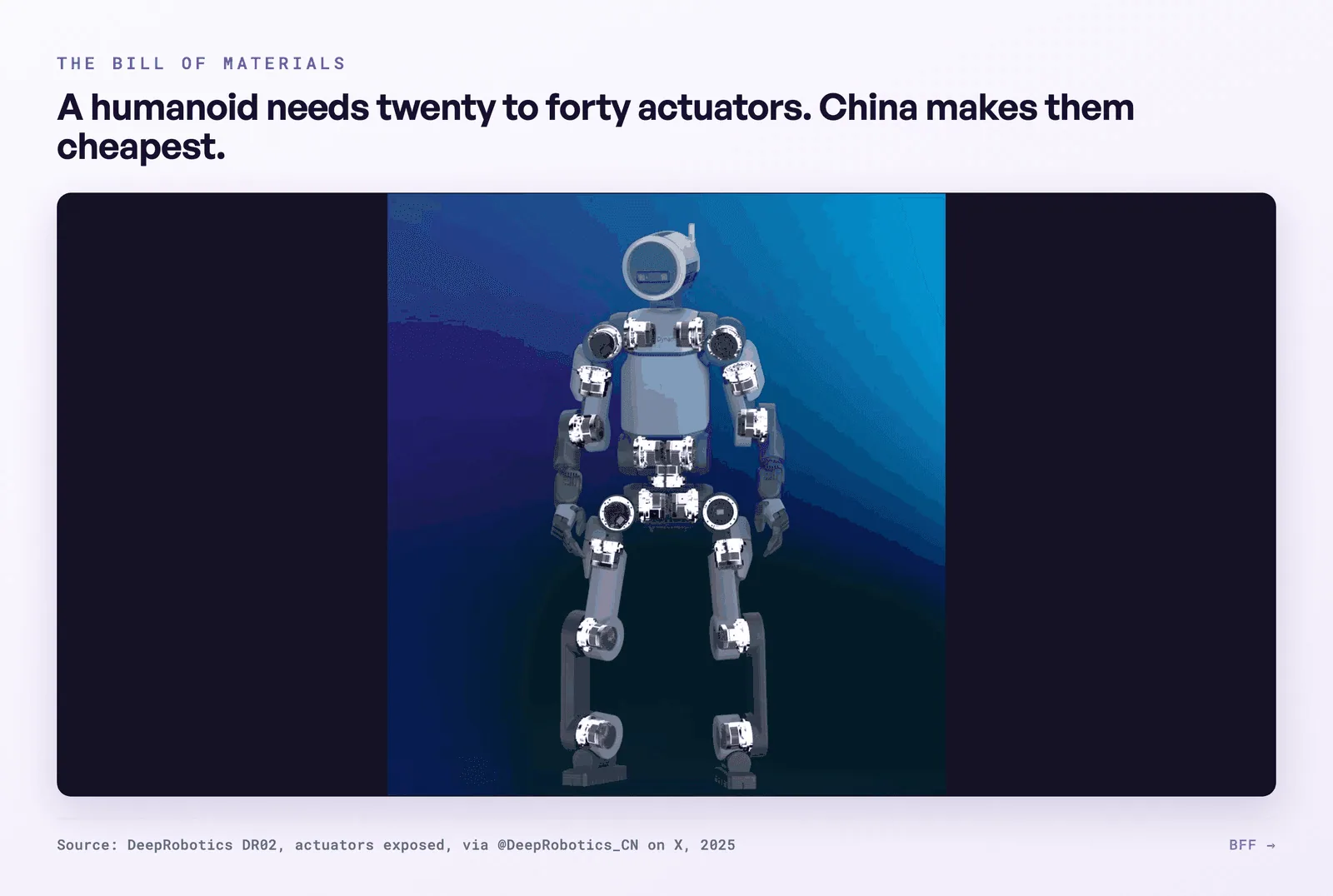
The actuator system, meaning the frameless motor plus harmonic reducer plus sensors, is the single most expensive subsystem, typically 30 to 60 percent of a humanoid's bill of materials. Individual harmonic-drive actuators run 2,000 to 5,000 dollars, custom high-torque variants up to 15,000, and a humanoid needs twenty to forty of them. China makes those parts, and makes them cheapest.
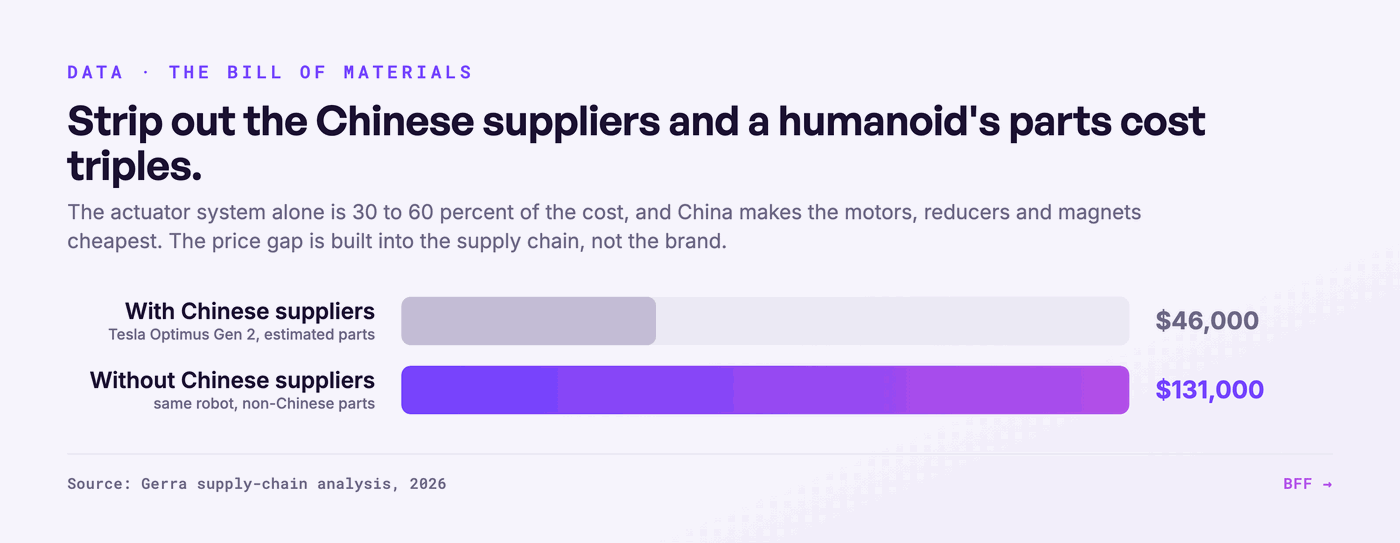
The headline number is what happens when you take them away: one analysis of Tesla's Optimus Gen 2 found that building it without Chinese suppliers would cost roughly three times as much, from about 46,000 dollars to about 131,000. That is a single analysis rather than a consensus figure, so I would treat the multiple as indicative, though it is directionally supported by the actuator share above.
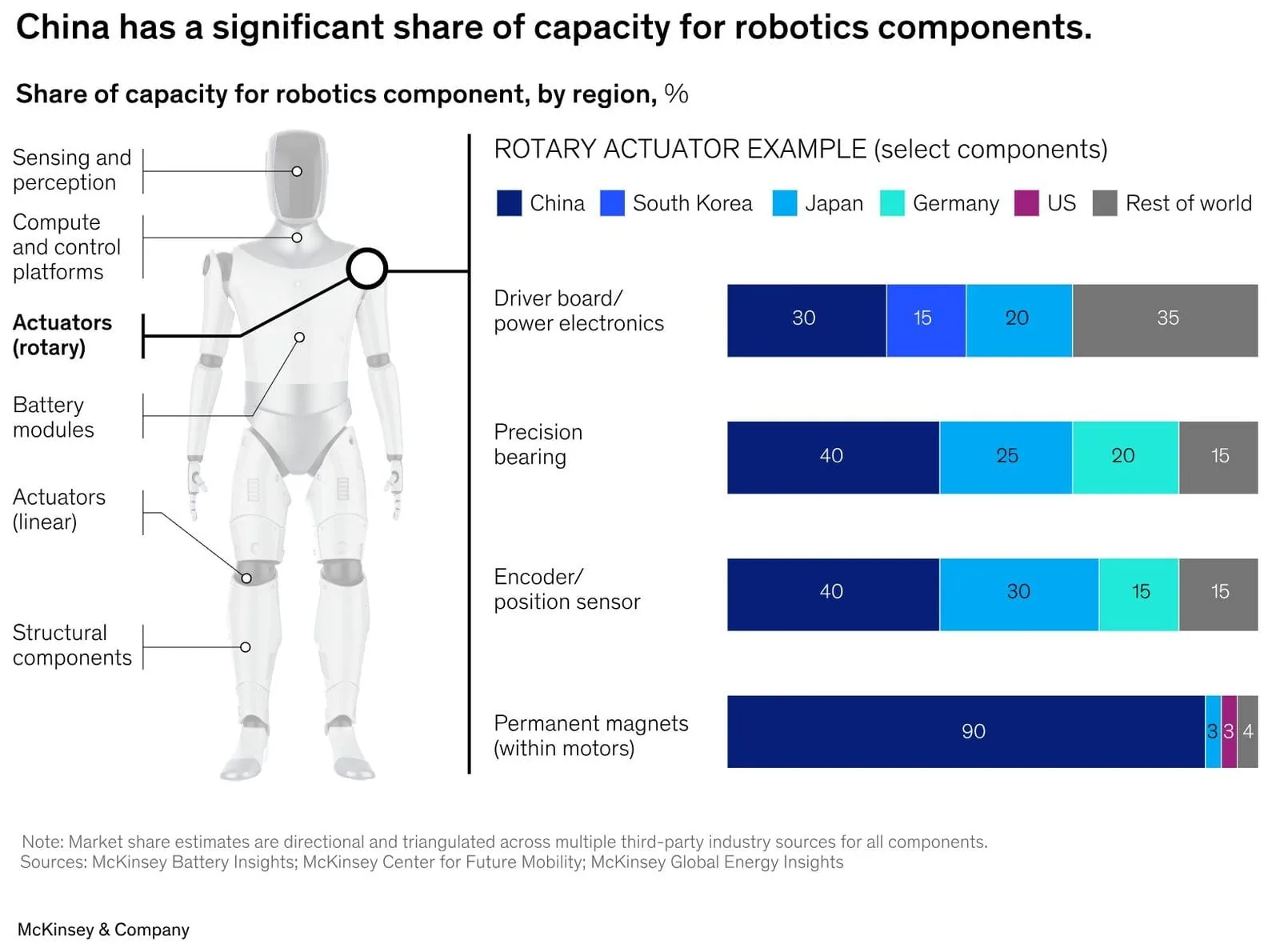
It goes deeper than assembly. China controls around 90 percent of global rare-earth refining and permanent-magnet production and around 70 percent of mining, and every humanoid motor depends on high-performance rare-earth magnets. The harmonic reducer, once a Japanese near-monopoly, is now produced at scale by Chinese firms. Europe's one hardware card, its German actuator and precision-mechatronics heritage, is being eroded from the same direction, since Chinese firms have already acquired flagship European makers such as KUKA. When the parts and the assembly are both local to China the price falls, and price is what turns a demo into a product.
13
12. The app store moment: who captures the margin
In May 2026 the robot got an app store. That event says more about where the money in this industry will sit than any shipment number, because it imports the platform economics of the smartphone into a field that never had them.
On May 7, 2026, Unitree opened UniStore, billed as the world's first humanoid robot application store. At launch it held 24 downloadable motions and tasks for the G1 and H1 humanoids and the Go2 and B2 quadrupeds, from dance routines to boxing sequences, installed from a phone the way you install an app. Alongside the store came a public SDK, so third-party developers can build and submit skills. A robot's ability stops being welded to its firmware and becomes a catalogue.
The brains are opening at the same time. NVIDIA's GR00T foundation models ship under a genuinely permissive Apache-2.0 licence, the training data flows in a shared format that bridges NVIDIA's stack and Hugging Face's LeRobot ecosystem, and in June 2026 NVIDIA and Unitree and Sharpa launched the first open humanoid reference platform, an H2 Plus body with dexterous hands and the full open software stack, aimed at any lab that wants to build without training a foundation model.
Put those together and the value chain starts to look familiar. Handsets taught the industry that when hardware commoditises and the operating layer opens, the margin migrates to whoever owns the app distribution, the developer ecosystem and the usage data. In robotics the equivalents are the skill store, the fleet contract and the manipulation data that only accumulates by running robots in the real world. That last one is the quiet compounding advantage of China's shipment lead, because every robot in the field is a data-collection point for the next model, and section nine showed who ships the robots. Unitree itself filed for a Shanghai IPO in March 2026, on revenue that grew 335 percent year on year, which is what a platform bet looks like when it goes public.
14
13. What is still genuinely hard
Strip out the demos and a sober list of unsolved problems remains. None of them is fatal. All of them are years of work.
Hands and touch
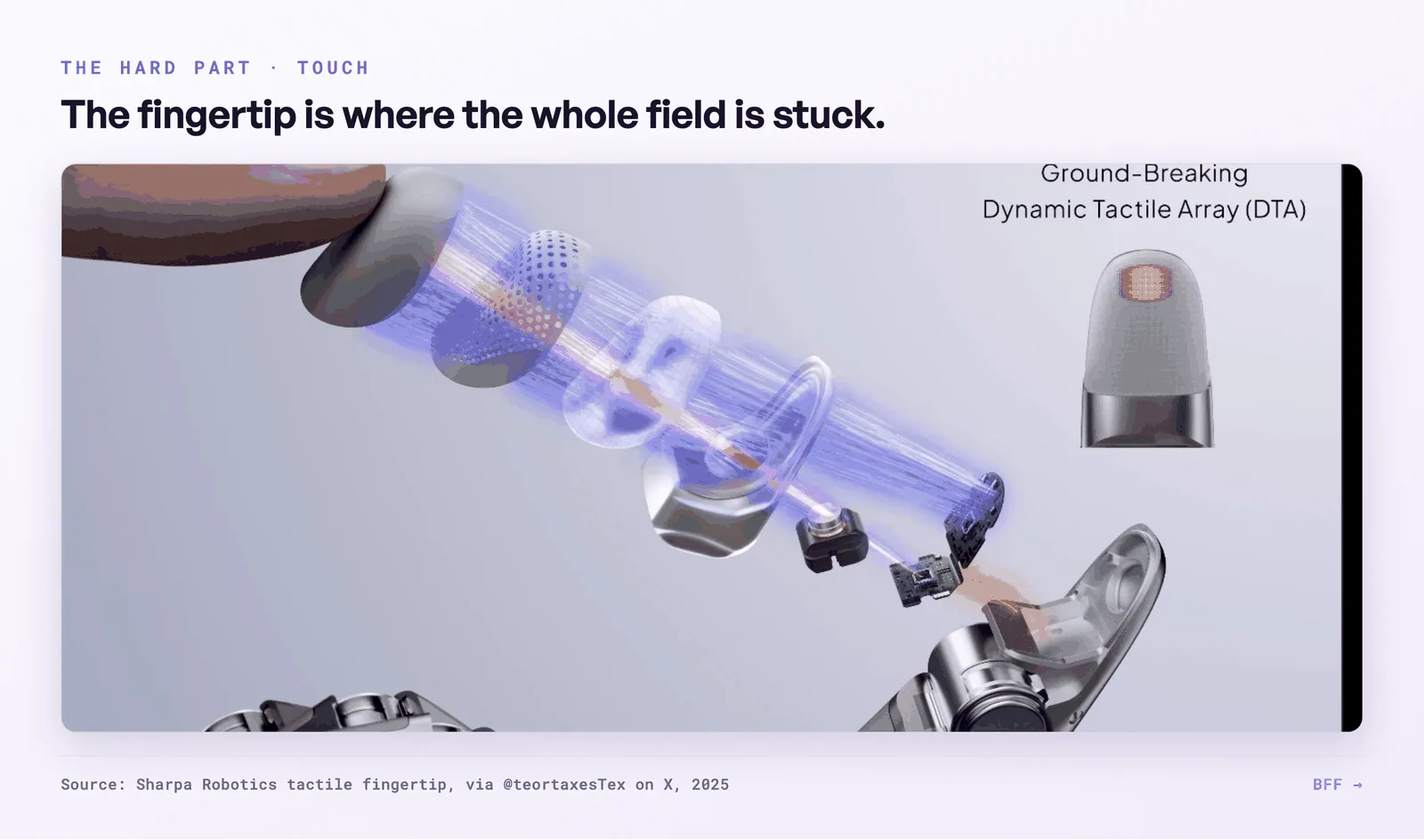
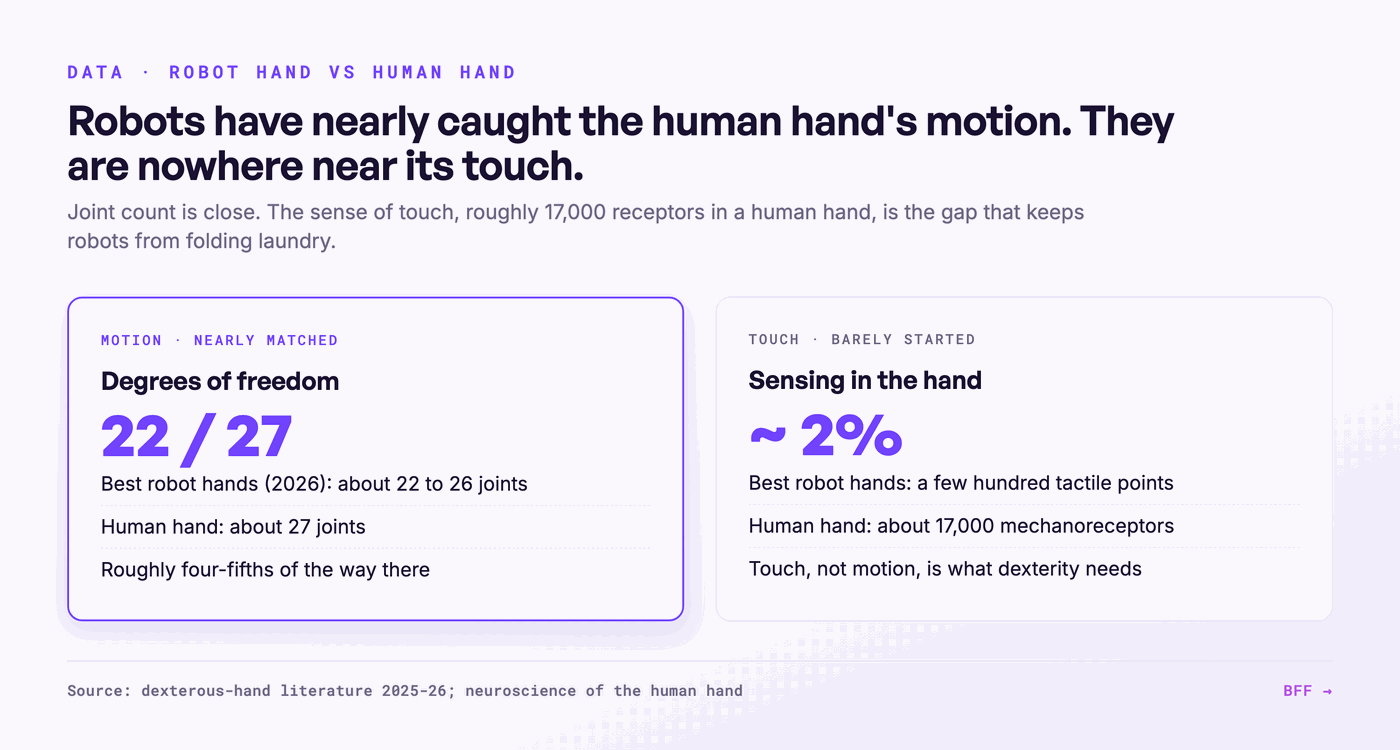
The human hand has around 27 degrees of freedom and roughly 17,000 touch receptors. The best robot hands sit at 22 to 26 degrees of freedom and, more importantly, are nearly blind to force. Roboticist Rodney Brooks argues the field is collecting the wrong data, because cameras capture how a task looks rather than the forces a hand feels while doing it. Folding laundry and routing a cable remain research problems rather than solved skills.
Battery and reliability
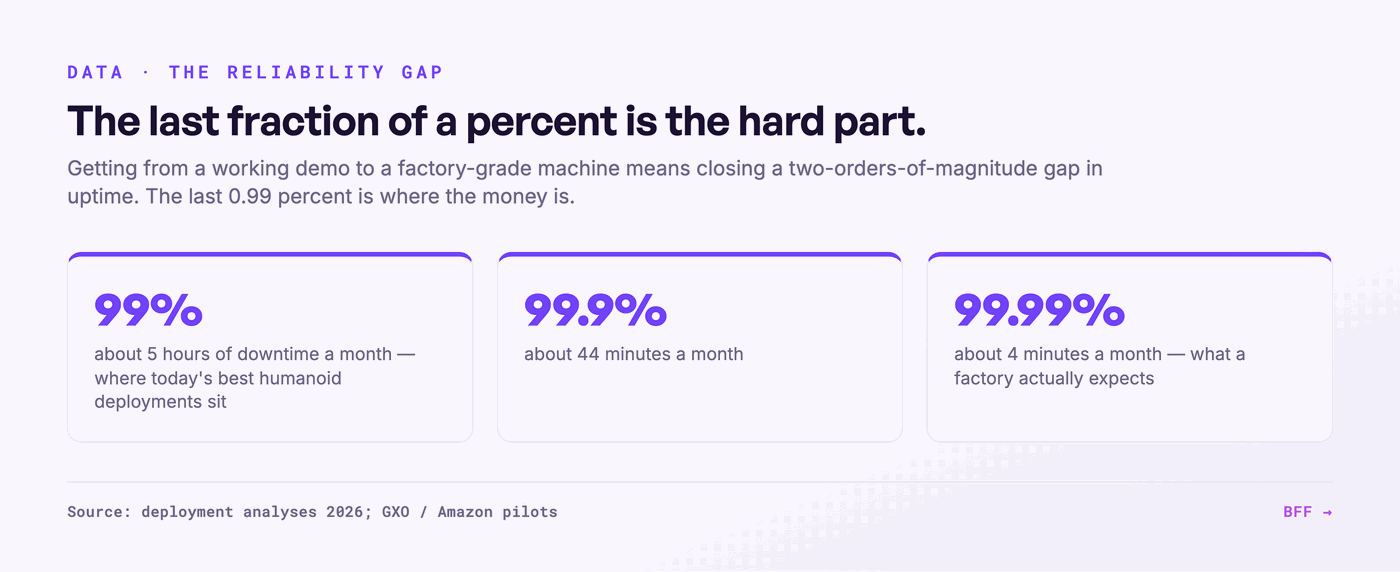
Real-world runtime is two to five hours, often less under load. More telling is uptime: current deployments run near 99 percent reliability, which sounds fine until you translate it to roughly five hours of downtime a month against the 99.99 percent that factories expect. As Agility's former product chief Melonee Wise put it, AI is not robust enough to meet the requirements of the market.
Cost and data
Western bills of materials sit near 50,000 to 60,000 dollars, and mechanical systems cannot ride the cost-collapse curve that chips did. There is also no internet-scale trove of robot training data the way there is for text, so every new skill still means collecting fresh demonstrations. Synthetic data from simulators such as NVIDIA's Isaac helps, and the Unitree side-flip proved a skill can transfer from sim to reality with zero tuning, but the shortcut is not free and does not yet cover dexterous, contact-rich work.
15
14. The pennies-per-hour fight
The whole trillion-dollar case rests on one claim: that robot labour collapses toward near-zero cost. The field's most credentialled sceptic says that is a category error borrowed from software, and the argument is worth having honestly.
Rodney Brooks, who co-founded iRobot and Rethink Robotics, calls the cheap-labour projection the fallacy of exponentialism. Digital electronics got about four-million-fold cheaper by shrinking electron flows, he notes, but you cannot do that with mechanical systems doing real work with real payloads. His estimate is that today's humanoids are perhaps four times larger than they need to be, implying at most a fourfold price cut, nothing like the pennies per hour that exponentialists predict. His deployment analogy is sobering: he rode a Waymo in 2012, and thirteen years later robotaxis run in only a handful of cities. Physical systems take decades to deploy at scale.
The counter-case is not small. McKinsey estimates automation could displace 400 to 800 million jobs worldwide by 2030 and force up to 375 million workers, about 14 percent of the global workforce, to change occupation. But which jobs go first is, for now, labour-shortage backfill rather than mass layoffs: US transport and warehousing added over 250,000 jobs in 2025 even as roughly three-quarters of logistics employers could not fill vacancies. The end state the boosters point to is the lights-out factory from section six, and that model exists today for phone assembly. Whether it generalises to messy, dexterous, unstructured work at pennies per hour is the open question, and Brooks's answer is that mechanical wear and maintenance and reliability set a floor silicon scaling never had to respect.
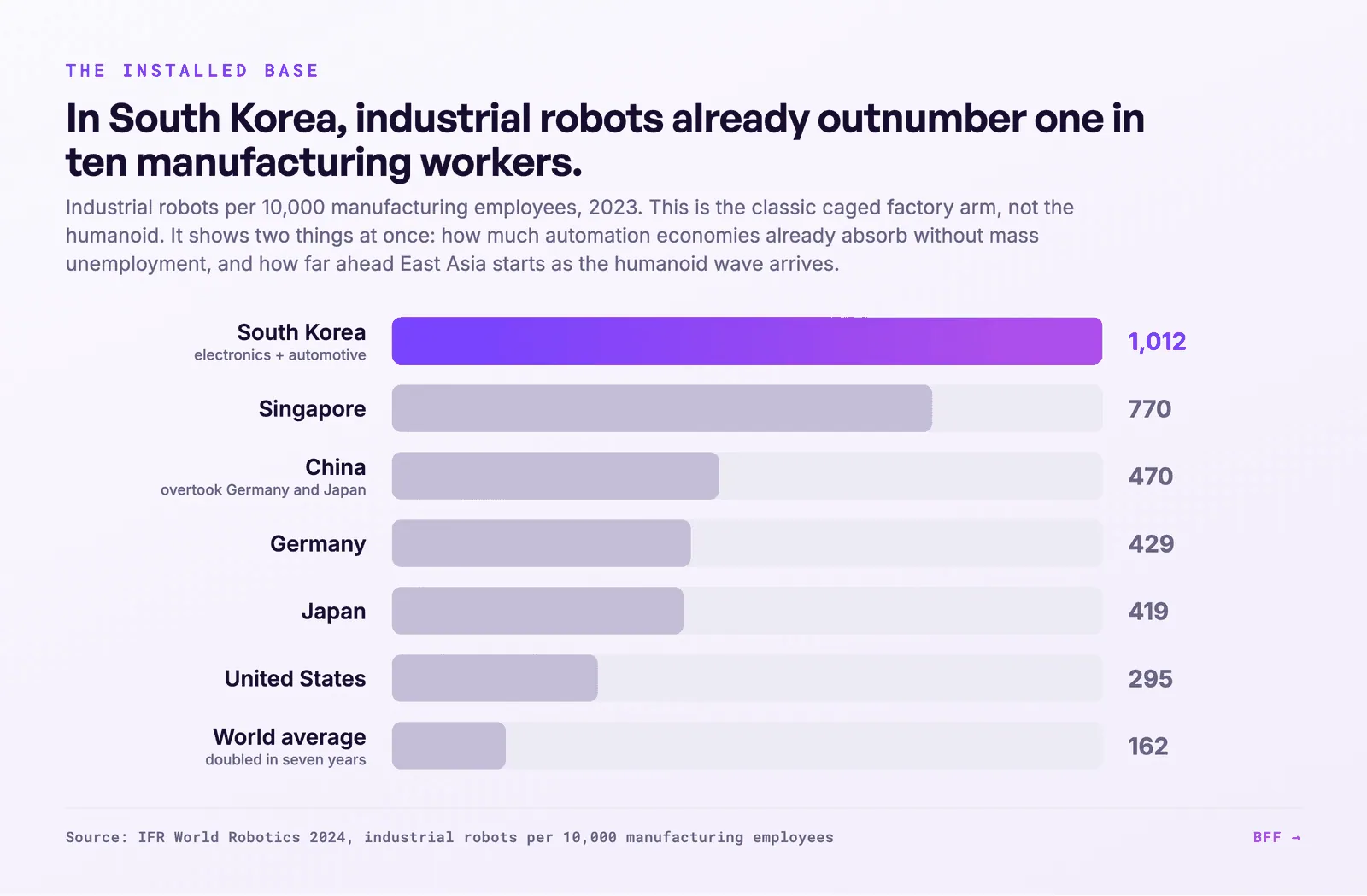
One number that calms the debate down is how much robot labour economies absorb already. That chart is the installed base of classic industrial robots, the caged factory arm, per ten thousand manufacturing workers. South Korea passed one robot per ten workers without the mass-unemployment cliff, and the world average doubled in seven years while logistics employers still could not fill their vacancies. The lesson from the installed base is that adoption tracks cost and reliability, and labour markets bend around it slowly. Humanoids extend that curve into unstructured work. They do not repeal it.
16
15. The other uniform: defence, policing and dual use
Everything in this dossier so far wears a work uniform. The same actuators, the same learned control and the same supply chain also come in camouflage, and a field dossier that skips that is not a field dossier.
A general-purpose robot is dual-use by default, because the payload decides what it is for. China has stopped being shy about the military half. At the Victory Day parade in Beijing on September 3, 2025, armed quadrupeds the state media call robot wolves rolled across Tiananmen Square on transporters, alongside uncrewed ground vehicles and drone systems, and footage from special-forces exercises shows rifle-carrying robot dogs working urban drills. Set that next to the marathon in section four and note that it is the same class of machine.
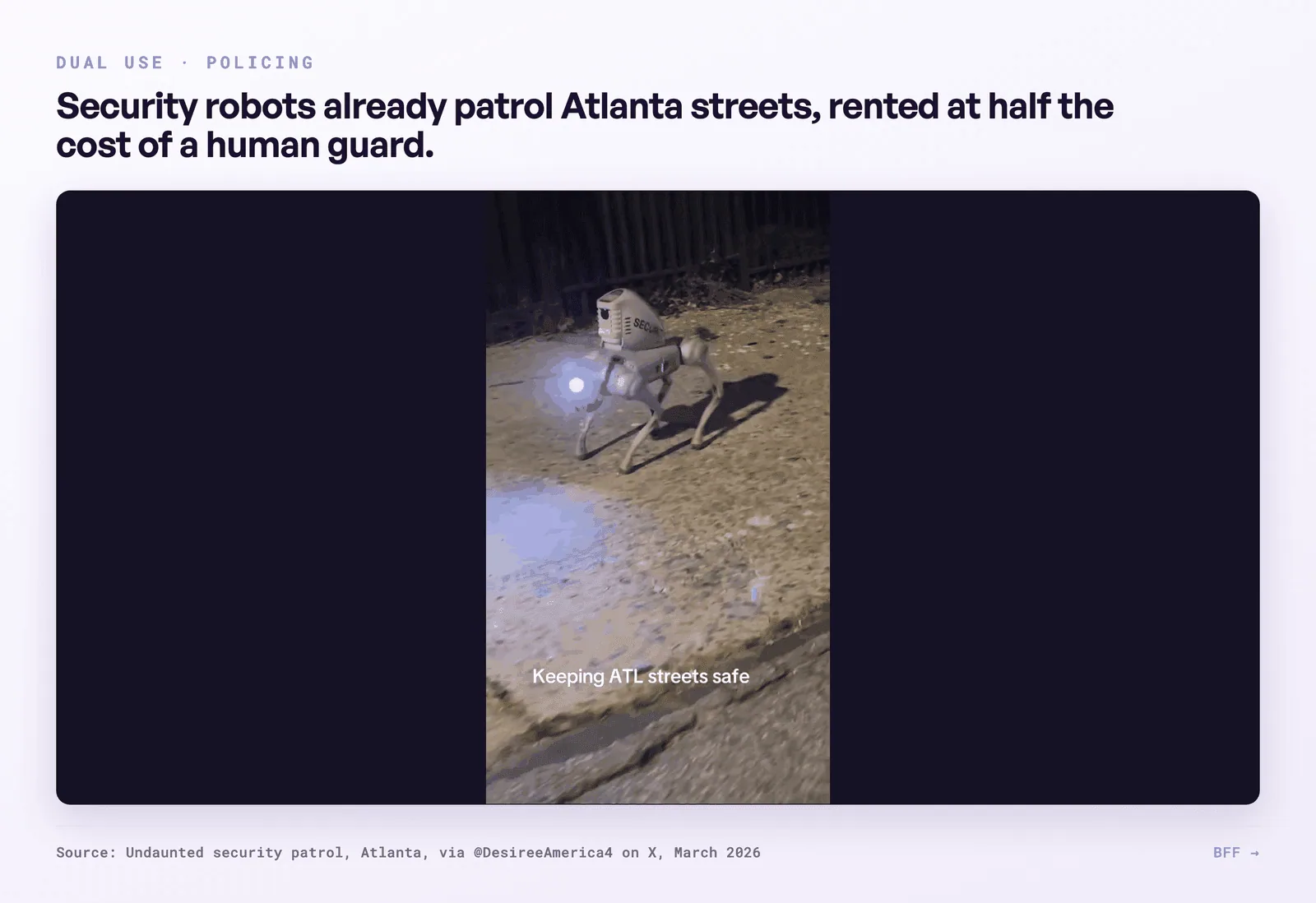
The Western version arrives in a security uniform rather than a military one. New York's police force returned its Digidog to service in 2023 for high-risk situations. In Atlanta, a startup rents out packs of patrol quadrupeds with thermal cameras and sirens to property managers, piloted remotely, at roughly half the cost of a human guard, and occupancy in one complex rose after they cleared out crime. That cost figure is the vendor's own and comes from a single operator, so treat it lightly. Ukraine's battlefield, meanwhile, is normalising uncrewed ground vehicles at industrial pace. None of this is a humanoid yet, and all of it is the same component stack from section eleven wearing its other uniform.
The industry saw this coming and drew a line worth knowing about, mostly for how little it binds. In October 2022, six leading makers, Boston Dynamics and Agility Robotics and ANYbotics and Clearpath Robotics and Open Robotics and Unitree among them, published an open letter pledging not to weaponise their general-purpose robots and asking lawmakers to prohibit misuse. The pledge is real and the signatories have largely kept it. It is also voluntary, it does not bind buyers or integrators, and armed derivatives of pledge-signatory platforms keep appearing at drills and parades, because an open affordable robot is armable by whoever owns it.
Why does this belong in a business dossier? Three reasons. Procurement, because the same bill of materials serves both uniforms, so export rules and telemetry questions and supplier scrutiny from section sixteen land on civilian buyers too. Regulation, because the EU AI Act already prohibits certain uses outright, and how Europe regulates police and security robotics will shape what any legged robot may do in a public space or warehouse or care home. And normalisation, which section four called a leading indicator and which cuts both ways: a public that meets these machines first as armed patrol tools will write the rules for the whole category in that mood.
17
16. Trust: the security and safety gap
A humanoid is a networked, mobile, physically strong computer. In 2025 the field learned that its security posture is closer to a cheap smart-home gadget than to industrial machinery.
In September 2025, researchers Andreas Makris and Kevin Finisterre disclosed UniPwn, a root-level takeover of Unitree robots over the Bluetooth channel used to set them up, affecting the Go2 and B2 quadrupeds and the G1 and H1 humanoids. Worse, every unit shipped with the same hardcoded encryption key, which made the exploit wormable: an infected robot could scan for and compromise other Unitree robots nearby, a self-spreading robot botnet with no human interaction. A separate researcher documented telemetry streaming to servers in China roughly every five minutes. Unitree acknowledged the issue and said it had fixed most of it.
The deeper point is that no mandatory safety-certification regime governs general-purpose walking humanoids the way ISO 10218 governs caged industrial arms, and the escorted-robot image from section eight is the physical face of the same gap. For a European buyer this is a live procurement and liability question rather than a hypothetical.
18
17. What we would watch
Our read: the capability trajectory is real and accelerating, the reliable-labour-at-scale story is years out, and the whole thing is an industrial and geopolitical story at least as much as a technical one.
The breakthrough that matters, learned control, is genuine and is not going backward, which is why we do not dismiss the field. At the same time the near-term reality is factory pilots and teleoperated consumer units, and the marketing routinely erases the difference. Both things are true at once, and holding both is the only sensible posture right now.
For a European audience the sharper question is not whether humanoids arrive. It is who captures the value when they do. If the West keeps inventing the best brains while China builds the bodies and owns the supply chain, the intelligence may be American, the machine may be Chinese, and the continent that wrote the safety rules may find itself buying both. That is not fate. It is a prompt.
So here is the short watch-list. Does a Western bill of materials break 20,000 dollars, or does the cost advantage stay Chinese? Does anyone field a genuinely autonomous deployment, with no teleoperator, running around the clock? Does a European humanoid champion emerge, or does the continent settle for writing the rulebook and buying the machines? And does the reliability gap close from 99 percent to 99.9 percent, the single number separating a clever pilot from a real workforce? Those four questions will tell you more over the next two years than any launch video will.
19
18. Verification and sources
This dossier draws on live web research and a personal archive of more than 15,000 sources. Load-bearing numbers were cross-checked against at least two sources where possible. The notes below flag confidence and the main caveats, in the spirit of showing our work.
| Claim | Confidence | Note |
|---|---|---|
| China shipped ~80-87% of 2025 humanoids | High | Omdia via Bloomberg/Xinhua; SCMP "over 80%". Total ~13,000-18,000 units by source. |
| AgiBot ~5,100 (39% share), Unitree ~4,200-5,500 | Medium-high | Omdia figures; the two are close enough to read as a duopoly. |
| Optimus BOM ~$46k with China, ~$131k without | Medium | Single analysis (Gerra); directionally supported by the 30-60% actuator share. |
| Valuations: Figure ~$39B, Skild ~$14B, Galbot ~$3B | High | Company announcements and Crunchbase, 2025-26. |
| 2026 Beijing marathon: robot 50:26 vs human 1:07:47 | High | Widely reported April 2026; winner Honor Lightning, teleop entry penalised. |
| Human hand ~17,000 mechanoreceptors | Medium | Broad neuroscience literature; Brooks cites "~18 families of touch neurons" rather than the exact count. |
| UniPwn wormable exploit, telemetry to China | High | Makris & Finisterre, Sept 2025; IEEE Spectrum; Unitree acknowledged. |
| Morgan Stanley $5T / 1B+ units by 2050 | Forecast | A projection a quarter-century out, not a measurement. |
| EU ~4.1M health-worker shortfall by 2030 | Medium-high | EU/ISSA/Bruegel projections; a modelled figure. |
| UniStore opened May 7, 2026 with 24 apps + SDK | High | Unitree announcement; CnTechPost, Digitimes, Pandaily. |
| Unitree Shanghai IPO filing, revenue +335% YoY | Medium-high | Filing reported March 2026; revenue ¥1.7B, would be China's first listed humanoid pure-play. |
| Robot density: Korea 1,012 / world 162 per 10,000 | High | IFR World Robotics 2024 (2023 data); industrial robots, not humanoids. |
| Armed "robot wolves" at the Sept 3, 2025 parade | High | Widely reported parade footage; drill footage credited in the caption. |
| Oct 2022 non-weaponization open letter, six signatories | High | Boston Dynamics, Agility, ANYbotics, Clearpath, Open Robotics, Unitree; voluntary, not binding. |
| Atlanta security "packs" at ~half guard cost | Medium | Single operator's claims via public reporting; cost figure is the vendor's. |
Photographs and video stills in this dossier are frames from publicly posted footage, credited to the original account in each caption. On the web edition these can be replaced with the live posts. Charts labelled "BFF" are our own, drawn from the sources named beneath them.
Dossier as pdf
Download this dossier
The full dossier as a pdf, with every figure and the source list. Fill in your details and the download starts right away.

Ruben Horbach
Co-founder · Back From the Future
Ruben researches how organisations adopt AI meaningfully — not as technology, but as a change in work and people. He builds the agent infrastructure behind BFF and speaks about the near future of work.