
01
Why this, why now
In the space of eight months, the most quoted number in enterprise AI was born, moved billions in market value, got quietly deleted, and was publicly dismantled. Meanwhile the technology it described kept getting an order of magnitude cheaper every year. That collision is the story of this dossier.
Every boardroom now holds two beliefs at once. The first: AI is everywhere, our people use it daily, we have pilots running. The second: we cannot point to a line in the P&L that AI improved. Both beliefs are correct, and the distance between them has become the defining management question of this technology cycle.
I went into this expecting to adjudicate a fight. The MIT claim that 95 percent of AI pilots fail had been sitting in every sceptic's opening move for the better part of a year, and a16z had just published a number that seemed to say the opposite. What I found instead was that the two sides were never measuring the same thing, and that the honest reading underneath them is harder and more useful than either headline. Adoption is now the minimum for staying in the game. Profit belongs to a small group that reorganised work around the machine.
This dossier walks the numbers, takes apart why pilots die, and ends with what we would actually do about it. Where the evidence is thin we say so, and the verification table at the back records how far we would push each claim.
- Aug 2025 — Fortune headlines an MIT-branded claim that 95 percent of GenAI pilots return nothing. AI stocks wobble.
- Sep 2025 — After 29 days, the report disappears from MIT's website. The number stays in circulation.
- Nov 2025 — McKinsey's State of AI: 88 percent of firms use AI, 6 percent see real profit impact.
- Jan 2026 — Exponential View publishes its forensic teardown. MIT calls the report "unpublished, non-peer-reviewed work."
- Apr 2026 — a16z counters with hard data: 29 percent of the Fortune 500 are live, paying customers of AI startups.
- 2026 — Agents enter the enterprise. 62 percent of firms are experimenting; 21 percent have governance ready for them.
02
1. The number that moved a market
On August 18, 2025, Fortune reported that an MIT study had found 95 percent of corporate GenAI pilots failing to produce any return. Within days the number was in every deck, every board pack and every sceptic's standard repertoire.
The report behind the headline was called "The GenAI Divide: State of AI in Business 2025," produced under MIT's Project NANDA. Its opening line did the damage: despite 30 to 40 billion dollars of enterprise investment in generative AI, "95% of organizations are getting zero return." The methodology sat further down: 52 executive interviews, 153 leader surveys and a review of about 300 public AI deployments, all gathered between January and June 2025. Those three figures matter, because section 2 is largely about what happens when they get mixed together.
What gets lost in the retelling is that the report's own diagnosis was organisational rather than technical. Companies buy or build static tools that demo well, the authors argued, then discover the tools cannot remember context, adapt to feedback, or fit the way work actually flows. They called it the learning gap. That part of the report has held up rather well, and this dossier leans on it more than once.
The market reaction was real. Coming days after a summer of record AI capital spending, the claim that almost none of it lands as profit spooked investors and knocked AI-linked stocks. The number then began to travel on borrowed authority, cited as "MIT research" in speeches, investment memos and procurement debates, usually without a footnote. By late 2025 it had become the standard opening move of every AI sceptic in every strategy meeting in the Western world.
03
2. The autopsy of "95 percent"
In January 2026, Azeem Azhar's Exponential View published a months-long forensic trace of the number, including correspondence with the authors and with MIT itself. The verdict: viral, methodologically weak, and buried under its own caveats.
The provenance is worth following, because the details change what the number means. The report was a preliminary draft, never peer-reviewed. It lived on an MIT web domain for 29 days, from August 18 to September 16, 2025, and was then removed. The PDF that still circulates carries MIT branding and has no canonical home. When Exponential View pressed the institution, MIT Media Lab's faculty director described it as "a preliminary, non-peer-reviewed piece," and MIT's media relations office eventually put it in writing: "It was unpublished, non-peer-reviewed work."
The statistics inside are shakier than the provenance. The first thing I went looking for was the sample size, because it is the part almost nobody checks. The core sample was around 52 interviews. Ninety-five percent of 52 is 49.4, and you cannot have four tenths of an organisation, so the underlying count is either 49 or 50. That alone puts the real figure somewhere between roughly 94 and 96 percent before any sampling question is asked. Run the interval properly on a sample that size and the honest range around "95 percent" spans the high 80s to 100. The report published a single number with no interval at all.
Then there is the denominator, which shifts between pages. At one point the failures include organisations that never attempted the tool category being measured. Counting those as failures is like noting a plane crash for someone who was not booked on the flight. Re-run the arithmetic with the report's own figures and a defensible denominator, meaning pilots that were actually launched, and the success rate lands near 5 in 20, about a quarter, with wide error bars either side.
The fieldwork window compounds it. January to June 2025 judged eighteen-month rollouts and three-month-old pilots by the same yardstick, in a market where enterprise AI spending was tripling per year. Azhar's conservative rewrite of the whole picture: by early 2025 perhaps one in seven organisations was already seeing measurable gains, and possibly more. For a technology that entered the corporate bloodstream in late 2023, that is a diffusion success story wearing a failure headline.
"The '95 percent' figure should be treated for what it is: not reliable. It is viral, vibey, methodologically weak and it buries its caveats." — Exponential View, "How '95%' escaped into the world," January 2026
We would hold the corrected figure loosely. It is a re-derivation from a flawed report's own numbers, and the raw data has never been shared, so the range around it is wide and our verification table marks it medium confidence at best. None of this makes the report worthless either. The lesson is narrower than "MIT was wrong": the headline number was a temperature check dressed up as a measurement, and it moved capital for half a year before anyone checked its pulse.
04
3. The counter-claim, and the honest adjudication
In April 2026, a16z compiled the opposite dataset: 29 percent of the Fortune 500 are live, paying customers of leading AI startups. Signed contracts, converted pilots, production usage. So who is right?
Both are, and that is the actual finding. The a16z report measured something deliberately hard: enterprises that signed a top-down contract with an AI startup, converted the pilot, and went live. By that bar, 29 percent of the Fortune 500 and roughly a fifth of the Global 2000 were paying customers within about three years of ChatGPT's launch. That is a penetration speed enterprise software has never seen; historically, startups needed years before their first Fortune 500 logo. Demand concentrates where value is legible, with coding an order of magnitude ahead of everything else, customer support and search behind it, and adoption no longer confined to tech-forward sectors.
One caveat we would attach before anyone quotes it back: a16z is a venture firm with capital in the category it is counting. That does not make the figure wrong, and the bar it set is stricter than most survey definitions. We would still weigh it as an interested party's count rather than an independent census, which is roughly how we weigh the MIT figure in the other direction.
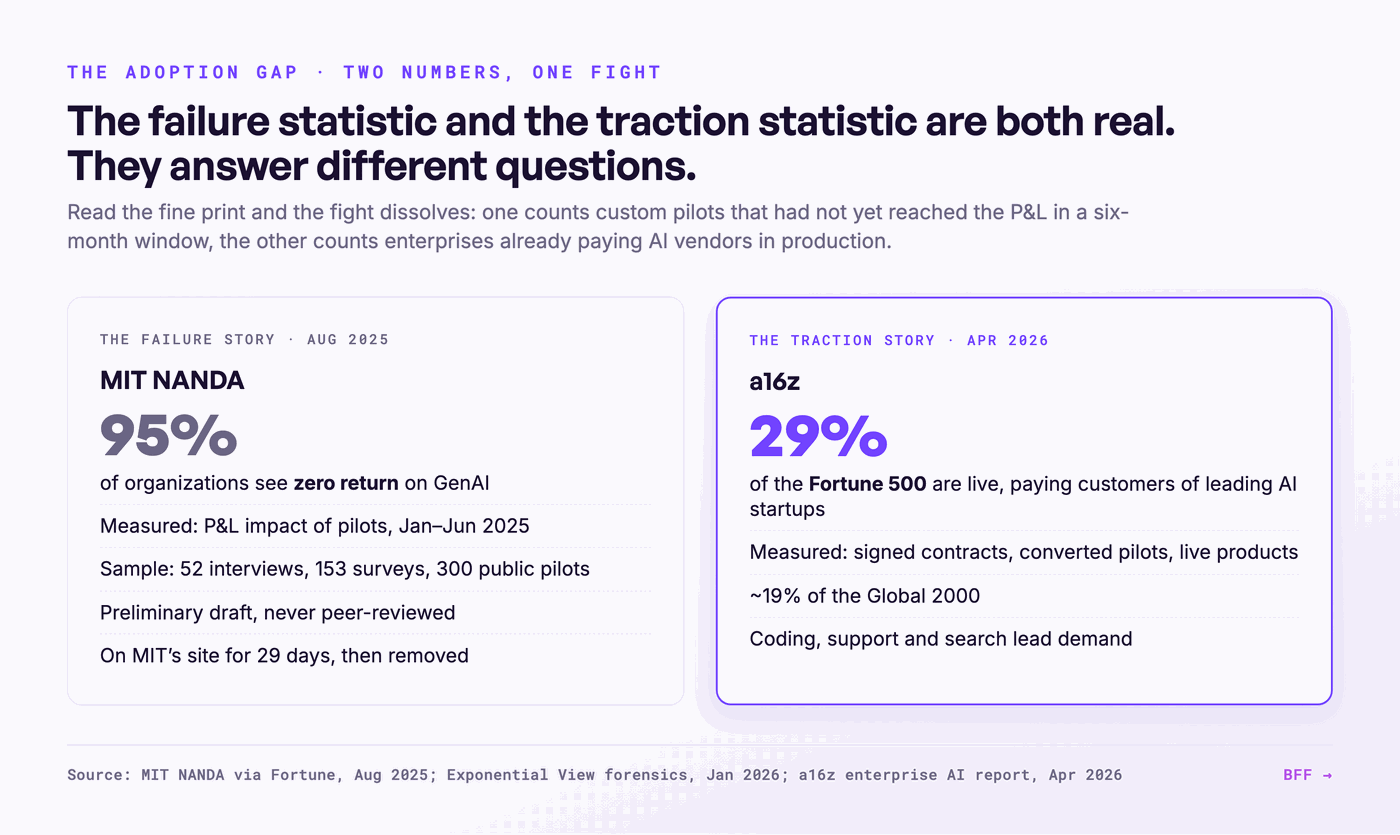
When I put the two reports side by side, the contradiction evaporated within about ten minutes. MIT NANDA asked, in effect: of the custom GenAI pilots running in early 2025, how many had already produced measurable P&L impact? Answer: few, on a flawed sample, in a window arguably too short for P&L impact to appear at all, and possibly too short to measure even if it had. a16z asked a different question: how many of the world's largest enterprises are paying real money for AI products in production? Answer: a remarkable share, and more every quarter.
A pilot that has not yet reached the P&L and a signed production contract are different units, drawn from different denominators, at different moments of a steep curve. The fight was never about the facts. It was about which question you wanted answered, and both camps found a number that answered theirs.
05
4. What "adoption" actually measures
McKinsey's State of AI survey, published November 2025 with nearly 2,000 respondents across 105 countries, is the cleanest single picture of the gap. Read it as a funnel, and read the funnel as a diagnosis.
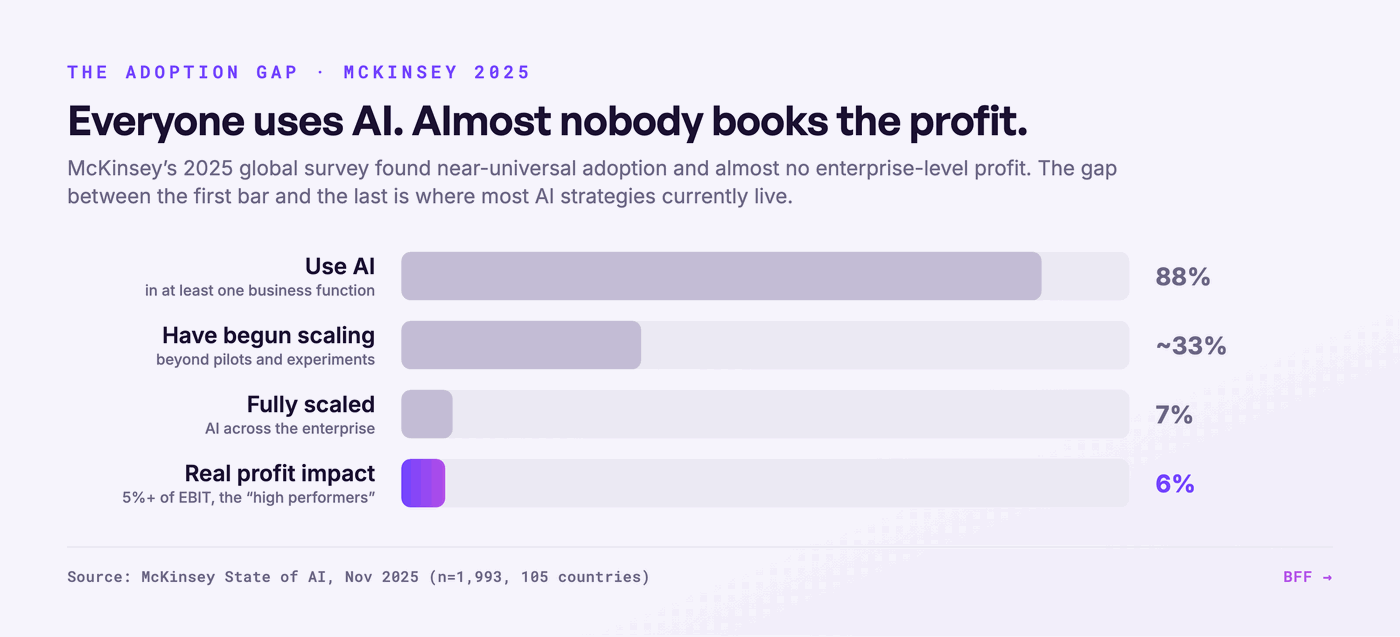
The chart carries the shape, so read the drop-offs rather than the bars. Eighty-eight percent of organisations use AI in at least one business function. By the bottom of the funnel, the group McKinsey calls high performers, meaning firms attributing a material share of EBIT to AI and treating it as a growth engine rather than a cost tool, is 6 percent of the sample. That is the honest size of the winners' circle in late 2025. In between, 39 percent report any EBIT effect at all, and most of those put it below 5 percent of earnings.
The expensive step is the one between using AI and scaling it. Answering yes to "do you use AI somewhere" costs nothing, since one team on Copilot qualifies. The stages below it measure progressively more costly truths: redesigned workflows, retired processes, earnings you can point at. That distance is not a technology gap. Individual usage keeps climbing on its own, with Gallup finding frequent AI use among US workers nearly doubling in two years, while the organisational numbers crawl. People adopt in weeks. Organisations adopt in years. The funnel is a picture of that mismatch.
One more McKinsey finding belongs here, because it predicts the rest of this dossier: the high performers are three times more likely to have senior leaders who personally own the AI agenda, and they set growth ambitions for it rather than cost-cutting targets. We would put medium-high confidence on that particular multiple, since we are reading it through secondary summaries rather than the underlying tables. The direction is not in doubt though, and it recurs in every other source we checked. The profile of the 6 percent is not "bought better software." It is "run by people who redesigned the work."
06
5. Zoom out: most of humanity has not even started
Inside the tech bubble, AI feels saturated and the race feels lost. One zoom-out sets that feeling straight: 84 percent of the world's population has never used AI at all.
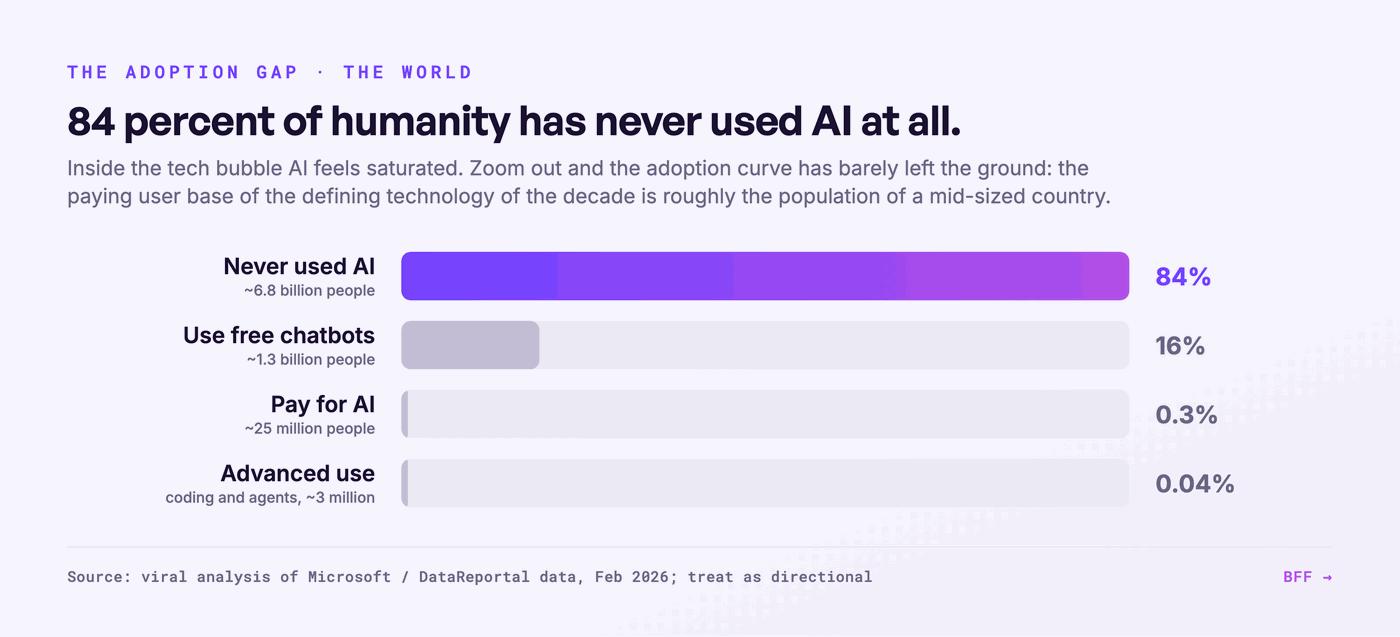
The breakdown that circulated in February 2026, built on Microsoft and DataReportal data, puts roughly 6.8 billion people at zero AI usage, about 1.3 billion on free chatbots, around 25 million paying for an AI service, and a few million using AI in advanced ways with agents and code. This is probably the weakest evidence in the dossier and I flag it as such: it is a viral analysis rather than a census, it may well be off in either direction, and I would not defend any single figure in it to the decimal. The shape is what matters, and the shape is a pyramid with an extremely narrow top. The paying user base of the defining technology of the decade is roughly the population of Australia.
For a business audience the pyramid cuts two ways. It kills the excuse of lateness, because the curve has barely left the ground and the sense that everyone is already doing this is mostly an artefact of who you follow online. It also sets up the more uncomfortable reading in section 9: even inside organisations, the real usage sits in the free-chatbot layer, broad and shallow and unmanaged. Depth lives at the top of the pyramid, and so do the 6 percent. Both readings point the same way. The game is early, and the advantage goes to whoever builds depth first.
07
6. The anatomy of a dead pilot
Strip the numbers away and ask the mechanical question: what actually kills an AI pilot? The research keeps returning four causes, and none of them is model quality.
Cause one: the tool cannot learn
MIT NANDA's most defensible finding: organisations buy or build static tools that demo brilliantly and then never improve. No memory of context, no feedback loop, no fit with the daily workflow. The winners in the same sample deployed systems that learn from use, plug into real workflows and get better over time. A pilot without a learning loop has a shelf life of exactly one wow-moment.
Cause two: the organisation does not know its own process
Ethan Mollick's favourite framing borrows the garbage can model from organisational theory: companies are semi-chaotic containers where problems, solutions and decision-makers collide, and nobody fully knows how work actually happens. His sharpest anecdote comes from researcher Ruthanne Huising, whose teams, assigned to map their own company's processes, routinely discover that no one at any level knows the whole picture. Now hand that organisation an automation project that requires the process to be specified. The pilot dies in the mapping phase.
Cause three: congestion
Exponential View's May 2026 analysis names the subtler killer. AI speeds up individual output, so developers ship half as much again and sales drafts proposals overnight. All of it then queues at the same human decision gates as before: review cycles, sign-offs, legal. Output accelerates, throughput does not, and the gains evaporate in the waiting room. Adding more AI to a blocked decision pipeline makes the blockage worse.
Cause four: the productivity paradox at the desk
An Upwork study found 47 percent of AI-using workers unsure how to achieve the gains their employer expects, and 77 percent saying the tools had added to their workload in at least one way. Tools handed down without redesigned expectations produce visible activity and invisible drag. The pilot "succeeds" as usage and fails as economics.
Four causes, one theme: the model was never the constraint. Every failure mode above is a property of the organisation, which is why buying a better model fixes none of them, and why the headlines built on failure rates keep misleading. The failure rate measures organisational readiness while being quoted as a verdict on the technology.
08
7. What the six percent do differently
The winners' playbook is remarkably consistent across McKinsey's high performers, Mollick's field work and the case studies: redesign the work, own it at the top, and connect the tinkerers to the strategy.
Mollick's operational frame is Leadership, Lab and Crowd, and it is the most useful three-part model we have found for this problem. Leadership means executives who paint a concrete picture of how work changes and put their own name on it, which is the behaviour McKinsey independently associates with a threefold improvement in the odds of scaling. The Lab is a cross-functional team that turns promising hacks into tested, benchmarked workflows. The Crowd is the workforce already experimenting, roughly 40 percent of employees by Mollick's reading of the surveys, mostly in silence. Each leg fails alone. Leadership without a lab is a memo. A lab without the crowd is a silo. A crowd without leadership stays underground. The 6 percent, in various vocabularies, run all three.
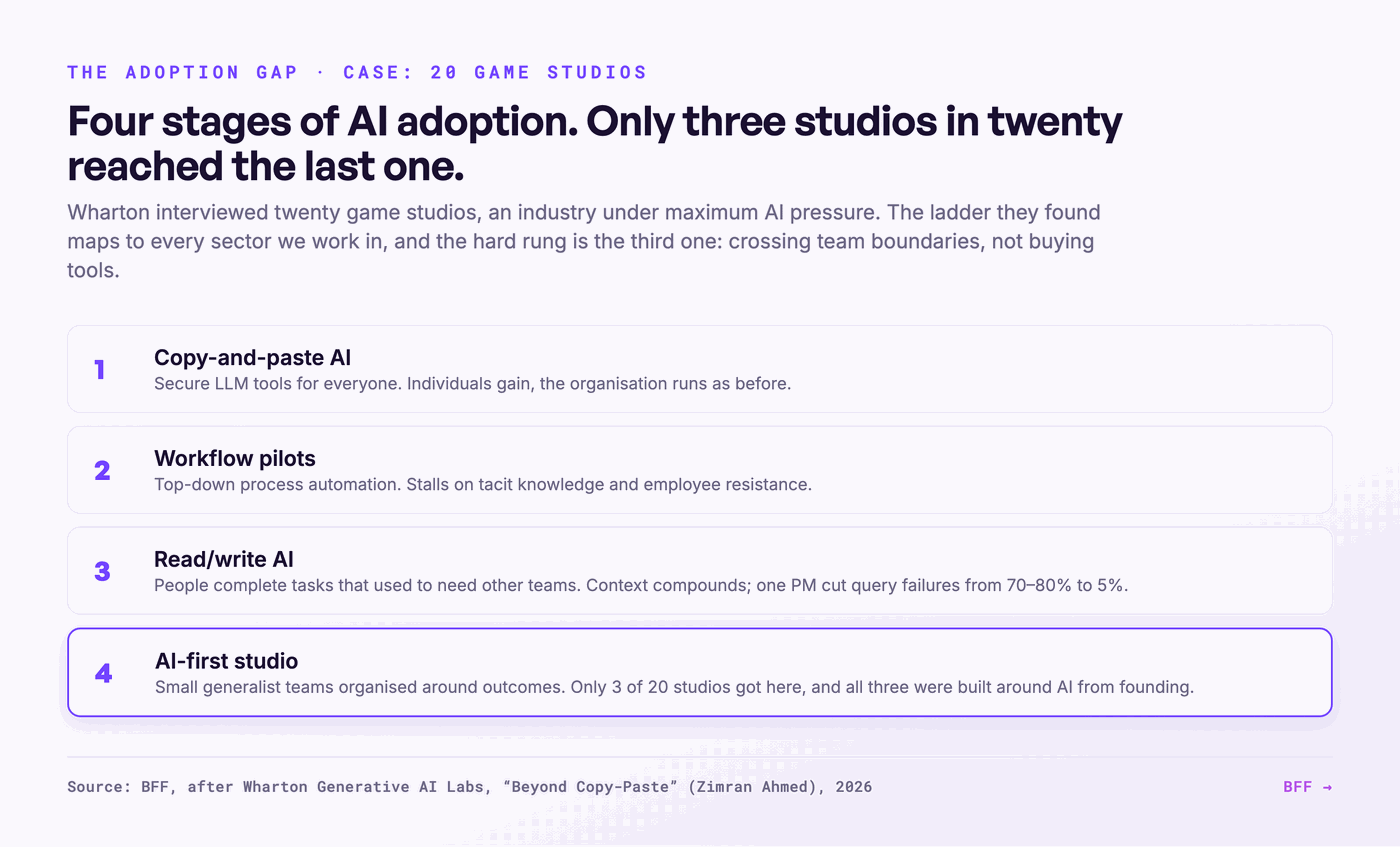
The best recent case anatomy comes from Wharton's Generative AI Labs, which interviewed twenty game studios, an industry where AI pressure arrived early and hard. The studios sorted onto a four-stage ladder: secure chatbots for everyone, then top-down workflow pilots, then the interesting stage where individuals use AI to cross team boundaries and context starts compounding in shared documents, and finally the AI-first studio, small generalist teams organised around outcomes.
Two details deserve a highlight. The classic pilot stage is where progress stalls on tacit knowledge and resistance, which is exactly what the garbage can model predicts. And only three of the twenty studios reached the top rung. All three were built around AI from their founding. Nobody in the sample rebuilt an existing organisation to get there; the ones that arrived had started there.
That last fact is the uncomfortable one for every established company, and it sets the bar honestly. Twenty studios in one industry is a small sample, it may not generalise beyond games, and we would not treat it as a law. But the question it raises is the right one: can an incumbent do deliberately what those three studios did by birth? The Monday-morning section is our answer.
09
8. The agent complication
2026 is the year agents, meaning AI that executes multi-step work rather than answering questions, arrived in the enterprise. They raise the ceiling on the prize and the price of the same old organisational gaps.
The numbers first. McKinsey found 62 percent of organisations at least experimenting with agents by late 2025, with 23 percent scaling them, concentrated in IT and R&D. Deloitte's 2026 State of AI survey adds the warning label: close to three quarters of companies plan to deploy agentic AI within two years, while 21 percent report a mature governance model for autonomous systems. An agent is an employee-shaped piece of software with no manager. Most organisations are hiring thousands of them without an HR department.
The field reporting is more instructive than the surveys. Box CEO Aaron Levie, after a road tour of enterprise IT leaders in April 2026, described the shift from "let a thousand flowers bloom" chat deployments to targeted automation of specific workflows, and catalogued what actually occupies the adopters. Change management came first. Then "tokenmaxxing," the very real budget fights over compute, with one company running a shark-tank for token allocations. Then decades of legacy systems that agents cannot reach. And running through all of it, a firm consensus that the use cases are new capacity rather than headcount removal, work the company could never prioritise before. One company now has a head of AI in every business unit reporting to a central team. His meta-observation is the one we keep coming back to: agents made the work more technical, with Skills and MCP servers and command lines, so diffusion needs engineers, and everyone is working more than ever.
"Most companies are not talking about replacing jobs due to agents. The major use-cases are things the company wasn't able to do before. More emphasis on ways to make money vs. cut costs." — Aaron Levie, field notes from enterprise visits, April 2026
We quote Levie as testimony rather than measurement. It is one executive's structured field reporting from a self-selected set of visits, which is a different evidential class from a survey, and we mark it that way in the verification table. It is also the closest thing to a look inside the adopters that anyone published this year.
Mollick adds a genuinely open strategic question in "The Bitter Lesson versus The Garbage Can": will agents need organisations to understand their own processes, or will they train on outcomes and route around the chaos? If the second turns out to be right, the garbage can stops being a moat for incumbents who at least knew their own mess. We do not know the answer, and it decides how much of section 6 survives the decade. Workforce effects we deliberately park here. McKinsey records 30 percent of firms expecting reductions, and that question gets its own dossier in this series, on entry-level work.
10
9. Shadow AI: the crowd already adopted
While the official pilot waited for the steering committee, the workforce went ahead. The most reliable adoption in most companies is the one nobody approved.
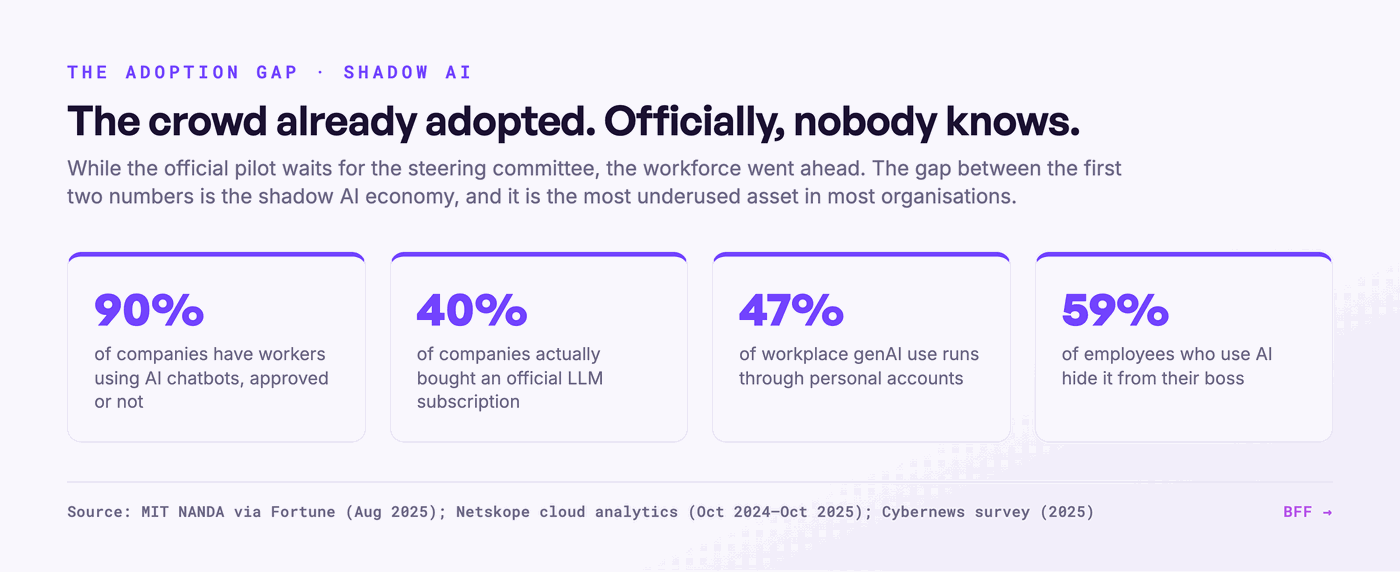
The same MIT NANDA research that produced the 95 percent headline contained a finding that has aged far better. Workers at over 90 percent of companies were regularly using personal AI tools for work, while only around 40 percent of companies had bought an official subscription. Netskope's cloud analytics, measured rather than surveyed, put nearly half of all workplace generative AI usage on personal accounts through 2025, which is the number in this cluster we trust most because it observes behaviour instead of asking about it. Survey figures on how many employees hide their usage vary by source; the one we cite sits at 59 percent, and the honest read is a clear majority rather than a precise share.
Security teams read those numbers as an incident report, and they have a point: unmanaged accounts, unknown data flows, no audit trail. Strategically, though, the shadow economy is the best free asset an organisation has. It is a completed, self-funded pilot programme. It shows exactly where AI already works, run by exactly the people who found it worth the career risk.
The employees hiding their usage are the Crowd from section 7, driven underground by fuzzy policy and misaligned incentives. Look at the reward they actually observe for showing their AI workflow: more work at the same pay, or an awkward conversation about whether the job is needed at all. Given that, hiding is the rational move, and the policy is what needs fixing.
The winners flip the incentive. Amnesty for past use, explicit permission with clear data rules, and visible rewards for shared workflows: an #ai-wins channel, office hours run by the power users, recognition that treats a discovered workflow as a contribution rather than a confession. The cheapest AI strategy available to any company this year is to surface the adoption it already paid for.
11
10. Efficiency theatre and the decision loop
The subtlest failure mode is succeeding at the wrong metric: visible busyness, faster drafts, impressive usage dashboards, and a P&L that never moves. History has a name for the fix, and it comes from electricity.
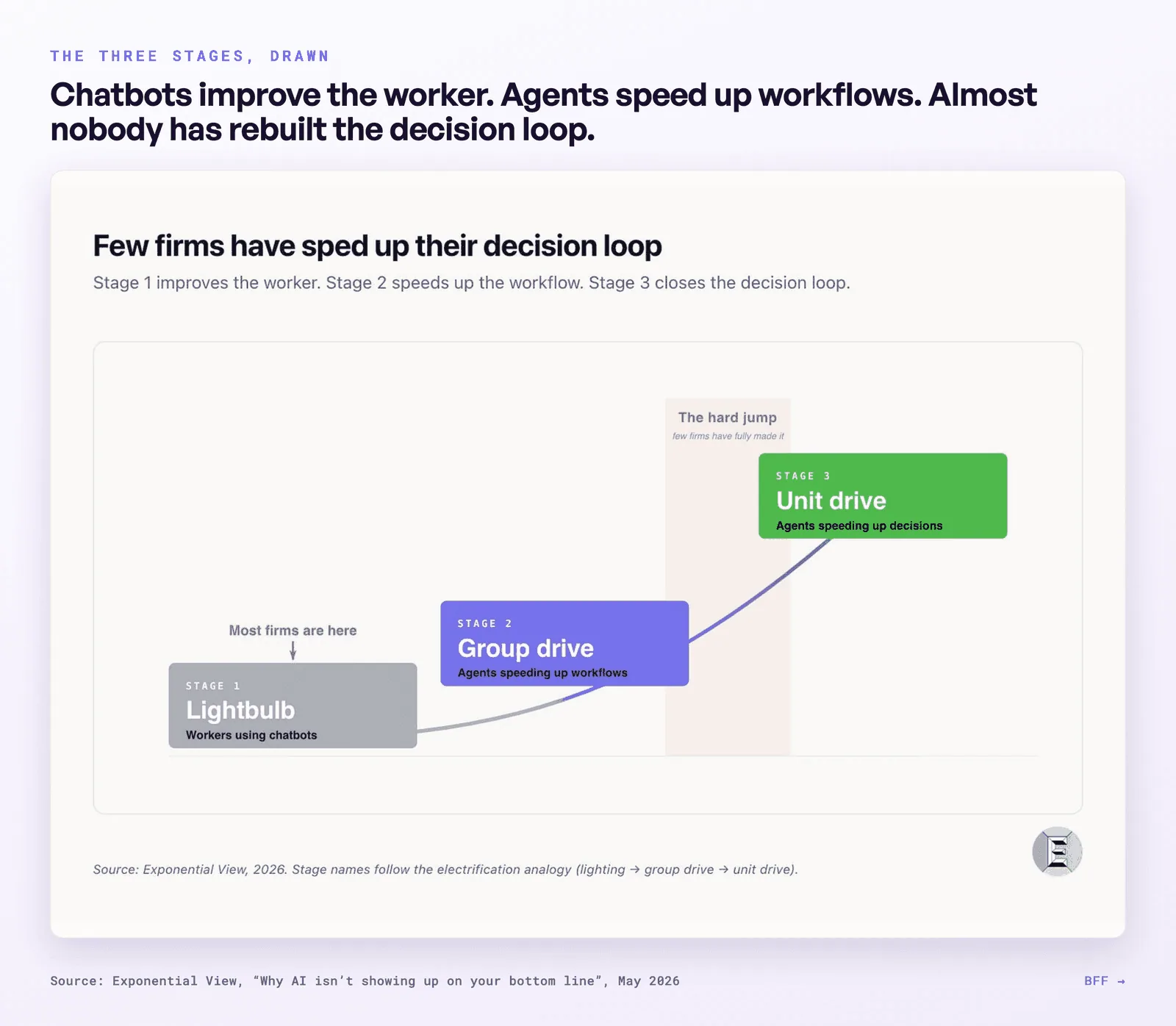
Exponential View's framework, built on the classic study of factory electrification, gives the gap its cleanest structure. Factories first replaced steam engines with electric motors and saw little gain, because they ran the new power through the old layout of shafts and belts. The transformation arrived only when engineers gave every machine its own motor and redesigned the floor around the workflow.
AI is repeating the pattern in three stages. The lightbulb stage is workers using chatbots for personal productivity. The group-drive stage is agents accelerating existing workflows. The unit-drive stage is where the decision loop itself, observe and evaluate and act, gets rebuilt around the machine and weeks compress into hours. Most firms appear to be at stage one. Around a quarter of executives say AI has met their ROI expectations, which is roughly what you would expect when new power runs through old shafts.
The cautionary tale for skipping the redesign and simply cutting is Klarna. In early 2024 the fintech announced its AI assistant was doing the work of 700 customer-service agents, and froze hiring. By May 2025, CEO Sebastian Siemiatkowski conceded the company "went too far." Cost had dominated the decision, quality dropped, complaints rose, and Klarna began hiring humans back into a hybrid model, with AI handling routine volume and people handling complexity, emotion and judgment.
The lesson is precise, and it is not "automation failed." Klarna automated the existing workflow to save money instead of redesigning the service around what each side does best. Group drive mistaken for unit drive, and the P&L punished the difference. The redesigned hybrid, worth noticing, kept most of the automation.
12
11. Europe and the Netherlands
Europe's version of the gap comes with better news than the continent's AI reputation suggests, and a familiar warning inside it.
The number that defined European AI pessimism was Draghi's: 13.5 percent of EU enterprises had adopted AI as of 2024, cited across the competitiveness debate as proof the continent was missing the wave. When I went to check whether it still held, the 2025 Eurostat release had already moved it. One fifth of EU enterprises with ten or more employees now use AI, a jump of 6.5 points in a single year and the fastest gain since measurement began. The Netherlands sits fifth in the EU-27, with a third of Dutch enterprises formally using AI.
| Enterprise AI use, 2025 | Share | Note |
|---|---|---|
| Denmark | 42.0% | EU leader |
| Finland | 37.8% | Second |
| Sweden | 35.0% | Third |
| Belgium | 34.5% | Fourth |
| Netherlands | 33.2% | Fifth of the EU-27, up from the low twenties a year earlier |
| EU-27 average | 20.0% | Up from 13.5% in 2024, the Draghi number |
| Romania | 5.2% | EU tail |
| Large EU enterprises | 55% | Versus 30% of medium and 17% of small firms |
Now apply this dossier's funnel logic to those numbers, because "uses AI" is the same top-of-funnel question McKinsey asked, measured a little more strictly. If the McKinsey ratios hold even loosely, the share of Dutch firms with real earnings impact is a low single-digit percentage, and the European share is lower still. We are stacking one survey's ratios onto another survey's base here, which is an estimate rather than a measurement, and we would not put a decimal point on it. The European gap is therefore double: fewer firms in the funnel at all, and the same organisational drop-off inside it.
The honest strategic read for a Dutch business mirrors the robotics dossier's conclusion about hardware. The models are American, increasingly the applications are too, and waiting for a European stack is a strategy for buying both later at retail. The counter-move is also the same. Adoption speed and workflow depth are sovereignty you can build in-house, on any model, starting now. A Dutch firm at stage three of the electricity ladder beats an American competitor at stage one, whatever flag the model flies.
13
12. The gap is organisational. The clock is exponential.
Here is the fact that turns the adoption gap from an interesting survey result into a strategic emergency: while organisations stood still, the technology got two orders of magnitude cheaper.
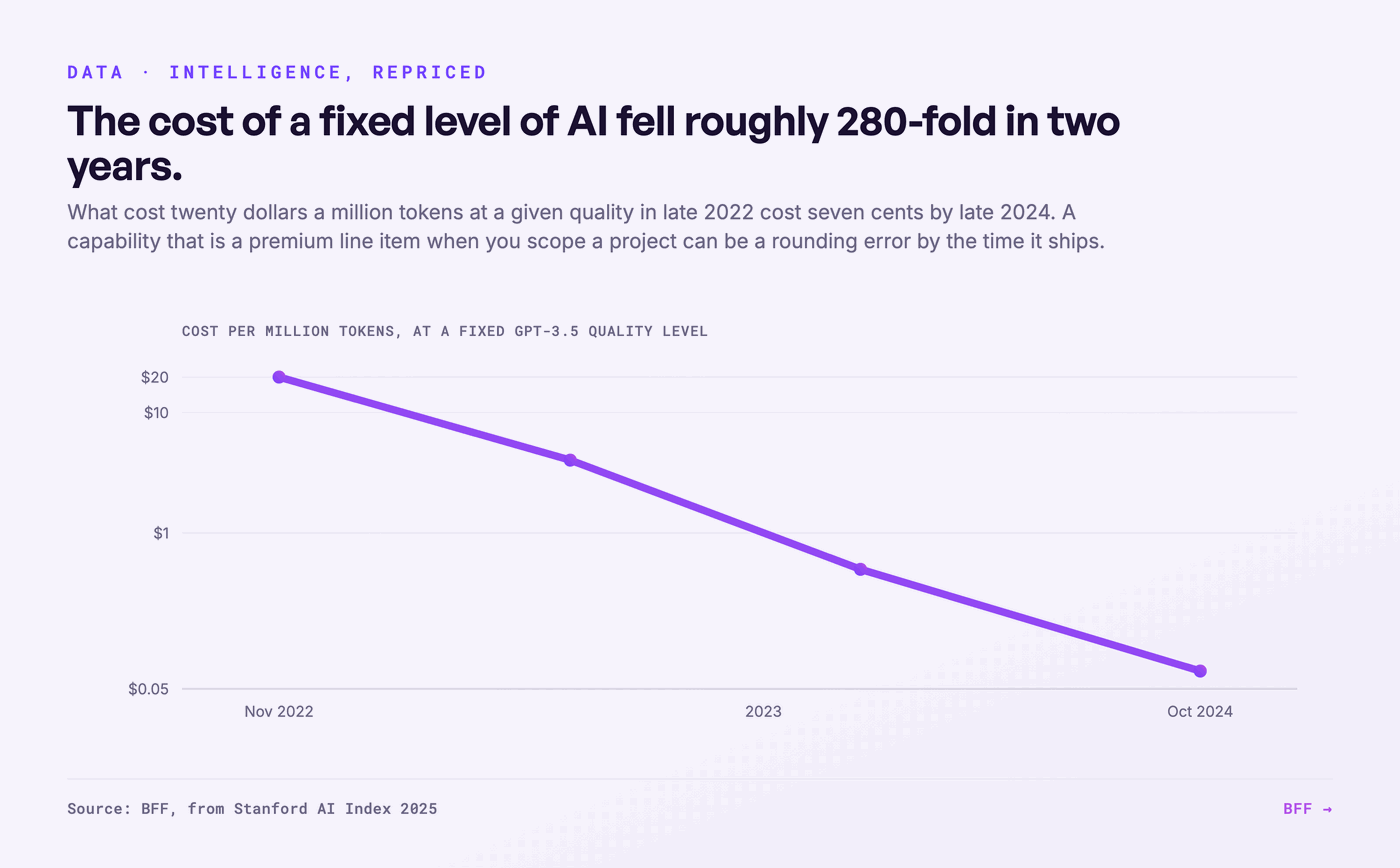
The chart is borrowed from this series' exponentials dossier, where we treat the whole curve family in full. The single line to retain: GPT-4-class output fell from roughly 20 dollars to roughly 7 cents per million tokens in three years, about a tenfold cost drop per year, while capability rose.
Held against section 6, the failure modes look different. Every one of them was diagnosed against last year's price and last year's capability. The pilots that died in 2024 were attempted with tools ten to a hundred times worse per euro than what is available as you read this. Menlo Ventures measured enterprise AI spend growing 3.2x in 2025 alone, so the buyers are plainly not waiting for the debate to resolve.
This is also why the gap does not close by itself, and why "we tried it and it didn't work" is the most expensive sentence in corporate AI. PwC's 2025 jobs barometer tells the compounding story from the labour side: since 2022, revenue per employee in the industries most exposed to AI grew 27 percent against 9 percent in the least exposed, and AI-skilled roles carry a 56 percent wage premium. That is a correlation across industries rather than a measured effect, and exposed industries differ in plenty of ways that have nothing to do with AI, so we read it as a direction rather than a dividend. The distance between the 6 percent and everyone else is not holding still. It compounds at the rate of the underlying curve, which is the fastest cost collapse in the history of any general-purpose technology. Organisational change runs on calendar time. The technology runs on exponential time. Every quarter of hesitation is priced at the difference.
14
13. What we would do on Monday
Our read, and our practice: treat the gap as the opportunity, because the hard part is organisational and the organisational part is learnable. Here is the playbook we run with clients, mapped onto the evidence in this dossier.
First, see it. Nothing moves an organisation like watching its own work done differently. Skip the abstract awareness deck and demonstrate a live workflow from your own company, rebuilt, in front of the people who run it. This is the Leadership leg: a vivid, specific picture, owned by name at the top, which is the behaviour McKinsey's data ties to a threefold improvement in the odds of scaling. Deadlines help more than visions. One consultant we rate opened a workshop by replacing a client's "everyone tries one AI task by July" mandate with "by end of day," and had compliance by dinner. That is one anecdote and we offer it as one, though it matches what we see whenever a deadline replaces an ambition.
Second, understand it. Before automating anything, find out what your organisation actually does, and accept that the org chart is fiction. Surface the shadow economy with amnesty and rewards, because the evidence in section 9 says your best pilot results already exist, unlabelled, on personal accounts. Stand up a small Lab, cross-functional and senior enough to retire a process, and let it benchmark the crowd's discoveries against real workflows. This is also where the honesty gates live: define what the machine may decide alone, what a human signs, and what stays human, before scale rather than after the first incident.
Third, adopt it, by workflow rather than by tool. Pick decision loops where congestion visibly bleeds money, like quote-to-contract or applicant-to-interview or brief-to-published, and rebuild the loop end to end, approval gates included, with a learning system in place of a static tool. Measure EBIT-adjacent outcomes: cycle time, cost per unit, revenue per employee. Never "usage." Kill pilots that only produce activity, and expect the third one to work.
We run this on ourselves and publish the results. Our own content operation went through exactly this arc: individual tools, then a redesigned pipeline with human approval gates, then autonomous loops with honest metrics. The numbers are public in this series' pipeline dossier, and they come from our own analytics rather than an estimate: 694,527 impressions in a half year, up 429 percent, at a marginal cost near zero, run by a team whose evenings got quieter rather than busier. The tools were not special. The workflow was redesigned around them. That is the whole trick, and it is available to any organisation willing to do the unglamorous middle part.
15
14. What we would watch
Our position: the adoption gap is real, the failure narrative built on it is not, and the next 24 months decide who compounds. Four questions will tell you most of what matters.
The 6 percent. If McKinsey's high-performer share climbs toward 15 or 20 percent by 2027, the playbook is diffusing and the window for easy differentiation is closing. If it stays pinned where it is while usage saturates, the organisational barrier is harder than we have argued here, and the AI-first insurgents from the Wharton sample become the main threat instead.
The agent governance ratio. Three quarters of firms deploying agents against one fifth governing them is a gap that produces incidents, and the first spectacular one will set regulation and boardroom mood for years.
The European catch-up rate. A jump of 6.5 points in a year is a real slope. Two more years of it and the European pessimism trade stops paying.
Your own measurements. The moment a company measures AI in EBIT terms rather than usage terms, it has left efficiency theatre. That one you can check on yourself this week.
The last word goes to the number that started it all. The 95 percent was wrong in its details and right in its warning, because most organisations are indeed not yet profiting from AI. Where the headline said the technology fails, the evidence says the organisation decides. We will be watching the high-performer share, and we will report what it does.
16
15. Verification and sources
This dossier draws on live web research and a personal archive of more than 15,000 sources. Load-bearing numbers were cross-checked against primary reports where available. The notes below flag confidence and the main caveats, in the spirit of showing our work.
| Claim | Confidence | Note |
|---|---|---|
| MIT NANDA: 95% of GenAI pilots, zero return; $30-40B spend | High on existence, low on the number | Report existed and said this; methodology weak. See §2. Fortune, Aug 18, 2025. |
| Report on MIT site Aug 18 to Sep 16, 2025; "unpublished, non-peer-reviewed" per MIT | High | Exponential View correspondence with MIT Media Lab leadership and MIT media relations, published Jan 2026; Internet Archive. |
| Corrected pilot success rate ~25% (range 10-40%) | Medium | Exponential View's re-derivation from the report's own figures; depends on unshared raw data. |
| McKinsey 2025: 88% use AI, ~1/3 scaling, 7% fully scaled, 6% high performers, 39% any EBIT effect, 62%/23% agents | High | McKinsey State of AI, Nov 2025; n=1,993, 105 countries, fielded Jun-Jul 2025. |
| Leaders owning AI = 3x more likely to scale | Medium-high | McKinsey 2025 finding as relayed in secondary summaries of the report. |
| a16z: 29% of Fortune 500, ~19% of Global 2000 are paying AI customers | High | a16z enterprise AI report, April 2026; the report's own bar: contract, converted pilot, live. a16z is an interested party in the category it counts. |
| 84% of world population never used AI; 0.3% pay | Medium-low | Viral February 2026 analysis of Microsoft/DataReportal data; directional, not a census. |
| Shadow AI: workers at 90% of companies; 40% official subscriptions; 47% personal accounts; 59% hide use | Medium-high | MIT NANDA via Fortune (its better-aged finding); Netskope measured analytics 2024-25; Cybernews survey 2025. Survey figures vary by source. |
| Deloitte 2026: ~75% plan agentic AI in 2 years, 21% mature governance | High | Deloitte State of AI in the Enterprise, 2026 report. |
| EV three stages, congestion, 27% ROI expectations met | High | Exponential View, "Why AI isn't showing up on your bottom line," May 2026. |
| Wharton: 3 of 20 studios AI-first, all founded around AI | High | Wharton Generative AI Labs, "Beyond Copy-Paste" (Zimran Ahmed), April 2026. Small sample, one industry. |
| Klarna: AI = 700 agents (2024), "went too far," rehiring (2025) | High | Company statements and CEO interviews, Feb 2024 to Jun 2025; widely reported. |
| Eurostat: EU 20.0% (2025) vs 13.5% (2024); NL 33.2%, fifth; DK 42.0, FI 37.8, SE 35.0, BE 34.5, RO 5.2 | High | Eurostat, December 2025 release, enterprises with 10+ employees. |
| Upwork: 47% unsure how to reach expected gains, 77% report added workload | Medium-high | Upwork Research Institute study; self-reported survey data. |
| Token cost 280x collapse; PwC +27% vs +9%, 56% premium | High | Verified in this series' exponentials dossier; PwC Global AI Jobs Barometer 2025. The PwC figures are a cross-industry correlation, not a measured causal effect. |
| Levie field notes (tokenmaxxing, new capacity over cuts) | High as testimony | Aaron Levie, April 2026; one executive's structured field reporting, quoted as such. |
| BFF content operation: 694,527 impressions, +429% in a half year | High | Our own Buffer and LinkedIn analytics; method and caveats in this series' pipeline dossier. |
Charts labelled "BFF" are our own, drawn from the sources named beneath them. The Exponential View chart in section 10 is reproduced in a BFF frame with attribution. Framed quotations are verbatim from the cited sources.
Dossier as pdf
Download this dossier
The full dossier as a pdf, with every figure and the source list. Fill in your details and the download starts right away.

Ruben Horbach
Co-founder · Back From the Future
Ruben researches how organisations adopt AI meaningfully — not as technology, but as a change in work and people. He builds the agent infrastructure behind BFF and speaks about the near future of work.