
In short
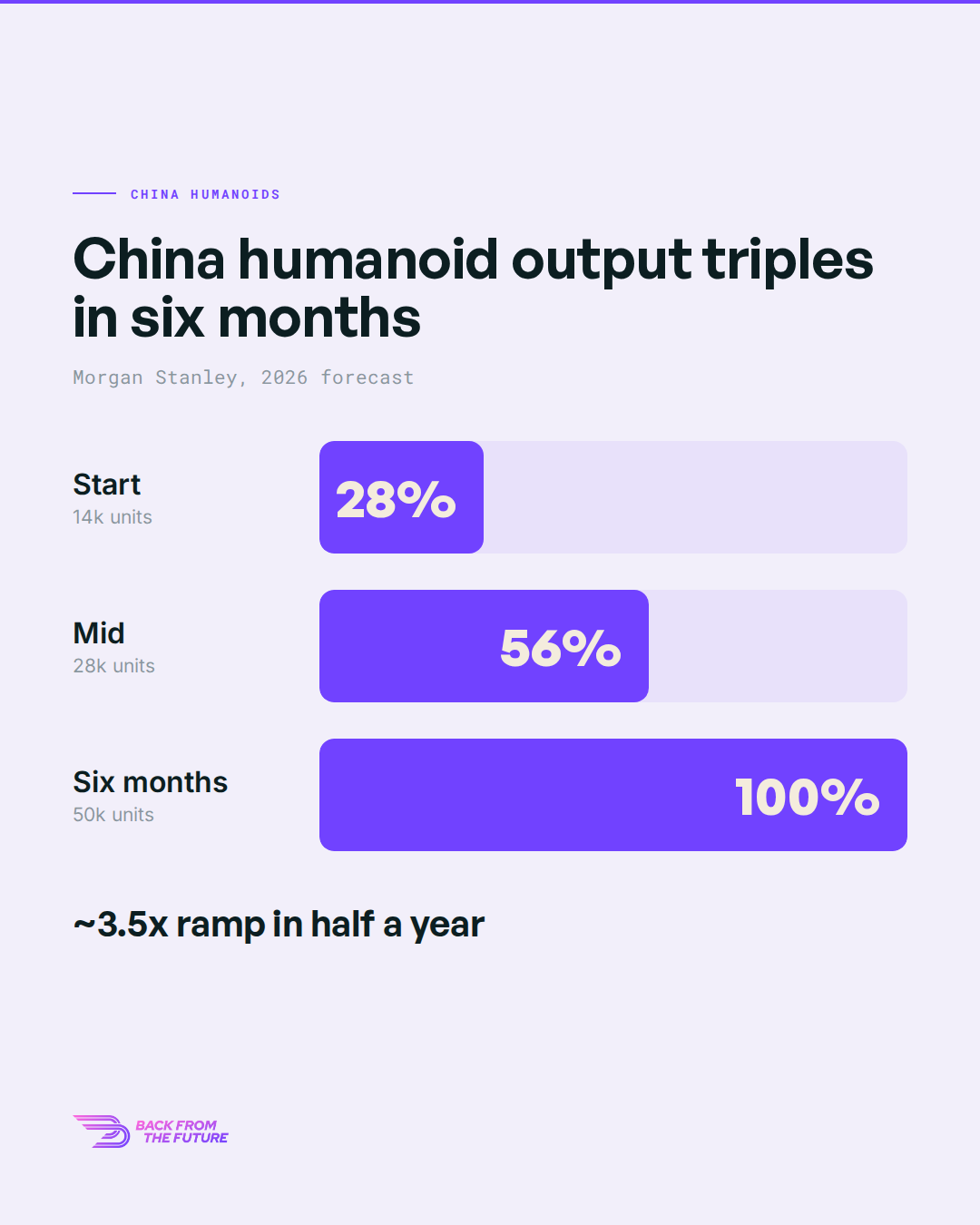
- Morgan Stanley revised its 2026 China humanoid forecast 3.5x in six months (14k → 28k → 50k).
- A single $1B State Grid order and 10,000-unit/year factories are pulling deployment forward faster than models assume.
- VC funding and component makers are being re-priced in weeks, not quarters (e.g. Leaderdrive +73%).
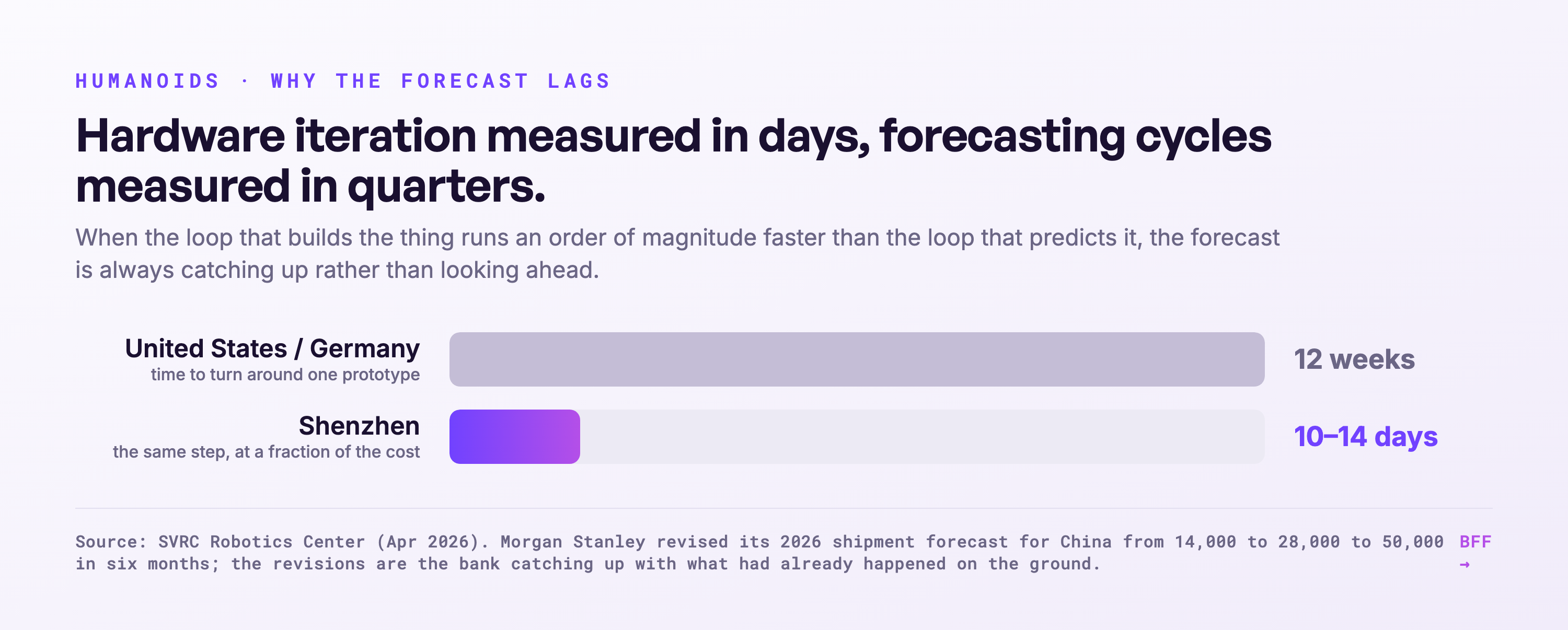
- ~85% of humanoid deployments happen in China, aided by 10–14 day prototype cycles vs 12 weeks in the West.
- Reliability and uptime data are still missing — scale-up isn't proven usefulness.
In January, Morgan Stanley expected 14,000 humanoid robots to ship in China in 2026. By spring the bank had raised that to 28,000. On June 24 it doubled the figure again, to 50,000 (CNBC, June 24, 2026).
That is one bank revising the same twelve-month window upward by 3.5x in six months. Forecasts revise slowly when a technology arrives roughly on schedule, and they double when deployment gets pulled forward faster than anyone budgeted for.
So the question I would ask is what sits underneath the revisions, because a bank does not double a shipment forecast on vibes.
What actually moved
Morgan Stanley's own report names three drivers behind the June upgrade (BigGo Finance, June 2026): accelerating commercial validation, national policy support, and aggressive supply chain capacity expansion.
The first of those has a hard number attached, which is a 6.8 billion yuan order, roughly $1 billion, from State Grid, China's electricity utility. That is a single customer placing a billion-dollar humanoid order. Analyst models built around gradual pilot programmes and cautious enterprise adoption have no slot for a purchase like that, so when it lands the model breaks upward.
The supply side is moving on the same curve. In March a production line in Guangdong went into operation with a stated annual capacity of over 10,000 humanoid units, reportedly China's first fully automated humanoid production facility, with a build time of about 30 minutes per robot and five more, larger sites planned. TrendForce projects Chinese vendors will drive annual output growth of up to 94% in 2026, with Unitree and AgiBot together accounting for nearly 80% of shipments (TrendForce, April 9, 2026).
The deployments are turning up in ordinary places too. Beijing-based RobotEra is putting a thousand humanoid sorters into more than ten logistics centres. When I visited a humanoid robotics company in Shanghai this June, the thing that stayed with me was not the demos. It was the shipping volume: 10,000 robots out the door last year, from a company three years old.
A stable forecast means the model has caught reality. A forecast that keeps doubling means reality is outrunning the model — and every plan built on the last published number is already stale.
The money is running the same pattern
VC funding into humanoids has the same shape as the forecast, which is lumpy and accelerating and hard to model. The sector's 44 funded companies have collectively raised $6.89 billion, with Figure alone at $1.75 billion (Tracxn, May 12, 2026). Zoom into the monthly data and the curve looks nothing like a smooth line: four of the last twelve months recorded zero qualifying deals, while September 2025 alone pulled in $1.14 billion (New Market Pitch, May 2026).
Shenzhen-based X Square Robot raised around $100 million in a round led by Alibaba Cloud, its eighth round of financing in under two years of existence (CNBC, September 8, 2025). Eight rounds in two years is a company being re-priced faster than a normal fundraising cadence allows for.
The re-pricing reaches down into components as well. When Morgan Stanley published its June upgrade it raised the twelve-month price target on Leaderdrive, a Shanghai-listed maker of harmonic drives, from 269 to 464 yuan, a roughly 73% jump on a single supplier in one report (AI Weekly, June 2026). Component makers get revalued in weeks once the shipment assumption doubles.
Why China's number moves faster
Part of this is structural. Roughly 85% of recent humanoid deployments are happening in China against about 13% in the US, and China dominates the components for rotary actuators, one of the most critical parts in a humanoid (McKinsey, May 2026). The iteration loop is simply shorter, too: a prototype that takes 12 weeks to produce in the US or Germany turns around in 10 to 14 days in Shenzhen, at a fraction of the cost (SVRC Robotics Center, April 17, 2026).
When your hardware iteration cycle is measured in days and your forecasting cycle is measured in quarters, the forecast will always lag reality. Morgan Stanley's revisions are the bank catching up with what had already happened on the ground.
The honest caveat
A forecast revised twice in six months signals uncertainty just as much as momentum, and I would hold it that way. Rapid scale-up and proven reliability are different things, and the public reporting stays quiet on uptime, failure rates, and how supervised these deployments still are. Fifty thousand robots shipped tells you nothing about how many are doing useful unsupervised work in month six. That data will surface eventually. It has not yet.
Watch the revisions
Here is the mental model worth keeping, and it generalises well beyond robotics. When a serious institution revises the same forecast repeatedly in the same direction, the revisions carry more information than the figure. A stable forecast means the model has caught up with reality. A forecast that keeps doubling means reality is outrunning the model, and every plan built on the last published number is already stale.
Morgan Stanley now projects 446,000 units and a $15 billion market by 2030. Given how the 2026 number has behaved I would treat that as a floor with a wide error bar, and check back in six months.
The 50,000 will be old by the time you have built a strategy around it. The direction and speed of the revisions will not be.

Ruben Horbach
Co-founder · Back From the Future
Ruben researches how organisations adopt AI meaningfully — not as technology, but as a change in work and people. He builds the agent infrastructure behind BFF and speaks about the near future of work.