
In short
- Meiji University's Functgraph 3D printer prints its own tools to upgrade itself into an assembly station.
- Tsinghua's DISH method prints a finished object in 0.6 seconds using only light.
- Combining self-modification and speed gives manufacturing software's self-improvement loop.
- As throughput becomes cheap, the scarce skill is deciding what the production line should become.
- These are lab-scale, fragile signals, but they point at where the curve bends.
A 3D printer at Meiji University prints the parts that turn it into a factory.
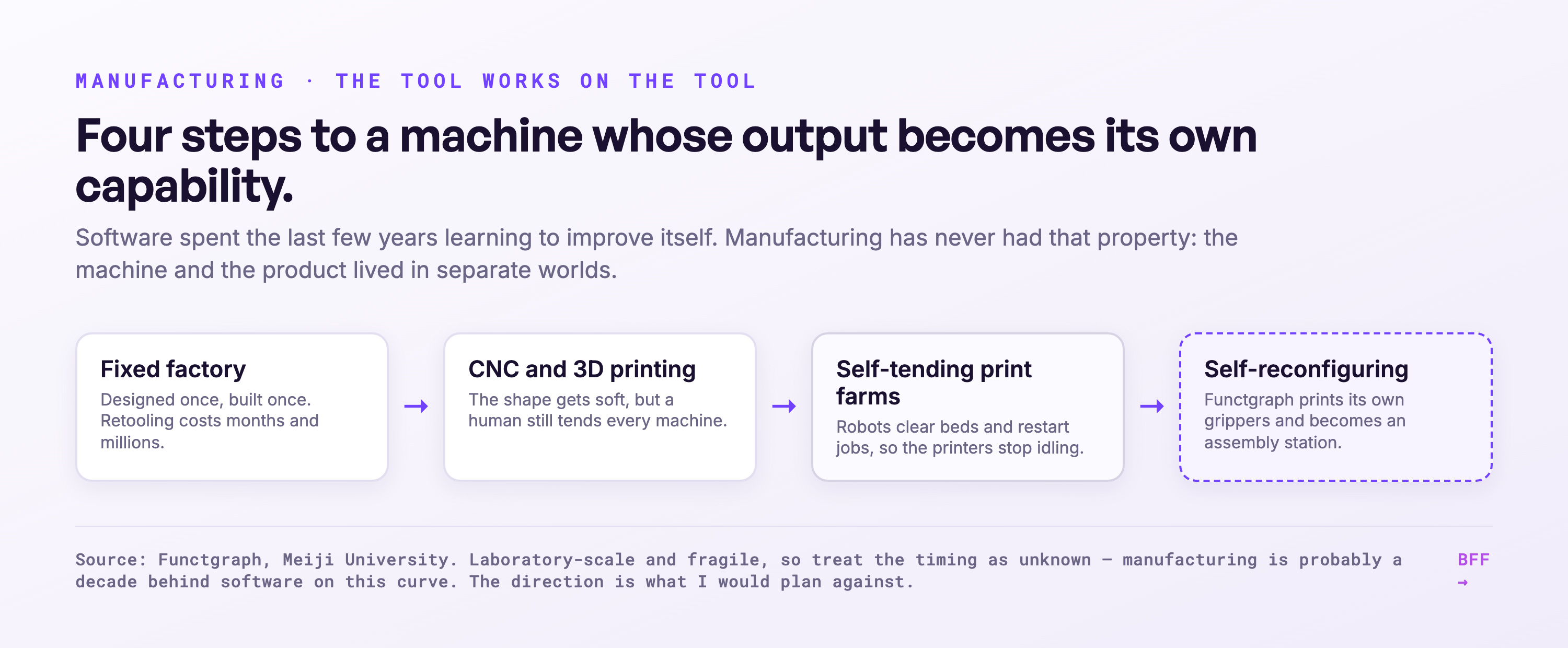
The project is called Functgraph. It starts life as an ordinary desktop 3D printer, then fabricates its own grippers and hooks and tooling, snaps them onto its print head, and upgrades itself into a small assembly station that can pick and place and build. The machine you bought is a starting condition, and what it becomes depends on what it prints for itself.
On its own that is a clever lab demo, and I would not have written about it alone. Put it next to a second development and it becomes a direction.
At Tsinghua University, a method called DISH prints a finished object in 0.6 seconds using only light. No nozzle tracing paths, no layer-by-layer waiting; the object appears in the volume of resin almost at once. For thirty years 3D printing has meant watching a part grow slice by slice over hours, and DISH compresses that into less time than it takes to read this sentence.
One machine reconfigures what it is. The other collapses how long making takes. Neither is a product, both are lab-scale, and I would hold them loosely as evidence. What they are good for is showing you where the curve bends.
The loop software already runs
Software has spent the last few years learning to improve itself. Models write code, test it, and feed the results back in, and development cycles that took teams weeks now take agents hours. The defining property of that loop is that the tool works on the tool.
Manufacturing has never had that property. A factory gets designed once, built once, and then produces one family of things until somebody spends months and millions retooling it. The machine and the product live in separate worlds, where humans redesign the machine and the machine makes the product.
Functgraph is a small crack in that wall, because the printer's output becomes the printer's capability. Print a gripper, gain the ability to grip. Gain the ability to grip and you can assemble. Assemble, and you are no longer a printer. The product line and the production line have merged into one object.
I have been collecting the pieces of this in my own archive for a while. A robot built specifically to tend 3D print farms, removing finished parts and starting the next job so the printers never idle. Six-axis non-planar printing that abandons flat layers entirely and lets the print head move through 3D space like a hand rather than a plotter. A $5,000 "microfactory in a box" that runs around the clock with swappable tools and assembles electronics on its own. Each one erodes a different assumption: that machines need human tenders, that printing means stacking flat slices, that a factory needs a building.
When execution gets cheap, judgment about what to execute gets expensive.
Why speed and self-modification compound
Here is the part that matters once you put the two on the same curve.
Self-modification on its own is slow. Functgraph takes hours to print each tool it adds to itself, which is interesting but you could retool faster by hand.
Speed on its own is rigid. DISH makes one object very fast, and the machine still only does the one thing it was built to do.
Combine them and you get something genuinely new: a machine that can produce its next version of itself in seconds. The iteration cycle of physical production starts to resemble the iteration cycle of code, where you try a tool geometry, test it, print a better one and repeat, all inside one afternoon rather than one procurement cycle. That is the loop software runs, and the physical world is getting its own version of it.
There is an old thought experiment lurking here. Von Neumann sketched self-replicating machines in the 1940s as a mathematical curiosity, and nobody in that lineage predicted the boring practical on-ramp: a desktop printer in a Japanese lab printing itself a gripper so it can tidy up its own build plate.
The question changes
For a century manufacturing competed on throughput: how many units, how cheap, how consistent. Entire economies organised themselves around being the place that produces fastest.
If machines can redesign and accelerate themselves, the scarce capability moves. Throughput becomes something you print more of, and what you cannot print is knowing what the production line should turn into next: which product, which tool, which configuration. The advantage travels from the factory floor to whoever specifies what the factory should become this week.
That is the same displacement we are watching in software work, where cheap execution makes judgment about what to execute expensive. Manufacturing is probably a decade behind software on this curve and these two examples are laboratory-scale and fragile, so treat the timing as unknown. The direction is what I would plan against.
When the factory can rebuild the factory, the question stops being how fast you can produce. It becomes how fast your production line can change what it is, and who in your organisation is capable of deciding what it should be.

Ruben Horbach
Co-founder · Back From the Future
Ruben researches how organisations adopt AI meaningfully — not as technology, but as a change in work and people. He builds the agent infrastructure behind BFF and speaks about the near future of work.