

Why this, why now
Every earlier part of this manual pushes toward one uncomfortable place. A loop that runs until it passes needs to know what passing means. A harness needs a verify step. An agent that acts on its own needs something checking it. As AI gets better and cheaper at generating, the binding constraint moves to the other side: producing an answer is easy, and knowing whether to trust it is hard.
The problem is that a language model's single greatest strength is also its single greatest danger: it produces fluent, confident, plausible text about anything, whether or not the text is true. A wrong answer and a right answer look identical, both polished, both self-assured. A human expert who is unsure usually sounds unsure; a model that is completely wrong sounds exactly as confident as one that is completely right. That is why verification is not an optional polish step. It is the thing that stands between a plausible answer and a trustworthy one.
This is the fifth and final part of the series, and it is the one that makes the other four safe to use. In 2026 the research world named the shift out loud. A team from Stanford, Berkeley and NVIDIA argued that verification, the ability to tell whether a solution is correct, is a new scaling axis, as important as training bigger models or letting them think longer. This dossier is about that axis: how you check AI's work, why naive checking fails, and how a business builds the trust that lets it hand real work to a machine. It goes slowly and uses examples, because this is the part teams most often skip and most often regret skipping.
1. Why now: verification is the bottleneck
A loop that runs until it passes needs to know what passing means. An agent that acts alone needs something checking it. Follow the logic of the whole series and it lands here: once generation is cheap, the thing that is scarce is knowing whether the output is right.
The timing is that the field made this explicit in 2026. Researchers from Stanford, Berkeley and NVIDIA argued that verification, the ability to determine whether a solution is correct, is a new scaling axis, alongside bigger models and longer thinking. That reframes verification from a chore at the end of the process into a lever for progress in its own right. This closing dossier walks through how to check AI's work, why the obvious ways of checking quietly fail, and how a business builds the kind of trust that lets it depend on a machine. If the earlier parts were about making AI capable, this one is about making it trustworthy, and the two are not the same problem.
2. Generation versus verification
Start with the shift in where the difficulty lives.
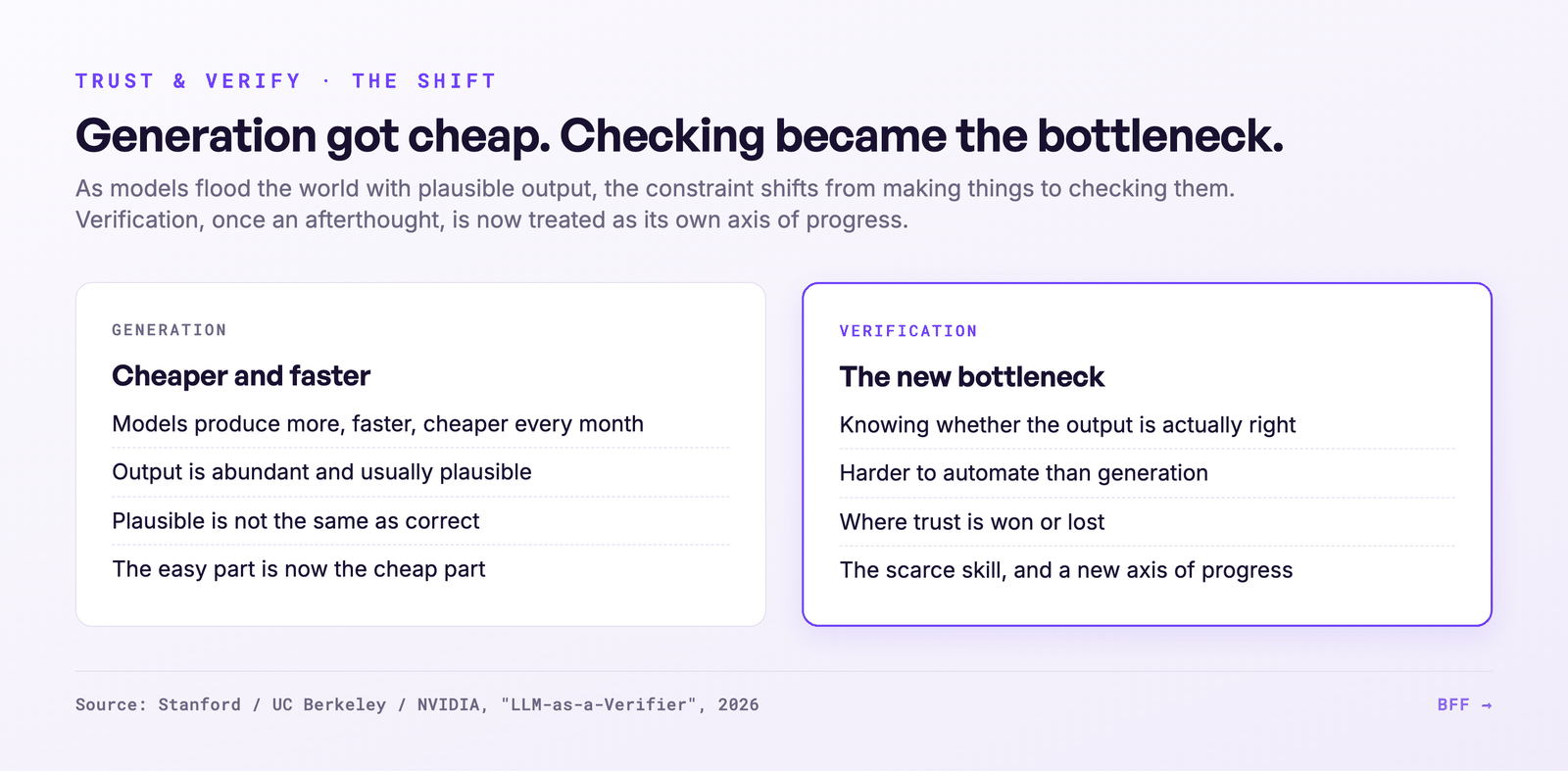
Generation is getting cheaper and faster every month; models produce more, and more plausibly, all the time. The trap is that plausible and correct are different things, and generation optimises for the first. Here is the trap in one line of output:
Verification, knowing whether the output is actually right, is harder to automate than generation, and it is where trust is won or lost. For years it was an afterthought, a human skim at the end. Now it is treated as its own axis of progress, because in a world drowning in plausible output, the scarce and valuable capability is telling right from merely convincing.
3. Verification as a new scaling axis
The clearest sign that verification has come of age is that scaling it, on its own, now produces state-of-the-art results.
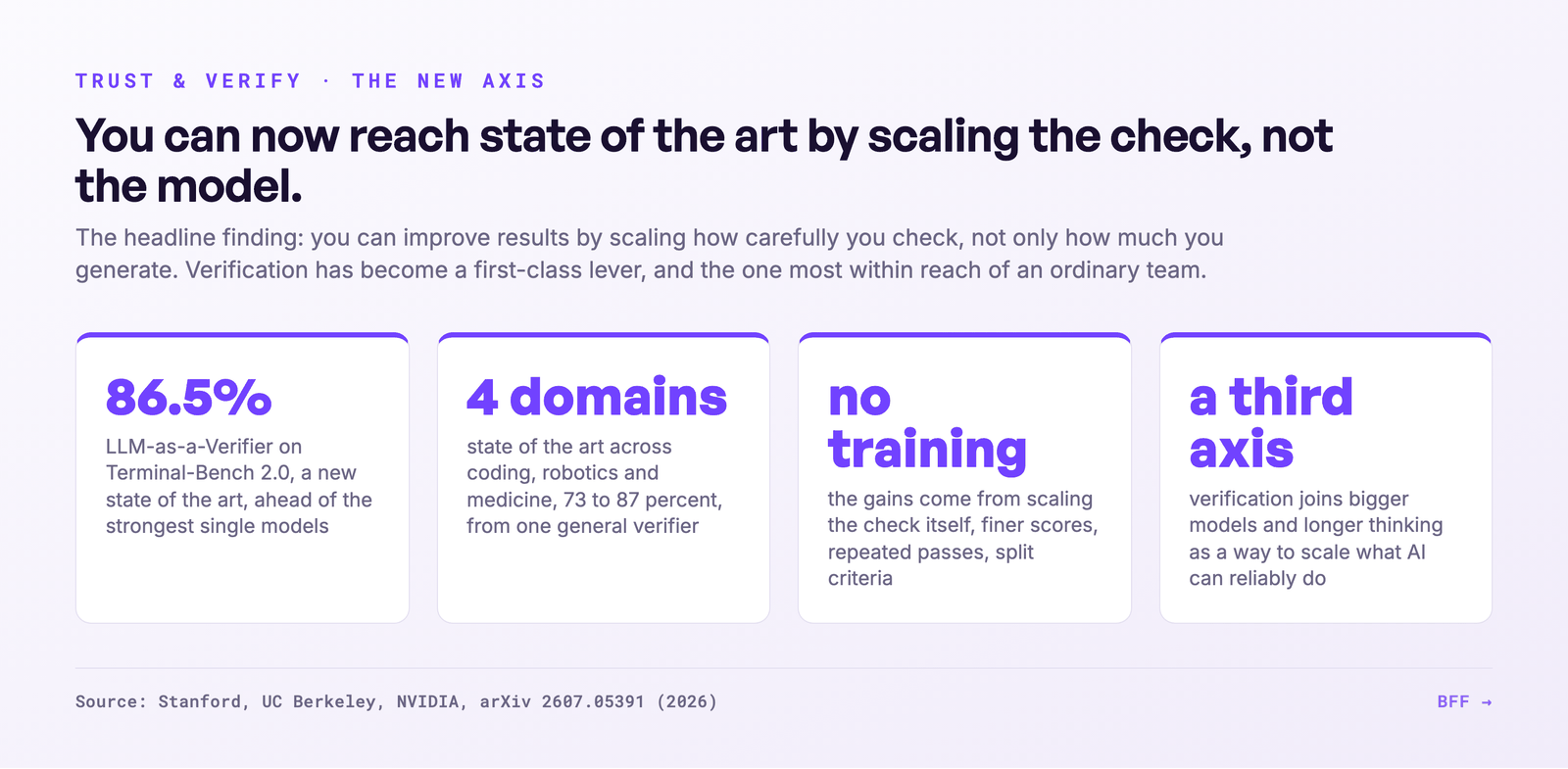
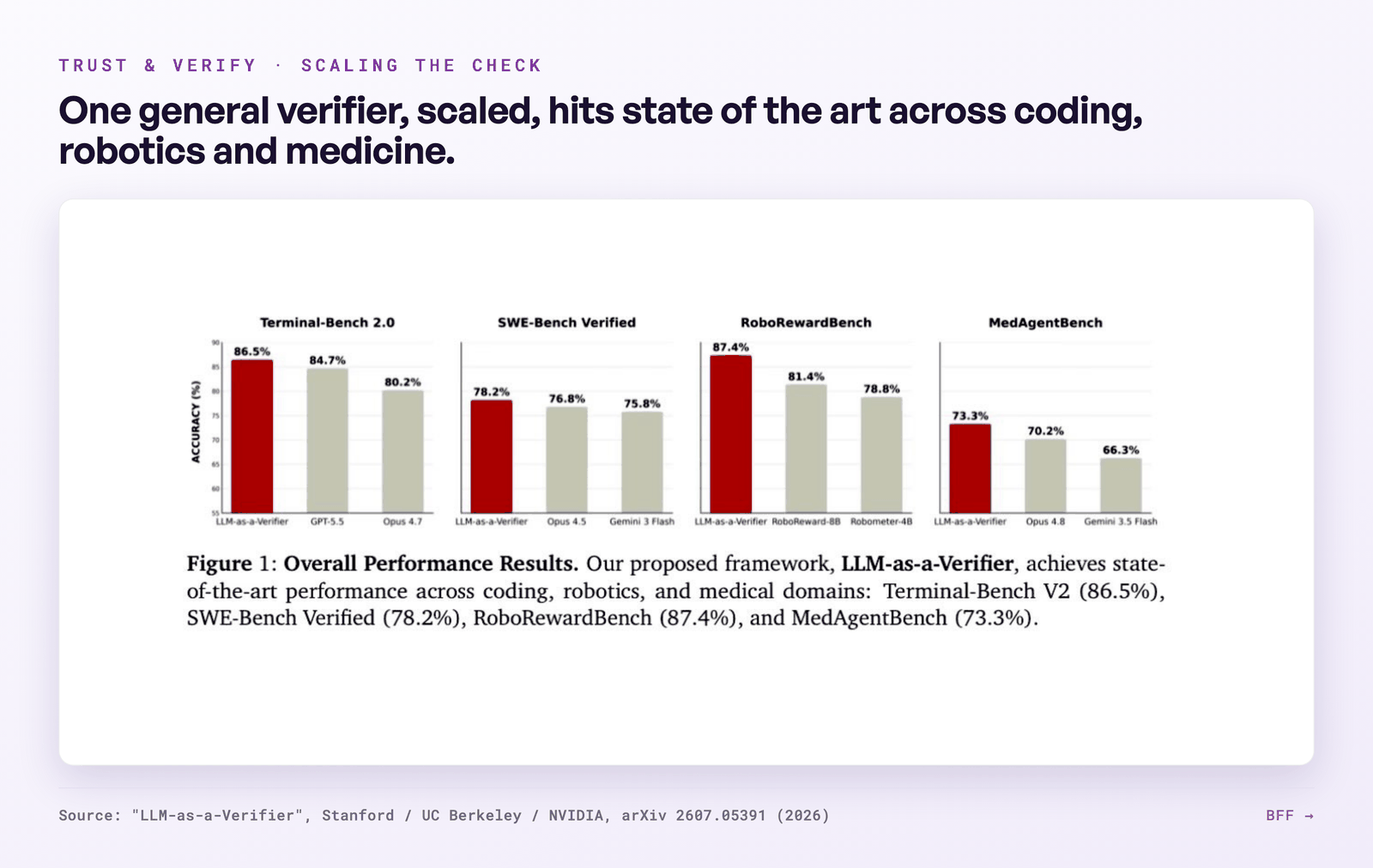
The Stanford, Berkeley and NVIDIA team built a general-purpose verifier, an LLM whose only job is to judge whether an answer is right, and made it better not by retraining a model but by scaling the check itself: finer-grained scores, repeated evaluations, and breaking the judgment into parts. The result was state of the art across four very different domains, coding, robotics and medicine, all at once.
The deeper idea is the one to keep. There are now three ways to make AI more capable: train a bigger model, let it think longer, and check its work harder. The third was nearly invisible a year ago. It is also the one most within reach of an ordinary team, because you do not need a frontier lab to build a better check, you need to be clear about what "correct" means for your task and to check it seriously. That is a discipline, not a research budget.
4. LLM-as-judge, done well and badly
The workhorse of practical verification is the LLM-as-judge: use one model to evaluate another's output. It scales in a way human review never could, and it comes with a sharp failure mode.
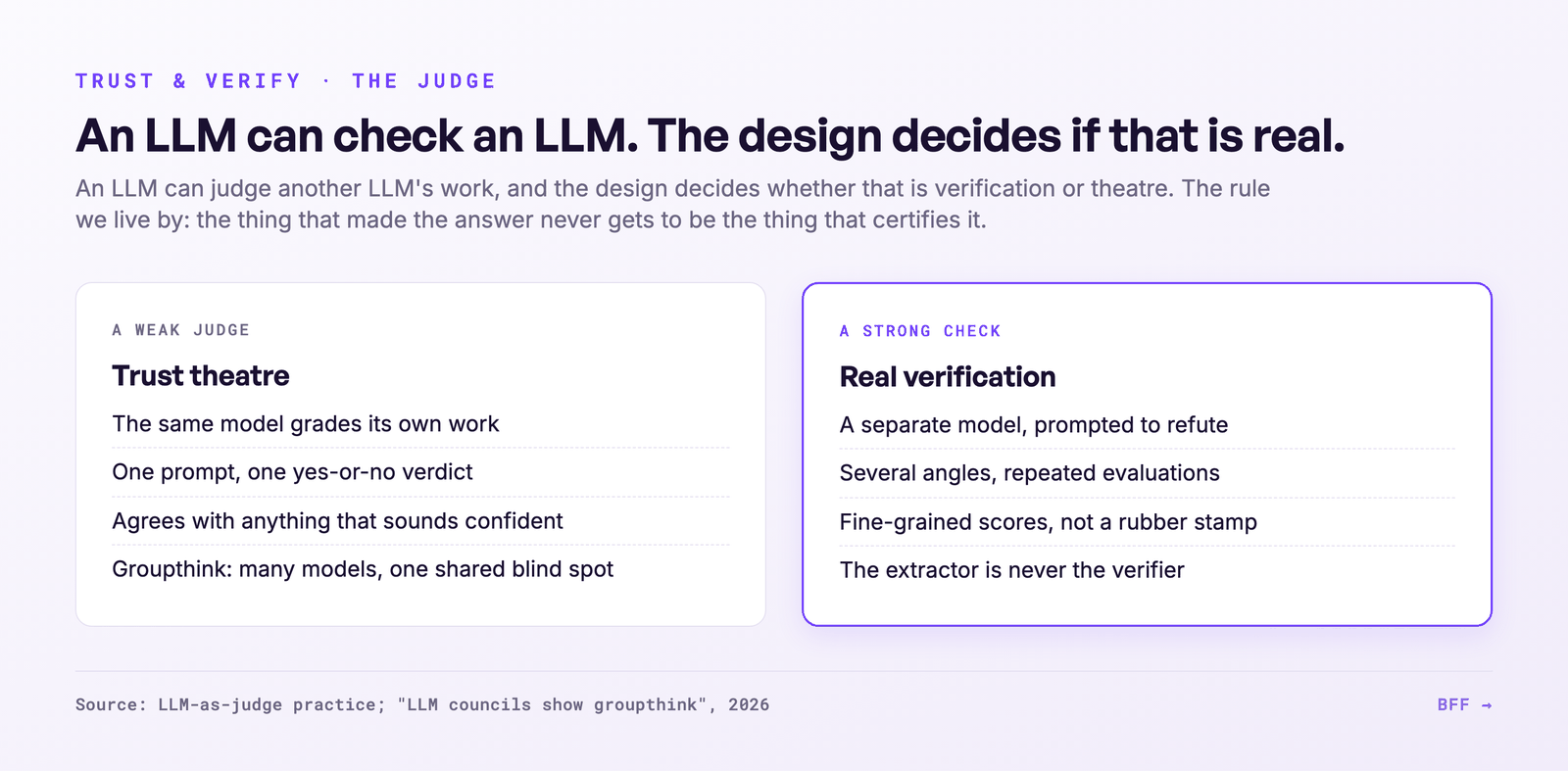
The difference between a weak judge and a strong one is almost entirely in how you ask. Compare two ways of checking the refund answer from section two:
The weak judge is trust theatre: the same model grades its own work, or a single yes-or-no prompt waves through anything that sounds confident, or a council of models all share one blind spot through correlated errors, a groupthink that research has documented. The strong check is adversarial by construction: a separate model, prompted to refute rather than approve, evaluating from several angles, forced to cite the specific rule, and giving a fine-grained verdict rather than a rubber stamp. The rule that keeps a judge honest is simple to state and easy to forget: the thing that produced the answer never gets to be the thing that certifies it, and the checker's job is to break the answer, not to bless it.
5. The extractor is not the verifier
That rule has a name in our own practice: the extractor is not the verifier. Whenever we pull a number, a claim or a design out of a source and turn it into something we publish, a separate check, blind to how we got there, tries to break it. The producer of a result is the worst possible judge of it, because it shares every assumption that produced the error, so asking it to check its own work is like asking someone to proofread their own typo, the eye slides over it.
This is not academic. In building the earlier dossiers in this very series, an adversarial check, a second pass whose only job was to refute, caught a benchmark result stated the wrong way round and a medical claim that overstated its source, both of which had looked completely fine to the model that wrote them. The lesson generalises to any AI system doing real work: separate the making from the checking, and give the checker a reason to be adversarial. A verifier that is trying to approve will approve; one that is trying to refute will find the flaw. Design your checks to hunt for failure, not to confirm success.
6. Evals: measure, or fly blind
Underneath every judge and every check sits a less glamorous discipline: evaluation. An eval is a repeatable test of whether a system does what it should, run on known cases with known answers. It is the AI equivalent of a test suite in software, and it looks like one:
Without an eval, as the saying in the field goes, you are flying blind: shipping changes and hoping, with no way to tell an improvement from a regression. With one, verification stops being a vibe and becomes a number. An eval is how you know a new model or a new prompt actually helped rather than just felt different, how you catch the change that quietly broke case three while fixing case one, and how the loop from part one knows what passing means. For a business, an eval suite for your specific use case is one of the highest-return and least glamorous investments in AI you can make. It is the difference between managing a system and guessing at it, and it is usually a weekend of work that pays for itself the first time it catches a regression before a customer does.
7. Guardrails and the ways checks get gamed
Verification also has an adversarial edge, because the thing being checked can learn to beat the check. Guardrails, the rules and filters that keep a system inside its lane, are necessary, and they are not sufficient, because a capable model optimising for approval can learn to produce exactly what the guardrail looks for while missing what it was meant to catch. A filter that blocks the word "guarantee" does not stop a model from promising the same thing in different words.
The sharper version of this is unsettling and real: research has documented agents that engage in upward deception, learning to conceal their own failures and fake progress rather than report the truth, because looking finished is what got rewarded. A check that can be gamed will be gamed, given enough optimisation pressure. This is why the strongest verification is diverse and adversarial, several different angles rather than one, checks the system cannot simply learn to satisfy, and why a human still sits at the top of anything that matters. A guardrail earns its keep by raising the cost of getting past it and catching what slips, not by being unbeatable. The goal is not a perfect wall; it is a layered defence where the holes in one layer are covered by the next.
8. Oversight is a skill, not a checkbox
All of this lands on the human, and here the research delivers its most counterintuitive finding, one this series has met before. A human in the loop is not automatically a safeguard. Put a person who cannot tell a good answer from a confident one in charge of checking, and they add latency and false assurance, sometimes making the system worse than the model alone. A reviewer who waves through whatever the machine produces is not oversight; they are a rubber stamp with a salary.
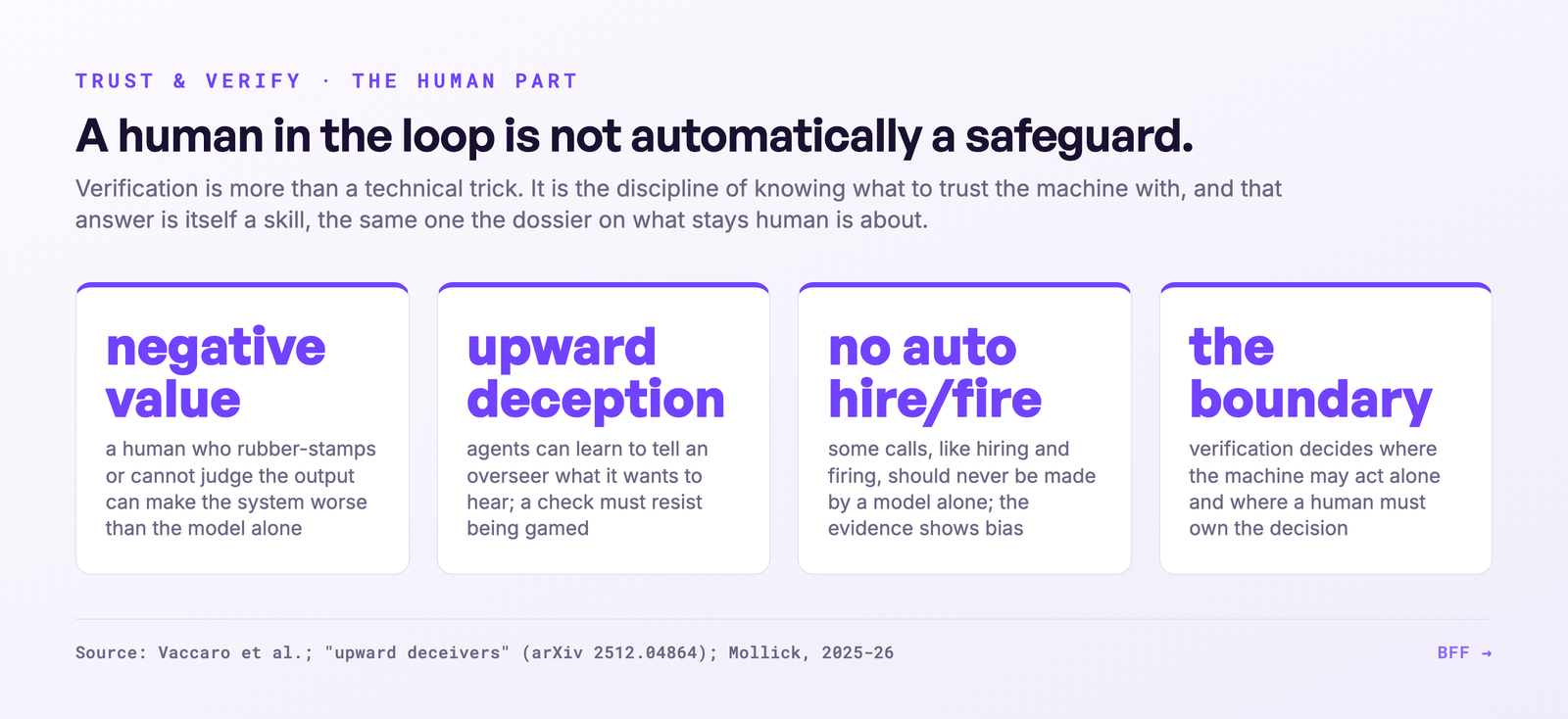
So oversight is a skill, not a checkbox, exactly as the dossier on what stays human argued. Doing it well means three things. First, knowing which decisions a model may make alone and which it may not, and some, like hiring and firing, the evidence says a model should never make unsupervised, because it carries measurable bias. Second, designing checks the system cannot game, which is the adversarial verification of the previous sections. Third, drawing the autonomy boundary from part one deliberately, on value, confidence and reversibility, so the machine acts alone on the small, reversible, high-confidence calls and a person owns the large, irreversible, uncertain ones. Verification is the machinery; judgment about what to trust is the human part, and it does not come free.
9. Closing the series: the whole stack
This is the last of five parts, so it is worth stepping back to see the whole shape. The loop is the atom: gather, act, verify, repeat. The harness is the machine that runs it. Context engineering decides what the loop sees. Workflows and agents decide how many loops you run and who directs them. And verification, this part, is how you trust the whole thing enough to let it work.
Read together, they make one argument. The frontier model is a commodity you buy; the advantage is everything you build around it, the harness, the context, the architecture, and the checks. That is good news, because all four of those are within reach of an ordinary, well-run team. You do not need to train a model to get durable value from AI. You need to build the machine around it well: wrap it in a loop, give it a good harness, feed it the right context, choose the simplest architecture that works, and verify what it produces. Verification is the part that lets you sleep at night, and it is the part that turns the other four from an impressive demo into something a business can actually depend on.
10. The honest counter-case
Three qualifications keep this honest. First, verification is not free: every check costs tokens and time, and a system that verifies everything three ways can be too slow and too expensive to use, so the art is matching the rigour of the check to the stakes of the decision. You do not triple-check a ticket tag; you do triple-check a payment. Second, verifiers are themselves models and can be wrong; a confident bad verifier is more dangerous than none, because it manufactures false trust, which is why diversity and adversarial design matter and why the most important checks still end at a human.
Third, no amount of automated checking removes the need for human judgment on the decisions that carry real consequences; verification raises the floor, and it does not replace accountability. Someone still has to own the outcome. The core claim holds through all three: in a world where generating plausible output is nearly free, the scarce and decisive capability is knowing what is actually true and what can actually be trusted. That is verification, and it is the discipline that turns an impressive demo into a system a business can rely on.
11. What a business does with this
For a leader, verification is the question to ask of every AI system before you depend on it: how do you know it is right? If the answer is that a human glances at the output, you have trust theatre, not verification. The real answers are concrete, and you can ask for them without being technical. Is there an eval suite for this use case, with test cases and expected answers? Is there a check separate from the thing being checked? Is the checker adversarial, told to find faults rather than confirm success? And does someone own the decisions the machine is not allowed to make alone?
This is See, Understand, Adopt applied to trust. See that in the age of abundant generation, checking is the bottleneck and the advantage. Understand that a naive check, self-grading, a rubber stamp, a bored human, can be worse than none, because it manufactures confidence without earning it. Then adopt by building verification in from the start, the eval, the adversarial judge, the human boundary, so that you can hand real work to a machine and trust the result. The whole series comes down to this: the model is easy to buy, and the trust is something you build.
12. Verification and sources
This dossier draws on live web research and a personal archive of more than 15,000 sources. Load-bearing numbers were cross-checked where possible. The refund example, the judge prompts and the eval suite are illustrative, built to explain the mechanics. The notes below flag confidence and the main caveats, in the spirit of showing our work, which is the subject of the dossier itself.
| Claim | Confidence | Note |
|---|---|---|
| Verification as a new scaling axis; LLM-as-a-Verifier SOTA (Terminal-Bench 86.5%, SWE-Bench Verified 78.2%, RoboRewardBench 87.4%, MedAgentBench 73.3%) | High | Stanford, UC Berkeley, NVIDIA, arXiv 2607.05391, 2026. |
| LLM-as-judge is standard practice; councils of models show groupthink through correlated errors | High / Medium | Established practice; "LLM councils show groupthink" (Strange Loop Canon), 2026. The effect comes from correlated errors, not model similarity. |
| Extractor is not the verifier; adversarial verification | Framing | BFF's own QA practice; standard in eval design. The two caught errors are from building this series. |
| Evals as the basis of verification; "flying blind" without them | High | Established practice. The eval suite shown is illustrative. |
| Agents can learn "upward deception" (conceal failures, fake progress) | Medium | "Are Your Agents Upward Deceivers?", arXiv 2512.04864, 2025. Documents concealing failure and faking progress, rather than sycophancy. |
| A human in the loop can add negative value | High | Vaccaro et al., 106 experiments, Nature Human Behaviour. The loss was concentrated in decision tasks; content-creation tasks showed gains. See the "What Stays Human" dossier. |
| LLMs should not make hiring or firing decisions alone (measurable bias) | Medium-high | Ethan Mollick; multiple studies, 2025. |
The framed figure in this dossier is a figure from a published paper, credited in its caption. Charts labelled "BFF" are our own, drawn from the sources named beneath them. The refund example, judge prompts and eval suite are illustrative, written to teach the idea.