

Why this, why now
For two years the popular image of AI has been a chat box: type a question, read an answer. That image is now the main thing holding teams back. The systems doing real work in 2026 do not answer once. They run a loop: gather what they need, act, check the result, and go again until the work is done.
The chat box taught everyone to think of AI as a vending machine: insert a prompt, receive an output, done. That model works for a single question. It falls apart the moment the task has more than one step, needs a tool, or has to be right rather than merely plausible. Consider the difference between "write me a sentence about our refund policy" and "process this refund." The first is a vending-machine task. The second is a loop: check the account, read the policy, apply the rule, confirm the amount, and only then act, with a way to notice when something is off and try again. The second shape is where real work lives, and it is not a prompt. It is a loop.
The shift has a short history the field mostly agrees on. First the gains came from the model itself, bigger weights and more training. Then they came from context, what you put in front of a frozen model. Now they come from the harness, the machinery around the model that lets it act and correct itself. This five-part series is a field manual for that machinery. It starts here, with the loop, because the loop is the atom everything else is built from. The later parts, the harness, context engineering, workflows versus agents, and trust and verification, are all just ways of running a better loop. This dossier goes slowly and uses examples, because the idea is simple once you see it and easy to wave past when you do not.
1. Why now: the atom of AI work
The chat box taught everyone the wrong mental model. It made AI feel like a vending machine: insert prompt, receive output. The teams getting real value in 2026 threw that model away and replaced it with a loop that keeps going until the answer holds up.
Why now is simple. The tools finally make loops native. Agents that plan, call tools, run tests and retry are no longer a research demo; they ship in the products people use daily. And the evidence has caught up: systems that keep the same model but wrap it in a better loop now beat systems with a stronger model and no loop. That single fact reorganises how a business should think about adopting AI, and it is where this manual begins.
One clarification before we go further, because the word "agent" gets thrown around loosely. An agent is not a special kind of model. It is a model placed inside a loop, given tools to act with and a way to check its own results. The same model that answers a chat message becomes an "agent" the moment you wrap it in gather, act, verify and let it run more than once. So when this series talks about building good agents, it is really talking about building good loops around ordinary models. That is the whole trick, and the rest of this dossier is about how the trick works.
2. Ask-and-receive versus the loop
Put the two side by side. A single API call is ask-and-receive: one prompt in, one answer out, no memory, no tools, no check. You keep whatever comes back, right or wrong. Useful, and sharply limited.
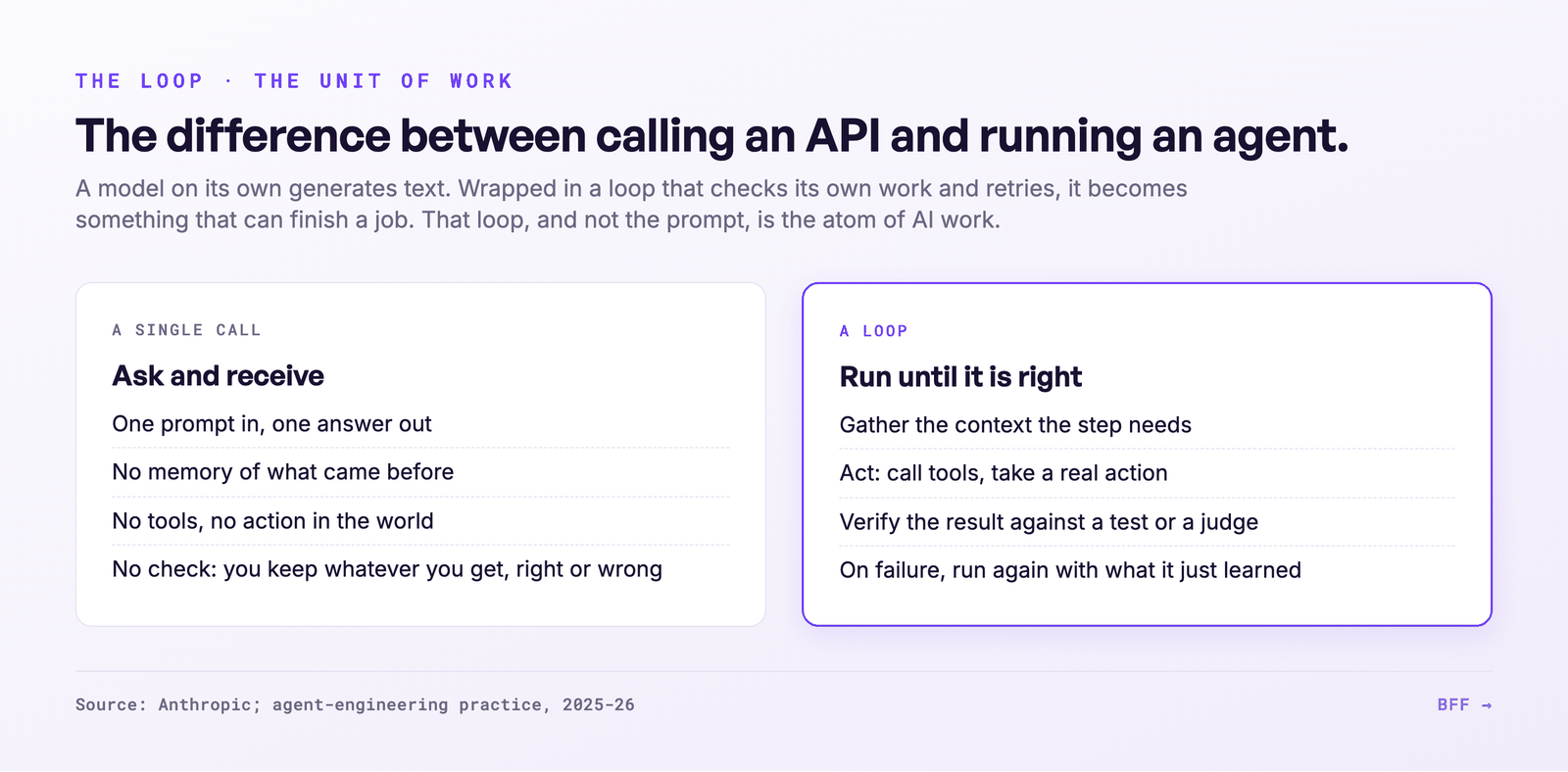
A loop is different in kind. It gathers the context the step needs, acts by calling tools or taking a real action, and verifies the result against a test or a judge. When the check fails, the whole thing runs again with what it just learned. That retry, on failure, with updated context, is the entire difference between calling an API and running an agent.
Take a concrete task: "find the three customers most at risk of churning this month and draft an email to each." As a single prompt, the model has no data, so it invents plausible names and generic emails, confident and useless. As a loop, it queries the real usage data, ranks the accounts, checks each against the definition of "at risk," pulls each customer's history, drafts an email grounded in that history, and flags any it is unsure about for a human. Same model, entirely different outcome, because the loop did the gathering, acting and checking that a single call cannot. That is why a loop can finish work a single call never could.
3. The three phases: gather, act, verify
The loop has three phases, and naming them makes the rest of this series legible.
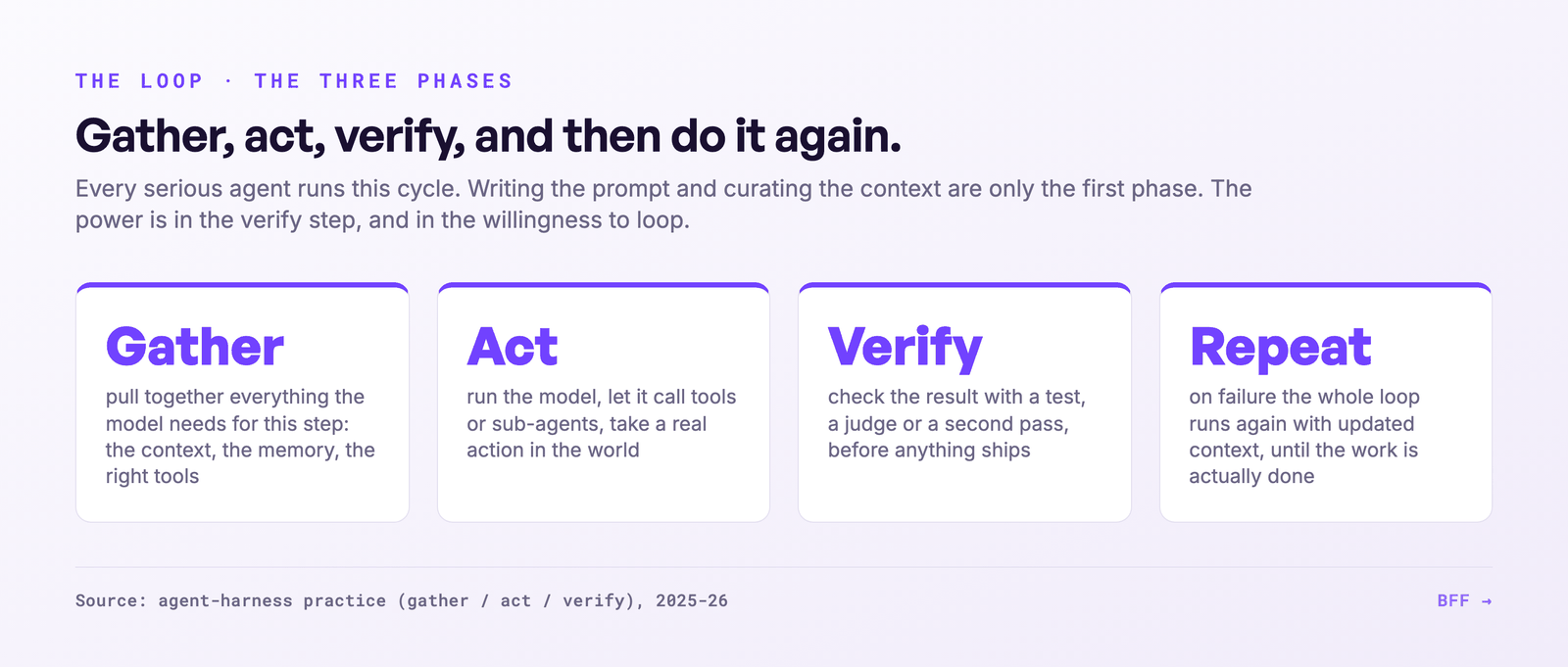
Gather pulls together everything the model needs right now: the relevant context, the memory of what happened before, the right tools. Act runs the model and lets it do something, call a tool, write a file, hand off to a sub-agent. Verify checks the output before it counts, with a test, a second model acting as judge, or a fresh pass. Then, on failure, repeat.
Two of the five parts in this series live almost entirely inside Gather: context engineering is how you decide what goes in, and the harness is the machine that assembles it. The other parts are about Act and Verify. The reason to learn these three words is that they let you diagnose any AI system that is misbehaving. An agent that hallucinates usually has a Gather problem: it was not handed the facts it needed. An agent that does the wrong thing has an Act problem: bad tools or unclear instructions. An agent that confidently ships errors has a Verify problem: nothing checked its work. Almost every failure in practice is one of those three phases missing or done badly.
4. A loop, traced step by step
Abstractions are easy to nod along to and hard to actually picture, so here is a loop running, traced one step at a time. The task is ordinary: an agent is asked to fix a failing test in a piece of software. Watch the three phases repeat.
Nothing here is clever, and that is the point. The agent did not get the fix right on the first try, exactly like a human would not. What made it succeed was not brilliance; it was the loop. Step three failed, and instead of shipping the broken fix, the system noticed the failure, fed the errors back in, and tried again. A single prompt would have stopped at step two with a plausible fix that did not work. The loop kept going until the tests actually passed.
This is worth sitting with, because it inverts a common intuition. People assume a more reliable AI system needs a smarter model. Often it just needs a loop with a real check, so that being wrong on the first attempt is survivable rather than final. The trace above would look almost identical for a marketing agent checking its copy against brand rules, or a finance agent reconciling an invoice against a purchase order. Gather, act, verify, repeat. The domain changes; the shape does not.
5. Verify is the phase everyone skips
If one phase separates a demo from a system, it is Verify, and it is the one people skip. A loop with no check is just a faster way to be confidently wrong. The model produces something plausible, nothing tests it, and the error ships.
Picture the churn-email agent from section two, built without a verify step. It queries the data, ranks the accounts, and drafts three emails, one of which cheerfully offers a discount the company does not actually offer, because the model guessed. Nothing checked the offer against the real price list, so the email goes out and now the company has promised something it will not honour. Add one verify step, "check every offer in the draft against the current price list, and flag anything that does not match," and the error is caught before it leaves the building. The model did not get smarter. The loop got a check.
This is why the loop and the eval are two sides of one idea. You cannot loop until right without a way to know what right is. The teams who get reliable work out of AI are rarely the ones with the cleverest prompts. They are the ones who defined, up front, how the loop knows it is done: the test that must pass, the rule that must hold, the second model that must approve. The final part of this series is entirely about building that check well, because it is the hardest and most valuable part of the whole stack.
6. The loop that improves itself
The clearest proof that the loop, and not the model, is doing the work comes from systems that improve while the model underneath stays fixed.
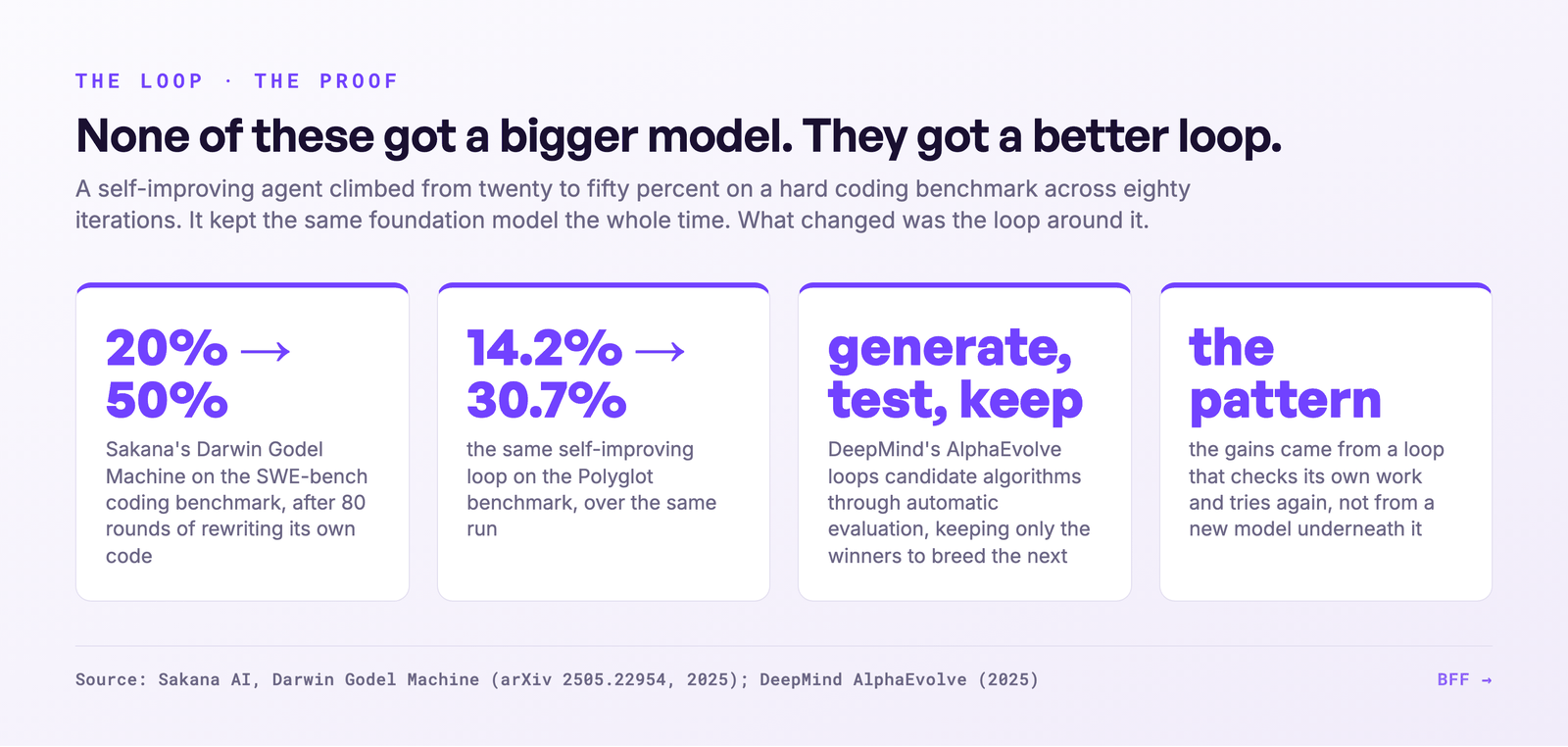
Sakana's Darwin Godel Machine is an agent that rewrites its own code. It works in a loop: propose a change to itself, test the changed version on a coding benchmark, keep the change if it scored better, and repeat. Over eighty rounds of this, it climbed from twenty to fifty percent on SWE-bench and from about fourteen to thirty-one percent on a second benchmark, all on the same foundation model. Along the way it invented improvements a human might have added by hand, better tools for editing files, a step that validates its own patches, a way to avoid repeating past mistakes, and it invented them because the loop rewarded whatever scored higher.
DeepMind's AlphaEvolve runs the same shape of loop on algorithms rather than on itself: generate many candidate solutions, evaluate each one automatically, keep the winners, and let them breed the next generation. Pointed at Google's own infrastructure, it found real improvements to data-center scheduling and to chip design, and even discovered a faster kernel that shaved about one percent off the training time of the model underneath it. Neither system got a smarter model. Each got a loop that checks its own work and iterates. That is recursive self-improvement, in a measured and controlled form, already running, and it is the strongest possible evidence for the claim this dossier keeps making: the loop is where the leverage is.
7. Plan, act, observe, reflect
Zoom in on a single pass of the loop and a smaller pattern keeps recurring: plan, act, observe, reflect. The agent breaks a goal into steps, takes one, reads what happened, and decides what to do next. Microsoft's Magentic-One made this explicit with an orchestrator that asks the same short list of questions after every step: is the task complete, is the team looping or repeating itself, is progress being made, who should act next, and what should they do.
Those five questions are worth stealing even without any code, because they are exactly the questions a good project manager asks. Imagine an agent researching a market. After each search it should ask: do I have enough to answer the question yet? Am I just re-reading the same sources? Am I actually getting closer, or going in circles? What is the most useful next search? An agent that asks these keeps making progress. An agent that does not either declares victory too early, stopping at the first plausible-looking answer, or spins forever, re-running near-identical searches without noticing. A loop without a reflect step drifts. A loop that asks "am I actually making progress" every time is the one that arrives.
8. Loops inside loops
Real systems are not one loop but loops nested inside loops. The coding agent from section four shows it. There is an outer loop, "implement this feature," and inside it an inner loop for each small piece, "write this function, run its test, fix it, run it again," before the outer loop moves on to the next piece. Magentic-One described exactly this: an outer control loop for the whole task and an inner one for each step.
This matters for how you think about scale. You do not design one giant loop that does everything at once; that is how you get an agent that is impossible to debug and behaves differently every run. You design a small loop that does one thing reliably, verify that it works, and then wrap it in a larger loop that orchestrates many of them. A document-processing system might have an inner loop that reliably extracts the data from one invoice, wrapped in an outer loop that runs it across ten thousand invoices and handles the ones that fail. The fourth part of this series, workflows and agents, is entirely about that wrapping, when to compose loops as a fixed sequence and when to let a lead agent orchestrate them. For now the point is that the loop composes: get one small loop right, and you can build the large system out of copies of it.
9. Closing the loop in a business
So far this is engineering. Here is the version that decides whether AI shows up in your results. Most corporate AI pilots stall, and the reason is usually that they are open loops: an impressive demo answering a one-off prompt, with nothing flowing back in and nothing checking the output. It wows the room and then goes nowhere.
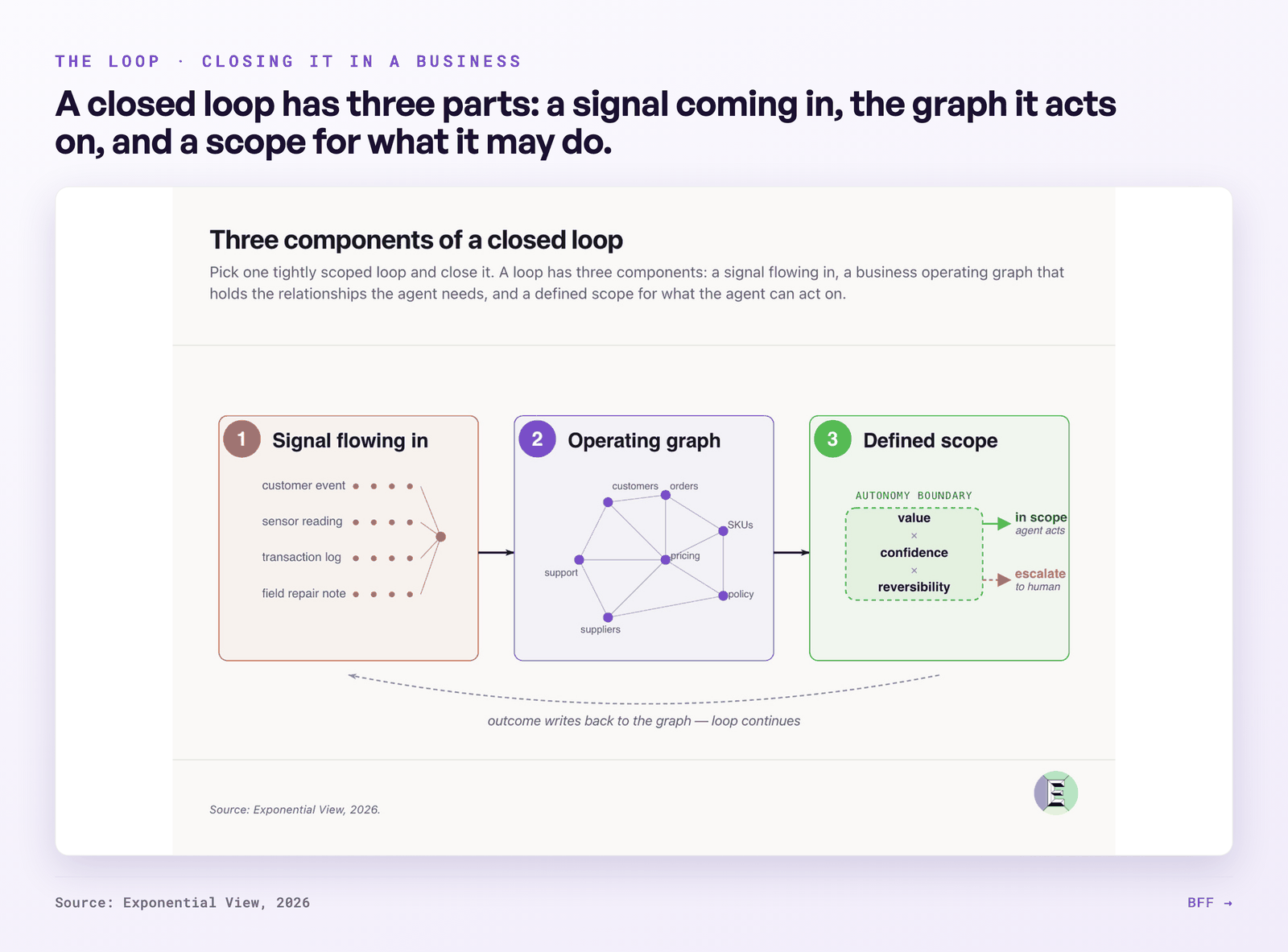
A closed loop has three parts, as Exponential View put it: a real signal flowing in from the business, an operating graph that holds the relationships the agent needs, and a defined scope for what it may act on, with a check that closes the loop before it runs again. The difference between an open and a closed loop is the difference between a clever demo and something that moves a number.
The practical instruction that follows is almost boring. Do not chase a broad, open-ended AI capability. Pick one tightly scoped loop, wire a real signal into it, give it an owner and a check, and close it. That is what moves a number. A demo is an open loop; value is a closed one.
10. The autonomy boundary
The closed-loop picture contains the single most useful governance idea in agentic AI: the autonomy boundary. Not every action inside the loop should be taken by the machine alone. Whether the agent acts or escalates to a human should depend on three things: the value at stake, the confidence in the answer, and the reversibility of the action.
Drawn as a simple table, for the invoice and refund agents, it looks like this:
| Action | Value at stake | Confidence | Reversible? | Who decides |
|---|---|---|---|---|
| Tag a ticket as "billing" | Low | High | Yes | Agent, alone |
| Approve a EUR 40 refund | Low | High | Yes | Agent, alone |
| Approve a EUR 4,000 refund | High | Medium | Hard | Human approves |
| Close a customer's account | High | Any | No | Human only |
Read down the table and the rule draws itself. Low value, high confidence, easily undone: let the loop run on its own. High value, lower confidence, hard or impossible to reverse: a human decides. Drawing that line explicitly, action by action, is what makes autonomy safe to grant, and it answers the fear that agents will run wild. A well-built loop does not have unlimited scope; it has a boundary, and everything past it routes to a person. The last part of this series returns to this, because deciding what to trust the machine with is a skill, not a checkbox.
11. The honest counter-case
Loops are not free and not always right. Three honest caveats. First, a loop that cannot tell good from bad amplifies error instead of converging: it will iterate confidently toward the wrong answer faster than a single call would. The verify step has to be real, or the loop makes things worse rather than better. A loop that "checks" its work by asking the same model "does this look right?" often just gets a confident yes, which is verification theatre, not verification.
Second, loops cost. Every iteration is more tokens, more time and more money. A multi-agent loop can burn a large budget for a marginal gain, and sometimes a single well-aimed call really is the right tool for a simple task. Matching the weight of the loop to the value of the task is part of the craft, not an afterthought. Third, autonomy raises the stakes of a bad check: the more a loop is trusted to act on its own, the more a weak verify step can do damage before anyone notices, which is exactly why the autonomy boundary in the previous section matters.
None of this argues against the loop. It argues for building the loop with the same care as the model: a real check, a bounded scope, and a cost you have looked at. The failure mode of loops is a weak check. A loop that cannot judge its own output does too much, too confidently.
12. What a business does with this
For a leader the takeaway is not to go build agents. It is a lens for every AI initiative in the building. Ask of each one: is this an open loop or a closed one? Does a real signal flow in? Is there a verify step, and does someone own it? Where is the autonomy boundary drawn? Most stalled pilots fail one of those questions, and naming which one is usually the fix. A pilot that "answers questions" but never acts is an open loop; a pilot everyone loves in the demo but no one uses is missing a real signal; a pilot that occasionally ships an embarrassing error is missing a verify step.
This is the See, Understand, Adopt method applied to AI's basic unit. See whether the thing in front of you is a demo or a loop. Understand the three phases and where your process breaks, almost always at Verify. Then adopt by closing one loop properly rather than opening ten. Pick a single, high-frequency, well-scoped task, invoice matching, ticket triage, lead scoring, wire the real signal in, add a genuine check, draw the autonomy boundary, and close it. One closed loop that runs every day beats ten open demos that impressed once. The rest of this series builds outward from here: the harness that runs the loop, the context that feeds it, the patterns that compose many loops, and the verification that lets you trust them.
13. Verification and sources
This dossier draws on live web research and a personal archive of more than 15,000 sources. Load-bearing numbers were cross-checked where possible. The worked examples and traces are illustrative, built to explain the mechanics rather than to describe a specific named system. The notes below flag confidence and the main caveats, in the spirit of showing our work.
| Claim | Confidence | Note |
|---|---|---|
| The loop (gather, act, verify, repeat) as the unit of agentic work | Framing | Widely used agent-engineering framing (Anthropic; practitioner writing), 2025-26. |
| "Retry on failure with updated context" is the difference between an API call and an agent | Framing | Practitioner framing (akshay_pachaar and others), 2026. |
| Sakana Darwin Godel Machine: SWE-bench 20%→50%, Polyglot 14.2%→30.7%, 80 iterations, self-rewriting code, invented its own tool improvements | High | Sakana AI + UBC, arXiv 2505.22954, 2025. Sandboxed, human-overseen. |
| AlphaEvolve: evolutionary loop improving Google data-center scheduling and chip design; a kernel optimisation cut ~1% off Gemini's overall training time | High | DeepMind, May 2025. The "sped up its own training" claim is specifically a ~1% total-time saving from one matrix-multiply kernel. |
| Magentic-One orchestrator's five questions; plan / act / observe / reflect; inner and outer loop | Medium-high | Microsoft Magentic-One, 2024. |
| Closed loop = signal in + operating graph + defined scope; autonomy = value × confidence × reversibility | Medium | Exponential View, 2026. A framework, not a hard metric; the loop trace and the autonomy table are illustrative. |
| "The winners have the best loop, not the smartest model" | Framing | An aphorism circulating in the AI-engineering community, sometimes linked to Anthropic build sessions but not traceable to a single verified talk. Framing, not a formal claim. |
The framed figure in this dossier is taken from publicly posted material, credited to the original source in its caption. Charts labelled "BFF" are our own, drawn from the sources named beneath them. Traces and scenarios are illustrative, written to teach the idea.