

Why this, why now
Most of the AI conversation is about what the technology takes: jobs, truth, money, attention. This dossier is about what it makes. In the last two years AI stopped reading the scientific literature and started adding to it, and the establishment noticed by handing it the two highest prizes in science.
The pattern is easy to miss because it does not arrive as a single product launch. It arrives as a protein that used to take a doctoral thesis and now takes an afternoon, a material that used to take a career and now takes a weekend, a maths problem that stood for eighty years and fell in a single run. Each of those on its own is a headline. Together they are a change in how fast a civilisation can learn. This dossier maps that change as it actually stands in the middle of 2026, separates the genuine breakthroughs from the press releases, and ends on the question a Dutch or European business should be asking: if the cost of discovery is collapsing, what do you do with the time you get back.
1. From reading science to writing it
The first generation of scientific AI was a very good librarian. It read everything and could summarise it. The second generation is a colleague. It proposes things the literature does not yet contain, and often it is right.
That is the line worth marking, because it changes what the technology is for. A librarian saves you time. A colleague changes what is possible. The numbers below are not a list of clever demos. Each one used to be a career, a laboratory, or an entire field, and each one now fits inside a budget cycle.
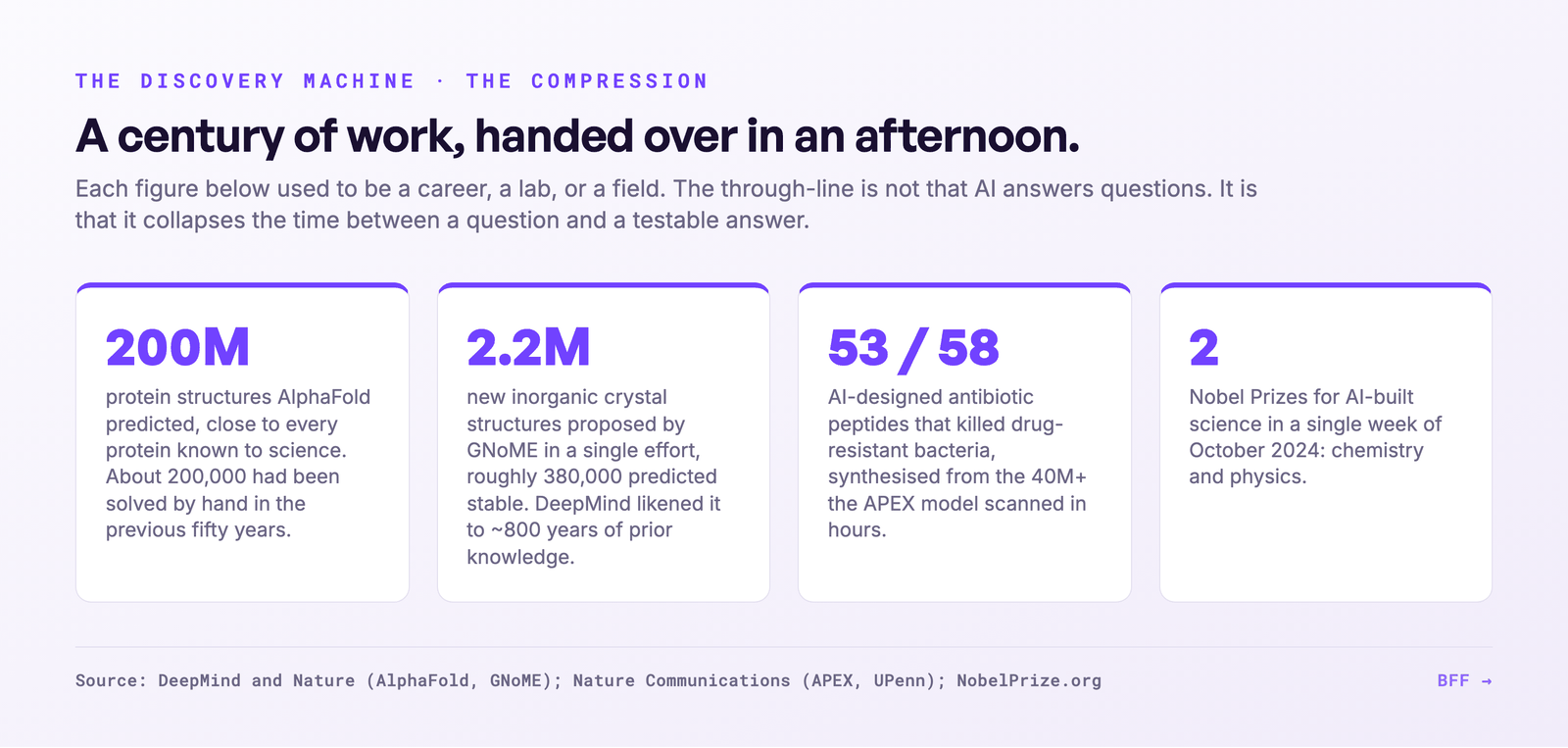
The mechanism under all of it is the same. A scientific problem is usually a search problem: somewhere in a space too large to check by hand sits the answer, and the work is finding it. AI is a search engine for those spaces. It reads the shape of the problem from millions of prior examples, then proposes the few candidates worth testing in the real world. The wet lab still runs the experiment. What collapses is the years of guessing that used to come first.
2. Proteins: first fold, then invent
Proteins are the machines of biology, and their function is set by their shape. For fifty years, working out that shape meant X-ray crystallography, one protein at a time, often a doctoral thesis for a single structure. By 2021, humanity had solved roughly 200,000 of them by hand. Then AlphaFold2 predicted the structure of about 200 million, close to every protein known to science, and put them online for anyone to use. More than two million researchers in 190 countries now do.
Prediction was the first act. The second is stranger. Systems like AlphaProteo no longer just read the structure of proteins that exist, they design new ones that never did, binders that lock onto a chosen target three to three hundred times more tightly than anything found by screening. Work that took years of trial and error now takes days.
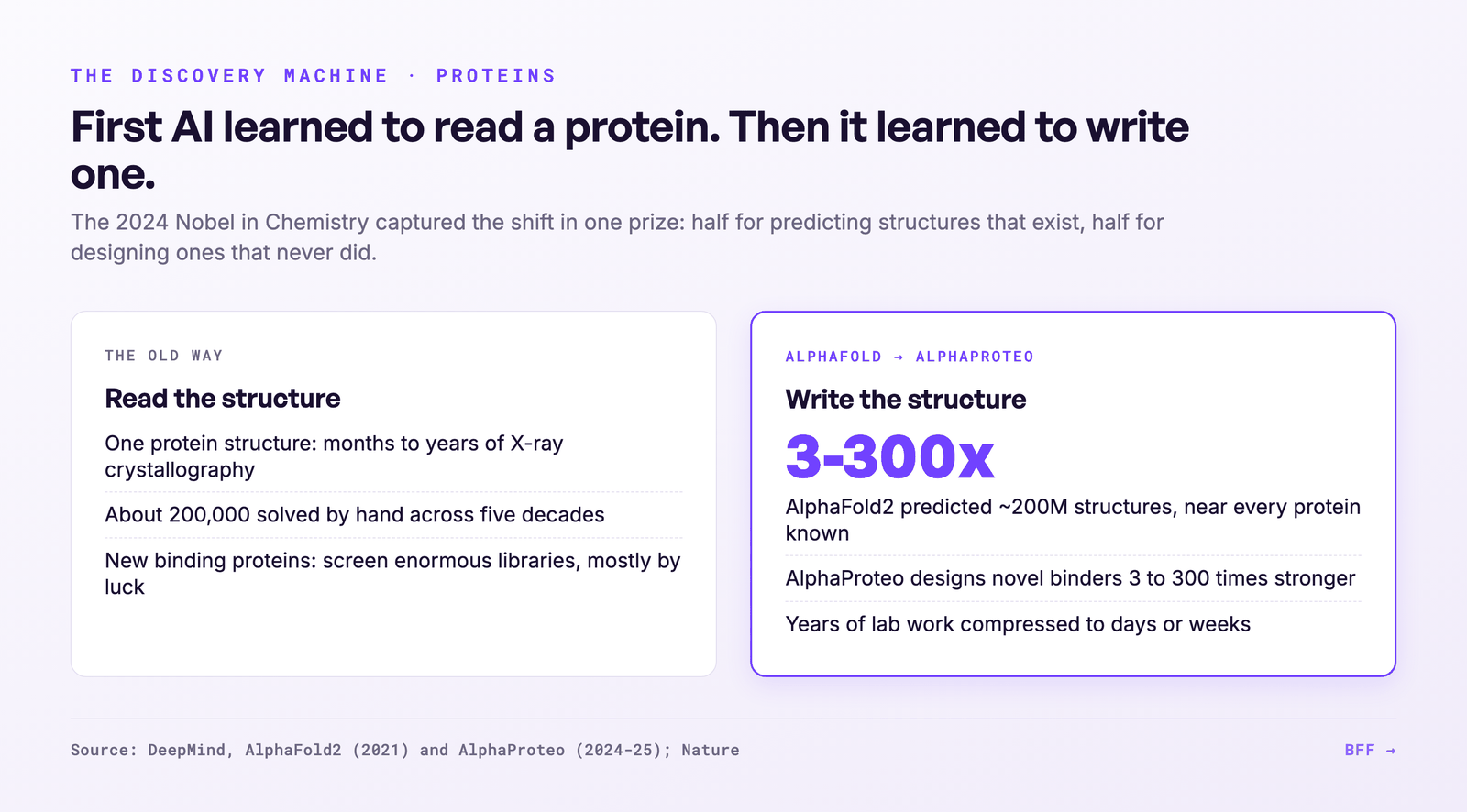
For a drug company this is the difference between hunting and manufacturing. The old model searched nature and vast chemical libraries for a molecule that happened to fit. The new model states the target and asks the machine to build a key for it. That is why the drug-discovery pipeline, long the slowest and most expensive in industry, is the first place the compression shows up on a balance sheet.
3. Materials: the eight-hundred-year library
The same move is happening in materials science, where progress has always been throttled by how many candidate compounds a lab can synthesise and test. In late 2023, DeepMind's GNoME proposed 2.2 million new inorganic crystal structures in a single effort, roughly 380,000 of them predicted stable enough to make. DeepMind described the haul as the equivalent of about 800 years of prior human knowledge, generated at once.
The candidates matter for the exact technologies this firm writes about elsewhere: better batteries, more efficient solar, superconductors, the physical stack of the electrotech transition. A stable new compound is not a finished product. It is a lead, and the shortage was never ideas, it was leads worth the cost of trying. Handing a lab hundreds of thousands of them changes the odds of the whole field.
Proposing was the 2023 move. By 2026 the loop had closed further. Microsoft's MatterGen inverts the problem: rather than list candidates, it designs a material to hit properties you specify, a target conductivity or magnetism, landing within roughly twenty percent of the goal. At the same time "self-driving labs", closed loops of AI and robotics, now run thousands of experiments with little human involvement, compressing years of synthesise-test-repeat into weeks. Propose, then design to specification, then test autonomously. That is the full pipeline, and it is being assembled now.
This is also the case that most needs a cool head. GNoME's numbers drew a serious challenge: independent researchers argued that many of the structures the study called novel were duplicates or minor variants of known ones, and some have called for the paper's core claims to be corrected. Read the 2.2 million as candidates generated, not confirmed new materials. The honest lesson is the one this dossier keeps returning to: the machine is extraordinary at proposing, and proposing is not the same as proving.
4. Mathematics: from answers to objects
Mathematics is the cleanest test of whether an AI is reasoning or remembering, because a genuinely new theorem cannot be in the training data. For most of the last decade AI could not do it at all. In the last year that changed twice, and the second time changed in kind.
In July 2024, DeepMind's AlphaProof and AlphaGeometry 2 solved problems from the International Mathematical Olympiad at silver-medal standard, twenty-eight points, one short of the gold threshold. A year later an advanced Gemini reached gold, solving five of the six problems. That was a machine climbing a test built for the brightest human teenagers. Impressive, but still a test with known answers. Then in May 2026 an OpenAI model disproved the Erdős planar unit-distance conjecture, an open question first posed in 1946. It did not recite a proof anyone had written. It found a new family of geometric constructions that no mathematician had ever put on paper.
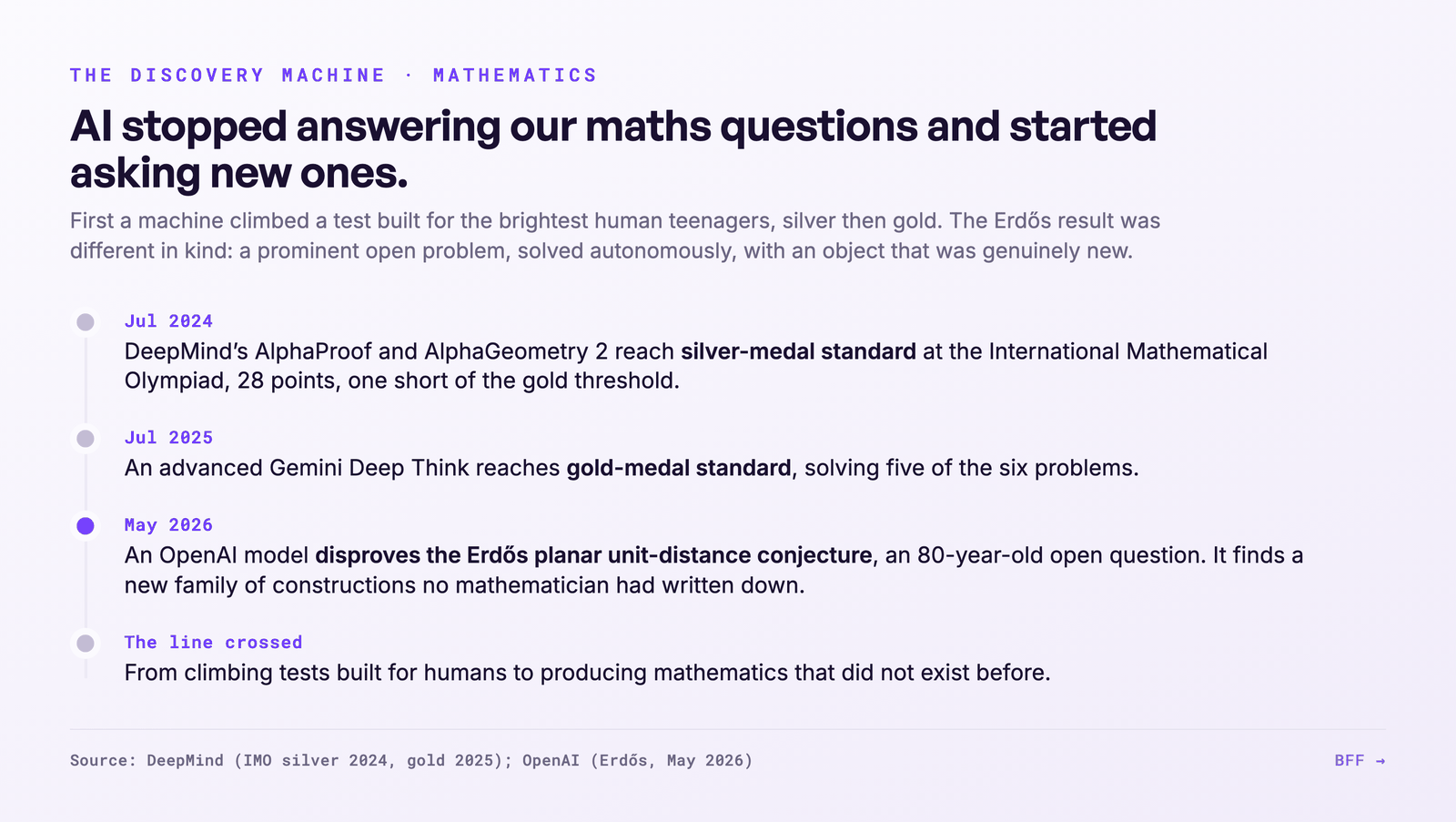
Two things made this more than a stunt. External mathematicians checked the construction and confirmed it holds. And it was not isolated: through early 2026 a separate system called AxiomProver produced complete, machine-verified proofs of four previously unsolved problems, in one case by spotting a link to a nineteenth-century result that humans had missed, and a general-purpose model cracked a number-theory conjecture with a strategy no mathematician had tried. Problems from the Erdős database began falling faster.
The distinction is the whole story. Solving Olympiad problems is answering questions we already knew how to ask. Cracking an open conjecture is producing an object that did not exist before. For eighty years the field assumed the best arrangements looked like tidy grids. A machine showed they do not. That is the moment the tool stopped being a student and started being a contributor.
5. Medicine: a vaccine for a dog, an antibiotic from venom
Nowhere is the compression easier to feel than in medicine, and two stories from the last year make the point better than any benchmark. In the first, an Australian tech entrepreneur with no background in biology sequenced the tumour of his dying rescue dog, used AI to find the mutated proteins and match them to drug targets, and designed a personalised mRNA vaccine from scratch. The genomics professor who reviewed it was, in his own word, gobsmacked. One of the dog's tumours has since roughly halved. One person, a chatbot, and about three thousand dollars covered ground that used to need a lab, a team, and years of funding.
In the second, researchers at the University of Pennsylvania pointed an AI model called APEX at the chemistry that evolution has been refining for millions of years: the venom of snakes, spiders and scorpions. It scanned more than forty million peptides in hours, flagged a few hundred candidates, and of fifty-eight the team synthesised, fifty-three killed drug-resistant bacteria without harming human cells.
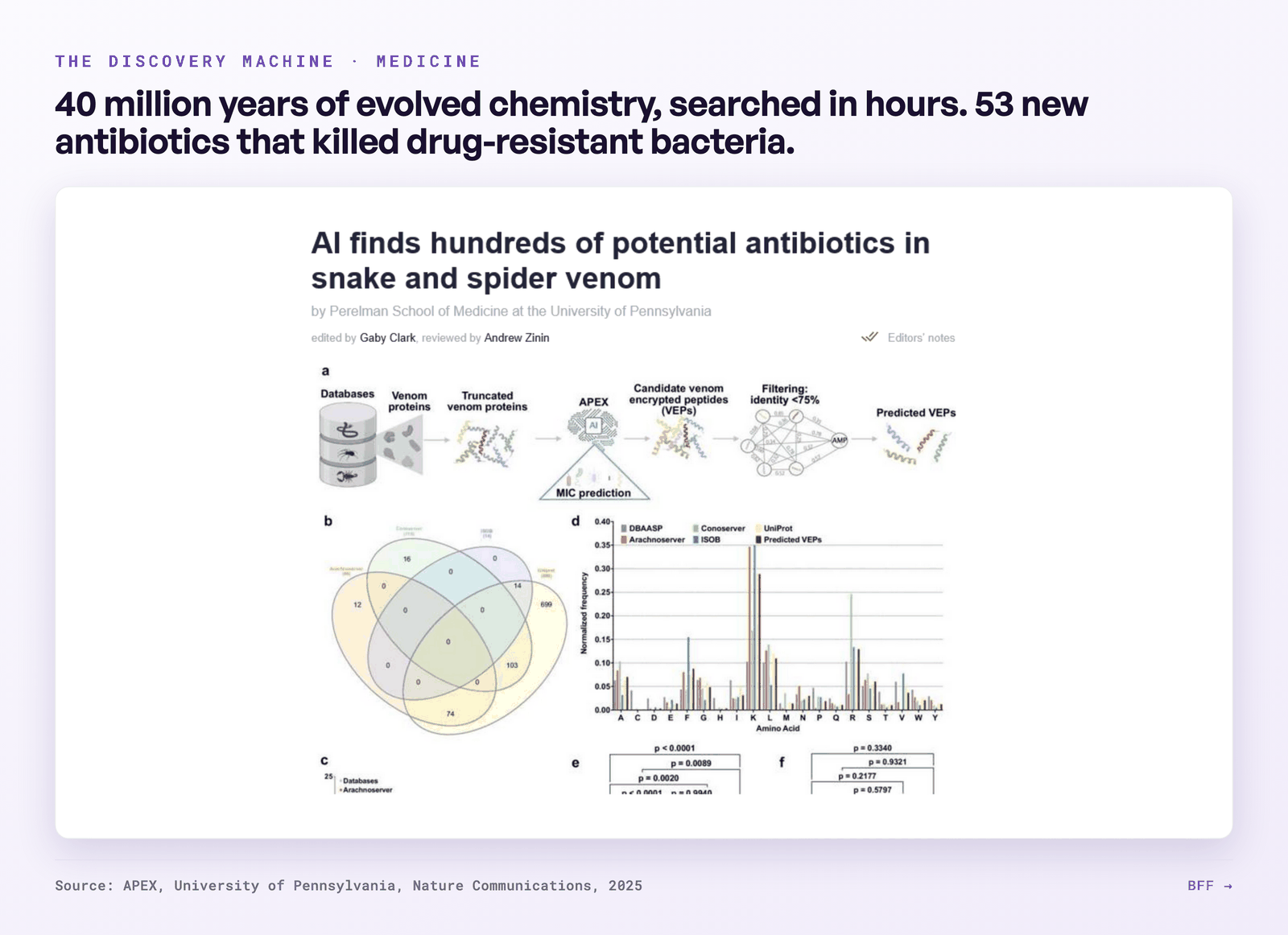
Antibiotic resistance is one of the slowest-moving disasters in medicine, precisely because finding new antibiotics is expensive and unrewarding work that the industry has largely abandoned. A model that reads two thousand entirely new antibacterial motifs out of natural chemistry in an afternoon does not solve the problem. It changes the economics of even trying, and economics is what stopped the search.
Vivid stories invite scepticism, so here is the same shift on a sober clinical timeline. In July 2026, Insilico Medicine began a Phase III trial of rentosertib, the first drug whose disease target and molecule were both discovered by generative AI, for a lung disease with few good options. Its mid-stage trial showed a measurable improvement in lung function. Google DeepMind's Isomorphic Labs put its first AI-designed cancer compounds into human trials the same year. No AI-designed drug has been approved yet, and most candidates will fail, as most drug candidates do. The milestone is quieter and larger: the pipeline now begins in software.
6. The co-scientist: hypotheses, not just answers
The step beyond prediction and design is the one that unsettles working scientists the most: systems that propose the hypothesis in the first place. In May 2026 this crossed from demo into peer review. Nature published Google's "AI co-scientist", a set of agents that argue their way to a hypothesis by reading across the literature to surface connections a specialist might miss. Its proposals were then tested and held up. It surfaced drug-repurposing candidates for acute myeloid leukaemia that suppressed tumour cells at clinically relevant doses, and a separate idea about cellular stress that Calico Life Sciences confirmed at the bench.
This is a real shift in the division of labour. The librarian answered your question. The co-scientist tells you which question is worth asking. It is easy to oversell, and we will hold the caveats until the next section, because the same capability that generates a brilliant hypothesis generates ten plausible wrong ones, and telling them apart is still human work. The honest summary is narrow and large at the same time: for the first time, the idea itself is something a machine can help produce.
The bottleneck in science was never only the thinking. It was the cost and time of testing the thinking. When both collapse, the rate limit on discovery moves somewhere new.The argument of this dossier, in one line
7. The week AI won two Nobels
If any of this were hype, the Nobel committee is a strange place for it to end up. In one week of October 2024, AI-built science won both of the prizes that matter most. The distinction between them is the tell.
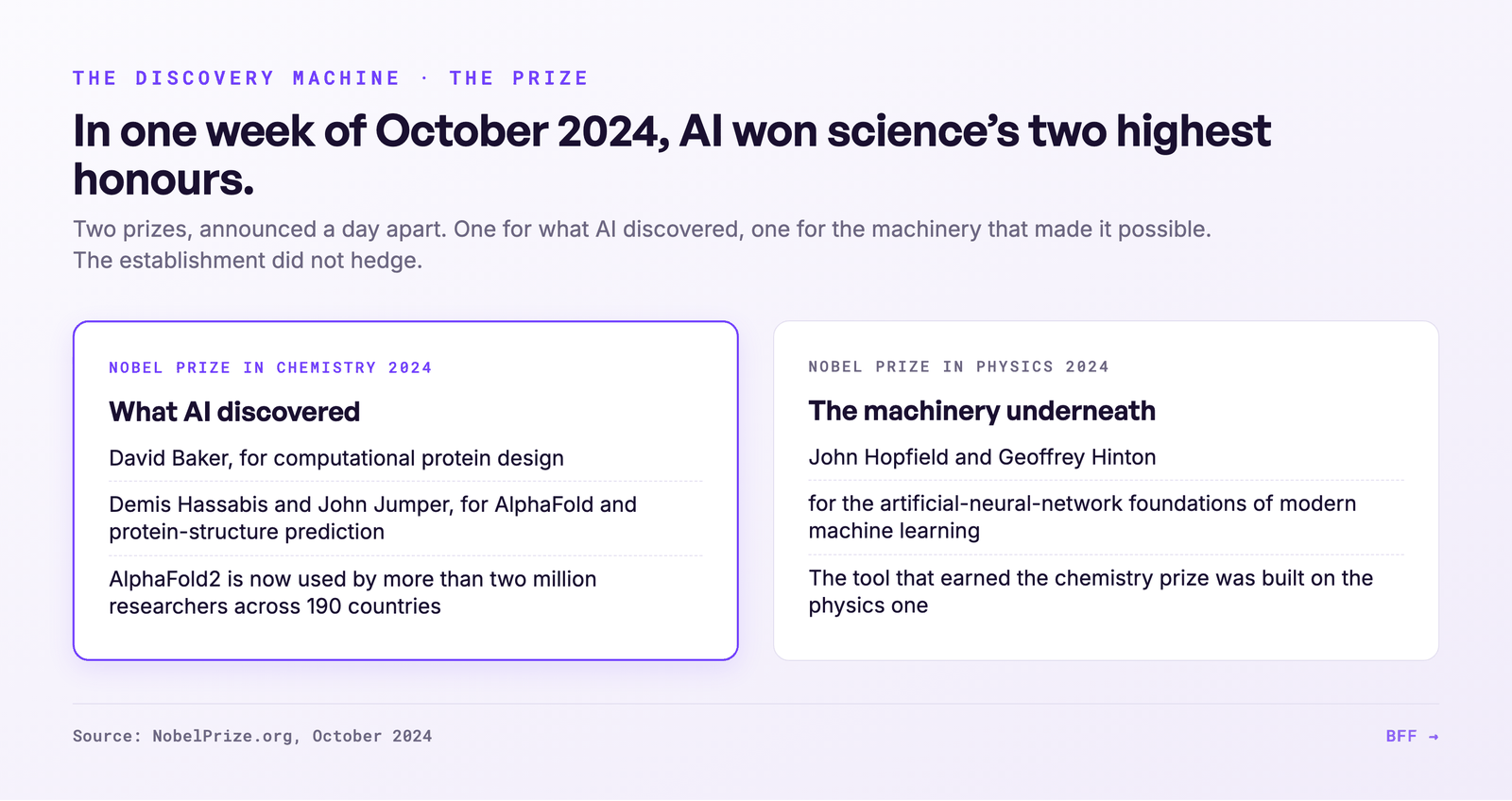
The Chemistry prize went to David Baker for computational protein design, and to Demis Hassabis and John Jumper for AlphaFold and protein-structure prediction. That is a prize for what AI discovered. The Physics prize, announced a day earlier, went to John Hopfield and Geoffrey Hinton for the neural-network foundations that modern machine learning is built on. That is a prize for the machinery that made the discovery possible. The tool that earned the chemistry prize was itself an application of the physics one. The establishment did not treat this as a novelty. It treated it as the arrival of a new instrument, on the level of the microscope or the telescope, and it is worth taking that judgement seriously.
8. What actually compressed
It helps to be precise about what is speeding up, because the word "discovery" hides three different jobs. The first is search: finding the promising candidate in a space too large to check. The second is prediction: guessing what a structure or a material will do before you build it. The third is generation: proposing something genuinely new. AI has become strong at all three, and they stack.
What has not compressed is the physical world. Cells still take their time to grow, trials still take years, a battery still has to be built and cycled. This is the crucial distinction for anyone tempted to read exponential curves as instant magic. AI collapses the part of science that happens on paper and in silico, the guessing and the sifting, which is often the longest and most expensive part. It does not repeal the laws that govern atoms and biology. The result is a discovery process that is lopsided: the front of the pipeline runs at software speed, the back still runs at the speed of matter.
9. The honest counter-case
A dossier that only cheered would be useless. There are real reasons to keep a cool head, and the people doing this work are usually the first to name them.
The validation gap. A predicted structure, material or hypothesis is a lead, not a fact. AlphaFold predicts a shape with a confidence score, and low-confidence regions are genuinely uncertain. GNoME proposed millions of materials, and the hard, slow work of actually synthesising them has only touched a sliver. The machine has moved the bottleneck from ideas to verification, and verification is still expensive. The most interesting response is the self-driving lab, which points AI at running its own experiments, and where it works it starts to close this gap. It is early, and most of the pipeline still runs at the speed of matter.
Reproducibility and "vibe physics". As AI floods fields with candidate results, the risk is a rising tide of plausible-looking science that no one has the time to check. Some of the loudest recent "breakthroughs" are better described as suggestive than settled. Anthropic's own researchers coined the half-joking phrase "vibe physics" for confident model output that feels right and has not been earned. The correct response is more verification, not less enthusiasm.
The human still designs the experiment. Every result in this dossier had a scientist deciding what to ask, what to trust, and what to test in the real world. The co-scientist proposes, the human disposes. The gap the models cannot yet cross is judgement under uncertainty, the taste to know which of ten plausible hypotheses is worth a year of a lab's time. That skill went up in value, not down.
10. Why this matters more than the job headlines
The feed is full of AI taking things. This dossier is deliberately about AI making things, because the making is the larger story and it is chronically underweighted. A model that writes marketing copy is a productivity tool. A model that designs an antibiotic, a battery material or a cancer vaccine is something else: a lever on the rate at which the whole society solves its hardest problems, from disease to energy to food.
That reframes the exponential in a way that matters for how a leader plans. If you believe AI is mainly a cheaper way to do today's knowledge work, you optimise for cost. If you believe it is compressing the timeline of discovery itself, you plan for a decade in which the ground under your industry moves faster than your product roadmap assumes. The second belief is the one the Nobel committee, the drug pipelines and the maths journals are now underwriting.
For a European reader there is a sharper edge. The tools of this discovery machine, the foundation models and the compute behind them, are mostly built elsewhere. The science they accelerate, though, is done in laboratories everywhere, including the strong ones in the Netherlands and across Europe. The opportunity here is to be the fastest, best-organised user of the instrument, the way the best universities were the fastest adopters of the microscope. Winning the model race is a different game, and mostly someone else's.
11. What a business does with a discovery machine
Most firms reading this do not run a wet lab, and the instinct is to file the whole topic under "interesting, not mine". That is a mistake. The discovery machine is a specific case of a general pattern, and the pattern applies to any organisation that solves hard problems: the cost of generating and testing options is falling fast, so the constraint moves to knowing which options are worth testing and being able to act on the answer.
That is the entire logic of how this firm works with clients, and the science makes it concrete. See what the tools can now do, at the frontier of your own field, not in the abstract. Understand where in your work the bottleneck is search, prediction or generation, because those are the parts that compress. Then adopt, by redesigning the process so that a human spends their scarce judgement on the short list the machine produces, rather than on the sifting the machine now does for free.
The organisations that will pull ahead are the ones that treat this as a change in method, not a new gadget to bolt on. That is a change-management problem before it is a technical one, which is the part most strategies get backwards.
12. What we would watch
- Validation throughput. The bottleneck is now testing, not ideas. Watch for automated wet labs and self-driving experiments that close the loop, because that is what unlocks the back of the pipeline.
- The first approval. An end-to-end AI-designed drug, Insilico's rentosertib, is already in Phase III, and Isomorphic's first oncology compounds are in trials. The signal to watch now is the first clear regulatory approval, judged more likely than not within a year or two. That is the moment the compression shows up in a way markets cannot ignore.
- A gold medal, then a real theorem. Olympiad gold is close. The signal to watch is a machine contributing a proof that working mathematicians actually adopt and build on.
- Reproducibility infrastructure. As candidate results multiply, the field that builds fast, cheap verification wins. Watch who is funding the checking, not just the generating.
- European lab adoption. The instrument is universal. The advantage goes to whoever organises to use it first. Watch which Dutch and European institutes move from pilots to standard practice.
13. Verification and sources
This dossier draws on live web research and a personal archive of more than 15,000 sources. Load-bearing numbers were cross-checked where possible. The notes below flag confidence and the main caveats, in the spirit of showing our work.
| Claim | Confidence | Note |
|---|---|---|
| 2024 Nobel Chemistry: Baker (protein design) + Hassabis and Jumper (AlphaFold) | High | NobelPrize.org press release, 9 Oct 2024. Baker one half, Hassabis and Jumper the other. |
| 2024 Nobel Physics: Hopfield and Hinton, neural networks | High | NobelPrize.org, 8 Oct 2024. Announced a day before the chemistry prize. |
| AlphaFold2 predicted ~200M structures; ~200k solved by hand; 2M+ users, 190 countries | High | NobelPrize.org popular information; DeepMind. The ~200k figure is the pre-2021 Protein Data Bank order of magnitude. |
| AlphaProteo binders 3-300x stronger, years to days | Medium-high | DeepMind AlphaProteo announcement (2024) and @rowancheung summary; figures are the developers'. |
| GNoME: 2.2M candidate crystals, ~380k stable, "~800 years of knowledge" | Medium | DeepMind, Nature, Nov 2023; 800-year framing is DeepMind's own. Contested: independent researchers argue many "novel" crystals were duplicates or minor variants, with calls to correct the claims. Read as candidates, not confirmed new materials. |
| IMO: silver in 2024 (28 pts, one off gold), gold in 2025 (five of six) | High | DeepMind: AlphaProof + AlphaGeometry 2 (silver, Jul 2024); advanced Gemini Deep Think (gold, Jul 2025). |
| OpenAI disproves the Erdős planar unit-distance conjecture, May 2026 | High | OpenAI announcement, 20 May 2026; problem posed by Erdős in 1946. Verified separately in BFF Signal work. |
| APEX: 40M+ peptides scanned, 386 flagged, 53 of 58 killed drug-resistant bacteria | Medium-high | University of Pennsylvania, Nature Communications, 2025; via @Dr_Singularity. Figures are the study's. |
| Rosie: AI-designed mRNA vaccine, one tumour roughly halved, ~$3,000 | Medium | The Australian / Fortune, Mar 2026. Single case; the professor's account, not a controlled trial. |
| Insilico rentosertib: first fully AI-designed drug (target + molecule) in Phase III, Jul 2026 | High | Insilico Medicine / PRNewswire, 8 Jul 2026; idiopathic pulmonary fibrosis; Phase IIa showed +98.4 mL forced vital capacity at 12 weeks. Isomorphic's first oncology compounds also entered trials in 2026. No AI-designed drug approved yet. |
| Google "AI co-scientist" in Nature; AML repurposing + Calico result validated | High | Nature, 19 May 2026. Framed by its authors as a faster discovery loop, not an autonomous scientist. |
| MatterGen designs materials to target properties; self-driving labs close the loop | Medium-high | Microsoft MatterGen (within ~20% of target properties); autonomous "self-driving labs" scaled through 2026, compressing synthesise-test cycles toward weeks. |
| Maths wave: Erdős construction externally validated; AxiomProver solves four open problems | Medium-high | External mathematicians confirmed the Erdős result; AxiomProver produced Lean-verified proofs of four unsolved problems (early 2026); a general model cracked a number-theory conjecture with a novel strategy. |
| "Vibe physics" as a caution about unearned confident output | Medium | Anthropic research framing; used here as a caveat, not a measured claim. |
The framed figure and the video still in this dossier are taken from publicly posted material, credited to the original source in each caption. On the web edition these can be replaced with the live posts. Charts labelled "BFF" are our own, drawn from the sources named beneath them.